


Political courage lacking in institutional reforms: Debapriya
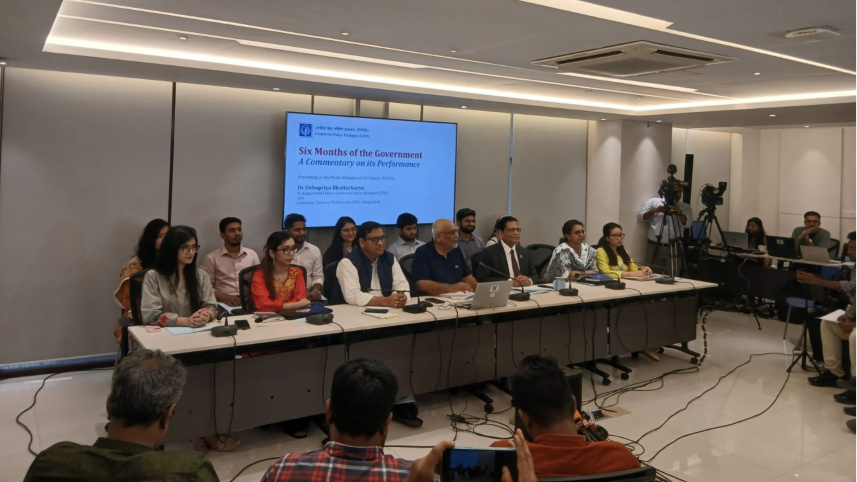
The government is showing a lack of political courage in separating policy from administration at the National Board of Revenue, abolishing the Financial Institutions Division, and deciding on pay scale reform, said Debapriya Bhattacharya, a distinguished fellow of the Centre for Policy Dialogue (CPD).
He made the comments today while presenting a paper at a media dialogue on the government’s six months in office, organised by the CPD at its office in Dhaka.

"The clearest sign of this lack of courage will be whether the government lets institutions grow strong and functional or allows political appointments to weaken the bodies that formulate, enforce and monitor laws," Debapriya said.
"Our concern is whether they are moving towards politicising these institutions again. If they make political appointments, they themselves will suffer the most," he added.
He noted that bureaucrats try various ways to influence the government and run it in line with their own preferences, adding that the country's future will depend on how competently the political leadership governs in the days ahead.
"We are saying these things now to ensure their success, because if they fail, we fear Bangladesh could face various kinds of disasters," he said.
Plans to stimulate the economy, boost investment, and strengthen the financial sector will not succeed unless the government protects institutions such as the Anti-Corruption Commission, the National Human Rights Commission, the Commission of Inquiry on Enforced Disappearances, the Election Commission, and the Public Service Commission, he warned.
Turning to the pay scale issue, Debapriya said six months had passed without a decision on salaries and allowances for government employees, largely due to fiscal constraints. The revenue shortfall against the FY2025-26 budget target could reach Tk 140,000 crore.
"You have built a magnificent palace [the budget] through which air does not circulate. You should have known about these things six months ago," he remarked.
He suggested the government could have introduced a 20-25 percent special allowance initially, then taken more time for a comprehensive decision. Having delayed, it now has no option but to act substantially.
He acknowledged, however, that employees had gone ten years without a pay rise, and that the workforce -- from secretaries to guards -- has interests that must be weighed.
"You cannot simply ignore it. The longer you delay, the more complicated it becomes, and the government's other work will also suffer," he said.
Assessing the government's overall performance, he said: "I want to give them an A, but circumstances pull them towards a B" -- meaning good intentions undermined by weak capacity and coordination. It would be wrong to say the government had done nothing, though many questions remain about its achievements.
"There is a lot of noise, but no music. We have to move towards music," he added.
Referring to a recent survey that found the prime minister more popular than the government, Debapriya noted: "Whether he can use that popularity to show political courage, put his own party on the right track, and properly manage the bureaucracy -- that is the biggest challenge."
 For all latest news, follow The Daily Star's Google News channel.
Comments