


Pre-Eid demand drives up prices of poultry, beef, aromatic rice and spices


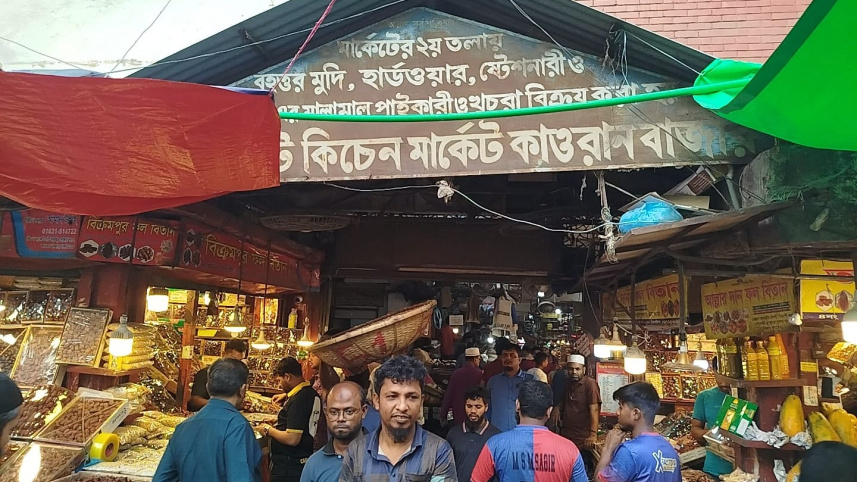
A pre-Eid surge in demand has pushed up the prices of chicken, beef, aromatic rice for pilaf, spices, cucumbers and lemons in several kitchen markets across Dhaka, intensifying the strain on lower-income households.
Traders said demand for some products doubled or even tripled ahead of Eid-ul-Fitr, while supply failed to keep pace, triggering price hikes.

The festival, the most significant religious occasion for Muslims, will be celebrated across Bangladesh tomorrow.
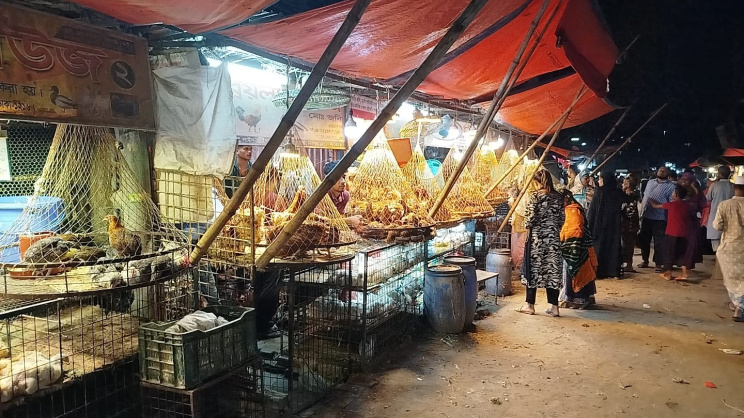
Chicken prices, particularly Sonali, recorded the sharpest rise over the past week. Sonali chicken is now selling at Tk 360–400 per kg, up from Tk 300–330. Broiler chicken prices also climbed to Tk 210–230 per kg from Tk 180–200 a week earlier.
Beef prices remained volatile amid strong demand. Market rates currently range between Tk 680 and Tk 850 per kg. Traders said prices fluctuated between Tk 750 and Tk 800 just a few days ago, reflecting intense market pressure.
Hanif Miah, a chicken retailer in Farmgate, said his daily sales surged from 100–150 chickens to 600–700. He attributed the increase largely to consumers shifting towards poultry as beef becomes costlier.
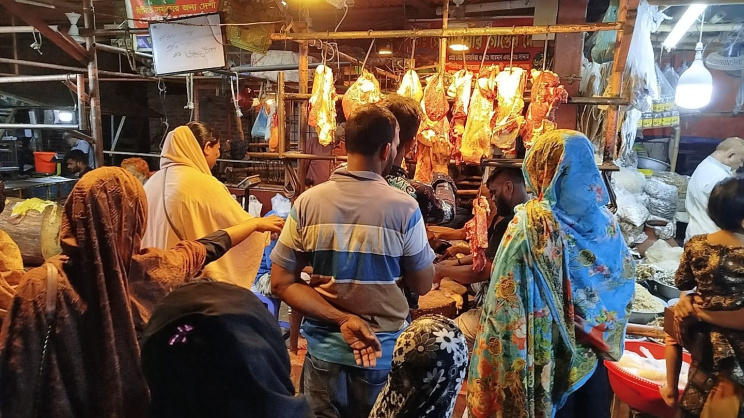
The shift in purchasing behaviour highlights the mounting pressure on lower-income households, as they seek relatively affordable sources of protein despite rising prices, he added.
Mohammad Shapon, a trader in Shewrapara, said demand for meat had strengthened significantly, with up to seven cows slaughtered daily compared to minimal sales under normal conditions. He added that cattle prices have increased by Tk 5,000–10,000 within 15 days.
In contrast, fish prices eased slightly due to lower demand during the period. However, lemon prices surged sharply, with a hali (four pieces) selling at Tk 50, up from Tk 30. Cucumber also rose to Tk 60–100 per kg, compared to Tk 40–60 a week earlier.
Aromatic rice prices increased by Tk 10–20 per kg over the past two weeks. Mid-range varieties now sell at Tk 160 per kg, while lower-quality rice is priced between Tk 140 and Tk 150, up from Tk 120–130.
Although the supply of bottled soybean oil has improved in markets such as Karwan Bazar, prices of sugar, lentils and oil remain high. Spice prices, which had risen earlier, have now stabilised.
Mohammad Bablu, a retailer at Karwan Bazar, said bottled soybean oil is still not available in line with demand. The commission per litre has fallen from Tk 5 to Tk 1. He added that sugar and vermicelli prices have not increased, while spice prices have risen by Tk 300–500 per kilogramme, depending on the type.
Visits to Karwan Bazar, Farmgate, Ibrahimpur, Shewrapara and Mirpur-11 showed rising demand for coconut and milk, although prices have not increased proportionately.
The price increases come amid broader inflationary pressure. Overall inflation rose to a ten-month high of 9.13 percent in February, up from 8.58 percent in January, according to data from the Bangladesh Bureau of Statistics.
Wali Ullah, a security guard in Ibrahimpur, said he supports a five-member family on a monthly salary of Tk 12,000, supplemented by an Eid bonus of Tk 8,500. After buying Eid clothes, he went to the kitchen market with Tk 3,000 but found the money nearly exhausted after purchasing beef, chicken, vermicelli, soybean oil, sugar and coconut.
“I expected prices to rise, but they’ve increased even more than I anticipated,” he said. “Eid is a time when you crave some meat, but in fulfilling that desire, many other wishes remain unfulfilled.”
Rifat Hossain, an auto-rickshaw driver in the same area, said he could not travel home for Eid due to financial constraints. Earning Tk 400–500 a day, he spent most of his savings on clothing and basic food items, leaving little room for additional expenses.
 For all latest news, follow The Daily Star's Google News channel.
Comments