


RMG factories can generate 1,768MWp from rooftop solar: CPD
Bangladesh’s garment factories have the potential to generate up to 1,768 megawatt-peak (MWp) of electricity through rooftop solar and meet part of their electricity needs amid persistent energy shortages, according to a study by the Centre for Policy Dialogue (CPD).
MWp measures a solar power system’s maximum theoretical electricity generation under standard sunlight and operating conditions.

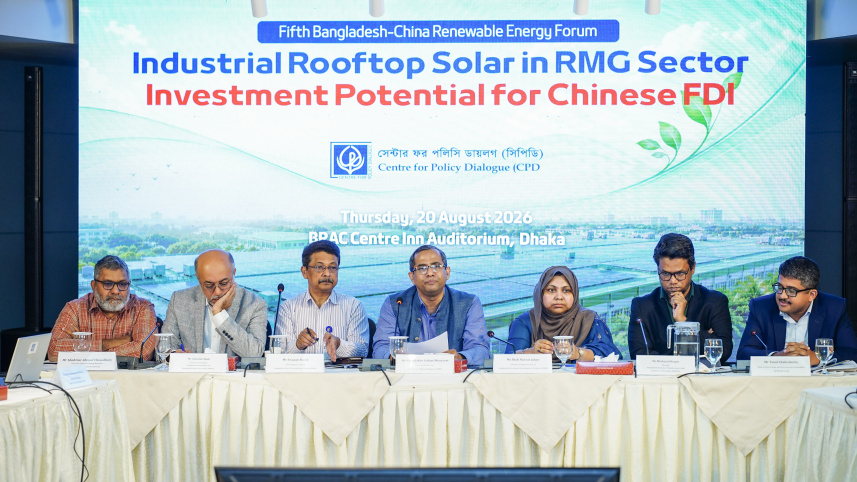
The CPD presented the findings at a discussion on the Chinese investment potential for rooftop solar in the RMG sector. The think tank organised the discussion at the BRAC Centre Inn in Dhaka.
Although Bangladesh has an installed power generation capacity of 29,500MW, fuel shortages restrict actual generation to roughly half of that amount.
The crisis has deepened over the past month after an accident at a floating liquefied natural gas (LNG) terminal in Cox’s Bazar curtailed gas supplies, forcing gas-fired power plants to scale back output.
Mapping nearly 9.7 million square metres of rooftop space across the sector -- using a ratio of 5.5 square metres per kilowatt-peak of solar capacity -- the CPD calculated that small factories could generate 485MWp, while medium and large units could generate 637MWp and 646 MWp, respectively.
The study assessed the share of electricity demand that factories can fulfil through rooftop solar. Median potential coverage stands at roughly 40 percent for large factories, 33 percent for medium units, and 38 percent for small facilities.
To calculate electricity demand across the factories, researchers used actual monthly consumption figures from 350 units to train a machine-learning model based on parameters such as factory type, size, workforce, location, and machinery.
The model was then applied to the broader factory population, while actual measured demand was used for 337 factories that were directly matched.
The study categorised 2,303 factories — comprising 61 large, 320 medium, and 1,922 small units — as either “investment-ready” or “investable with support”, estimating their total rooftop solar investment requirement at $188 million.
 For all latest news, follow The Daily Star's Google News channel.
Comments