


The fall of an industrial city

Enamul Kabir, 54, arrived in Khulna from Nalchity in Jhalakathi in August 1992, searching for stable employment. Like thousands of others from the country’s southern districts, he was drawn to the city by the promise of jobs in its bustling industrial sector.
He soon found work at Crescent Jute Mills, one of the largest state-owned jute mills in the region, and for almost three decades the mill sat at the centre of his life. The wages let him raise two children and build a modest life in a city that became his new home. In 2020, that life crumbled when the government shut down all 25 state-owned jute mills in the country.

“My children grew up in Khulna. They still want to live here because this city is their home,” he said. “But after losing the job, it became impossible to bear the living cost.”
Four years ago, facing mounting pressure, he left for his ancestral village, leaving behind decades of memories and a community built around the mill.
For Nasima Akter, 49, the mill closures meant the collapse of a lifetime of hope. She worked there as a casual worker for 16 years, always believing she would become a permanent employee. That never happened. A divorced mother of two, she could no longer afford her rent and moved to a slum-like settlement with her son.
“When the mill closed, I received Tk 114,000 as settlement. It disappeared within months,” she said. “Now I work whenever I can. Earlier, shopkeepers trusted us and gave us groceries on credit because they knew we had steady jobs. Now they don’t. Even landlords refuse to rent houses to former jute mill workers.”
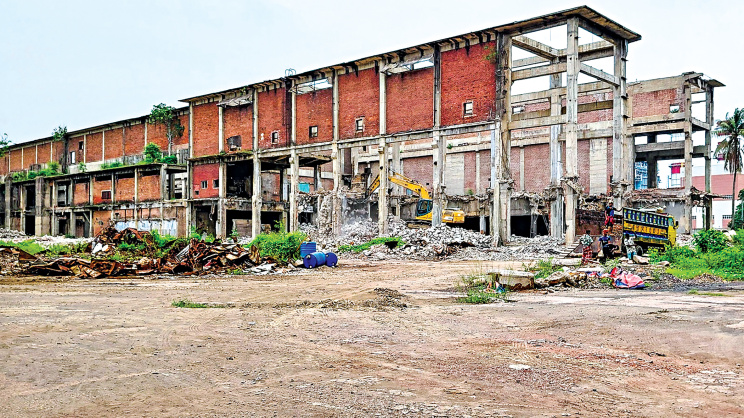
Their stories reflect the struggles of thousands whose lives were built around Khulna’s once-thriving industries.
The industrial belts of Khalishpur, Daulatpur, and Rupsha were once alive with production: jute mills, textile factories, paper mills, hardboard factories, match plants. Tea stalls, grocery stores, transport operators, and rental housing all depended on the steady flow of workers and wages. People arrived from Barishal, Jhalakathi, Pirojpur, Bagerhat, Satkhira, and Gopalganj in search of jobs, many settling permanently.
By the 1980s, the three industrial belts together employed tens of thousands of workers. Over the next four decades, most of that disappeared.
AN INDUSTRIAL POWERHOUSE
Khulna’s emergence as a major industrial centre began in the 1950s and 60s. Its location offered clear advantages with river routes, including the Rupsha and Bhairab. When the country’s second-largest seaport, Mongla Port, was established in 1954, it broadened the scope for Khulna significantly.
Raw materials moved in efficiently and finished goods moved out; abundant labour and nearby natural resources completed the conditions for industrial expansion. Factories sprang up across Khalishpur, Daulatpur, and Rupsha. None mattered more than jute.
Crescent Jute Mills, Platinum Jubilee Jute Mills, Star Jute Mills, and other state-owned factories became symbols of the city’s industrial success. At their peak, the region’s seven state-owned jute mills employed nearly 50,000 permanent and temporary workers. Entire neighbourhoods, schools, markets, and housing colonies grew up around them.
FIRST MAJOR BLOW: NEWSPRINT MILLS
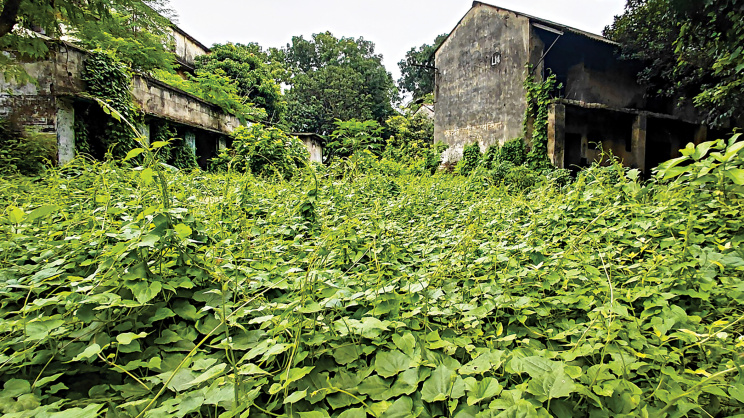
For many, the decades-long slow decline began with Khulna Newsprint Mills, which started production using raw materials from the Sundarbans in 1959.
For years, the mill, with an annual capacity of 48,000 tonnes, supplied newsprint to newspapers nationwide. That changed in the 1990s, as the government liberalised trade at the behest of multilateral lenders, including the World Bank.
The withdrawal of a 75 percent import duty on newsprint in fiscal year 1995-96 made imported paper more competitive and cut demand for the mill’s output. Rising furnace oil prices, working-capital shortages, raw material constraints, and government-controlled pricing pushed it deeper into losses, which reached Tk 284 crore between 1995 and 2002.
The mill closed on November 30, 2002, ending 43 years of operation and costing around 3,200 workers their jobs.
DADA MATCH FACTORY
Established in 1955 in Rupsha, the match factory once relied on Gewa timber from the Sundarbans and produced around 12,500 matchboxes a day, supporting countless families for decades.
 For all latest news, follow The Daily Star's Google News channel.
 It closed on August 18, 2010, after leaseholder Bhaiya Group cited heavy financial losses, putting around 1,950 workers out of work. Many left Khulna for work elsewhere. Others stayed and struggled to adapt.
A FORGOTTEN LANDMARK
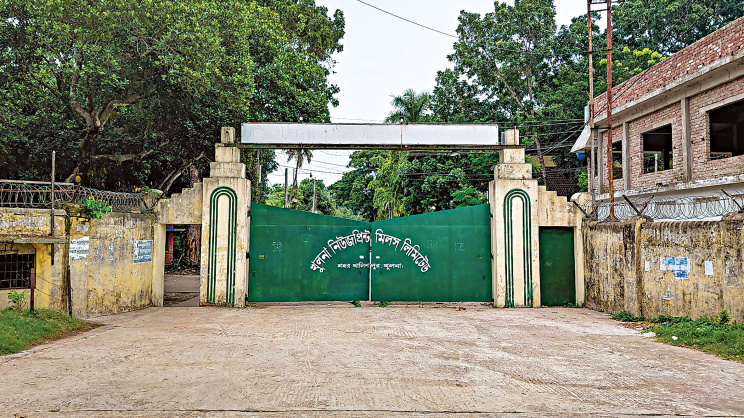
Established in 1931 as Acharya Prafulla Chandra Cotton Mill on 25.6 acres in the heart of the city, Khulna Textile Mills was shut down by the government in 1993, laying off around 1,600 workers and employees.
THE END OF JUTE MILLS AND AN ERA
The biggest blow came on July 1, 2020, when the government shut down 25 state-run jute mills operated by the Bangladesh Jute Mills Corporation (BJMC) amid mounting losses.
The mills employed more than 50,000 workers nationally across permanent, temporary, and substitute categories; seven were in Khulna, employing more than 29,000 workers, including around 15,000 permanent employees. Counting the jute mill closures, more than 34,000 people have lost their jobs in Khulna since 2002.
The impact rippled through the local economy. Tota Mia, a mobile financial service (MFS) agent at Chitrali Market, said daily transactions at his outlet had fallen from Tk 35,000 to Tk 40,000 to about one-tenth of that amount after the mills closed six years ago.
“Before their shifts and after, [workers] would crowd the shops to send money through bKash, recharge mobile phones, and pay electricity bills,” he said. After the mills closed, business fell, leading to the decline of MFS agents in the market from more than a dozen to four.
“From the front of Chitrali Market to Peoples Goal Chattar there were more than 150 small and large garment shops. Every Thursday, after workers received their wages, the market would see a shopping spree,” said Swapan Howlader, who once owned a clothing store there.
Unable to sustain the losses, he closed the shop, and now alters old trousers and clothes on the pavement beside the market. “Now I am struggling just to pay the shop rent, electricity bills, and household expenses. Many days pass without a single customer.”
‘NOT EVEN 1,000 NEW JOBS IN 10 YEARS’
No major industry has emerged over the last decade to fill the void left by the closure of the state-owned jute mills. Private investment has stalled, generating limited employment. The most notable one is the shrimp industry.
“We once hoped that the shrimp industry would become one of the main driving forces of Khulna’s economy. But that industry is also facing a severe crisis now,” said Abdul Jabbar, a former director of the Khulna Chamber of Commerce and Industry (KCCI).
Nearly 80 percent of shrimp processing factories have become virtually defunct due to raw material shortages, declining production, international competition, and structural problems, he said. “Thousands of workers have lost their jobs and are living a subhuman existence.”
Around 120 shrimp and fish processing plants registered with the Bangladesh Frozen Foods Exporters Association once operated in the region. Even a few years ago, 35 to 40 were running. Today, only 8 to 10 remain operational and continue exporting.
“This is a clear indication of the decline in Khulna’s industrial and export sectors,” Jabbar said, citing a lack of investment, weak infrastructure, the energy crisis, and policy uncertainty.
To revitalise Khulna’s economy, there is no alternative to establishing new industries, reviving existing ones, and providing special incentives to export-oriented sectors, he said.
Kazi Hafizur Rahman, another former KCCI director, said the 2022 inauguration of the Padma Bridge had raised hopes of new industrial investment.
“While the bridge has undoubtedly improved connectivity and reduced transportation time, the level of industrial investment the business community had anticipated has not yet materialised,” he said.
Some jobs have appeared in logistics, real estate, healthcare, education, retail, IT, and small-scale agro-processing, but “large-scale manufacturing industries capable of generating significant employment have yet to emerge in the region,” he said.
He pointed to the lack of gas supply, high energy costs, bureaucratic complexity, and the absence of targeted policy incentives for the southwest.
“Khulna has all the ingredients to become a major economic hub -- a seaport, rail and road connectivity, proximity to international markets, and a skilled workforce. What is needed now is a comprehensive government strategy to develop Khulna as a dedicated economic and industrial zone,” Hafizur said. “In the last 10 years, not even 1,000 jobs have been created here in total.”
Kazi Aminul Haque, a former KCCI president, said no new jute mill, public or private, has been established in the region in recent years. Despite the region’s potential centred on Mongla Port, port-based industrialisation and investment have yet to reach expected levels.
PROMISES AND REALITY
When the state-owned jute mills closed, the government promised to revive them by leasing the factories to private investors. Six years later, little has changed. Four mills have been leased out for 30 years to lessees including footwear and pharmaceutical manufacturers, feed producers, and foreign investors.
Production is currently underway at Eastern Jute Mills and Khalishpur Jute Mills; Daulatpur Jute Mills also resumed production after being leased by BJMC, though it is now temporarily suspended. The lease agreements do not require operators to manufacture jute goods or any specific product. They are free to produce whatever they choose.
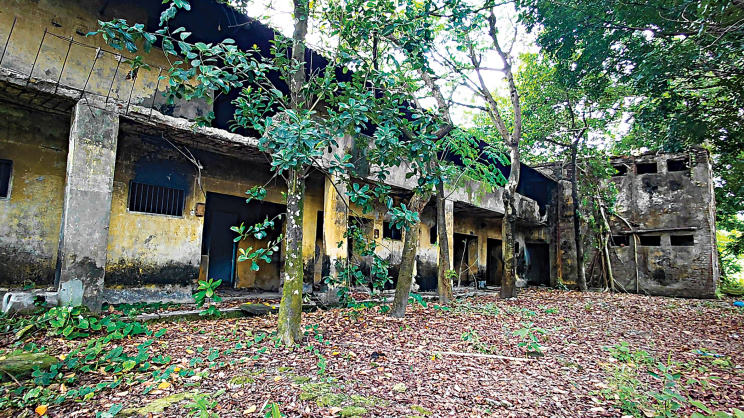
The Newsprint Mills was listed for privatisation in 2005. Two tender attempts failed, and the mill was returned to the industries ministry in 2008. Plans for a textile village and other redevelopment proposals have since stalled, and trees now cover much of the abandoned site.
The Bangladesh Chemical Industries Corporation, which owns the mill, has sold 50 acres of the land to North-West Power Generation Company for a power plant.
The Dada Match Factory’s infrastructure also remains unused, its machinery deteriorating while former workers wait for the factory to reopen.
“We urged the government to take steps to resume its operation without any further delay,” said HM Shahadat Hossain, general secretary of the Dada Match Workers’ Union.
The city’s fading fortunes show in its population. Khulna City’s population peaked at 770,000 in 2001 and fell to 718,000 in 2022, according to Bangladesh Bureau of Statistics census data.
The urban share of Khulna Division’s population dropped to 41 percent in 2022 from 55 percent in 2001.
“It is heartbreaking to see the decline of what was once a vibrant industrial hub. Thousands of workers have lost their livelihoods, while vast industrial estates remain abandoned,” said Sheikh Ashrafuzzaman, president of the Greater Khulna Development Movement Coordinating Committee.
“This is both an economic and social tragedy.”
Comments