


UN Women workshop calls for scaling up women-led climate action
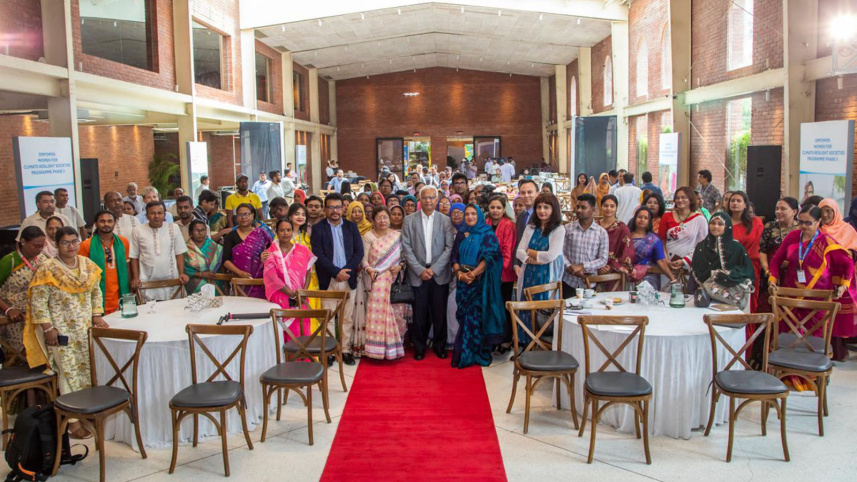
Women's leadership must be placed at the centre of Bangladesh's climate response to expand local solutions into national action, speakers said at the "EmPower II: National Lessons Learned and Scale-Up Workshop" organised by UN Women Bangladesh in Dhaka.
Supported by the governments of Sweden, Switzerland, Germany and New Zealand, the workshop brought together government officials, development partners, civil society organisations, financial institutions, academics, grassroots women climate champions and UN agencies to discuss pathways for scaling up gender-responsive climate action, according to a press release.

The EmPower: Women for Climate-Resilient Societies Phase II programme, jointly implemented by UN Women and the United Nations Environment Programme (UNEP), operates in Bangladesh, Cambodia and Vietnam. In Bangladesh, it covers 10 upazilas across Khulna, Satkhira, Jamalpur, Kurigram and Cox's Bazar.
According to the organisers, the programme has reached more than 33,000 women through climate-resilient livelihood initiatives and essential services, benefited around 1.6 million people, mobilised USD 3 million for 308 women-led renewable energy enterprises, and supported the government in translating the Climate Change Gender Action Plan into measurable sectoral interventions.
The workshop was inaugurated by Abu Zafar Md. Zahid Hossain, MP, minister for women and children affairs and social welfare, as the chief guest.
Speaking at the event, he said: "When education, skills and confidence come together, women can speak clearly, make decisions, and lead change in their communities. We must give women the knowledge to adapt to climate change, because those who are equipped with skills and confidence will be able to survive and lead."
UN Women Representative Gitanjali Singh said the programme had demonstrated that gender-responsive climate action is practical, scalable and a sound investment, highlighting its impact on women's livelihoods, renewable energy access and participation in climate decision-making.
The workshop also featured a panel discussion with women climate champions from project districts, thematic sessions on renewable energy, climate financing, implementation of the Gender Action Plan for Adaptation to Climate Change (GAPACC), and women-led climate action.
Special guests included Diepak Elmer, head of cooperation at the Embassy of Switzerland; Redita Rokib, adviser for development cooperation at the German Embassy in Dhaka; Nayoka Martinez-Bäckström, first secretary and deputy head of development cooperation at the Embassy of Sweden; and Md. Saidur Rahman Khan, secretary of the Ministry of Disaster Management and Relief. Dr. Nurun Nahar, additional secretary (Development Wing) at the Ministry of Environment, Forest and Climate Change, attended as the guest of honour.
During the programme, UN Women launched the EmPower Bangladesh webpage and inaugurated a photo exhibition featuring stories from the Women in Climate Action Network (WCAN). The organisers also acknowledged Bangladesh Center for Communication Programs (BCCP), Manusher Jonno Foundation and BRAC University CED for their contributions to the project.
 For all latest news, follow The Daily Star's Google News channel.
Comments