


RU artwork criticised over alleged portrayal of July uprising as more significant than Liberation War
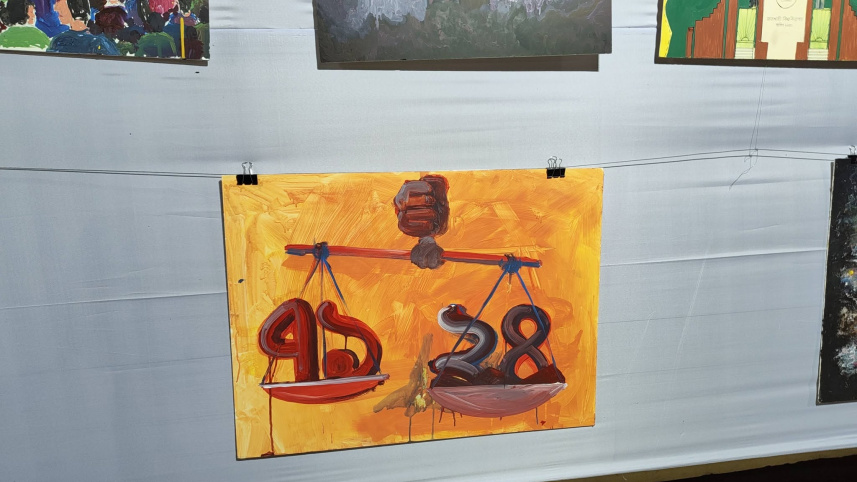
An artwork displayed at a Rajshahi University exhibition marking the July Uprising has drawn criticism for allegedly portraying the 2024 uprising as more significant than the 1971 Liberation War.
The three-day exhibition, titled “July Mass Uprising: Free Homeland Through Colours and Brushes,” began on Sunday morning.

Controversy arose over a artwork showing a weighing scale, with “71” written on one side and “24” on the other, symbolising the Liberation War and the July Uprising respectively. The scale tilted towards “24” which critics said suggested the uprising was being given greater importance than the Liberation War.
Mohammad Ali, dean of the Faculty of Fine Arts, said he was unaware of the artwork as he was not on campus and had not yet seen the exhibits. He added that the pieces were selected through registration, with Prof Ariful Islam of the Department of Ceramics and Sculpture overseeing the process.
Prof Ariful said he had only signed a letter and that the artworks were submitted without verification.
Prof Kamruzzaman, administrator of the university’s public relations office, said the exhibition was organised under the supervision of the Faculty of Fine Arts. “Our responsibility was limited to allocating the exhibition space at the Senate building. The public relations administration knows nothing about the artwork,” he said.
Fuad Ratul, convener of the RU unit of the Socialist Students’ Front, said attempts to pit 1971 against 2024 could undermine national unity. “Such a tendency only benefits the defeated forces,” he said.
Sultan Ahmed Rahi, president of the RU unit of Bangladesh Jatiotabadi Chatradal, said the Liberation War remains the country’s foundational history.
“Although 2024 is an important chapter, it does not become greater by diminishing 1971. There is no need to insult one history to establish another,” he said.
Hafez Mehedi Hasan, general secretary of the RU unit of Islami Chhatrashibir, said the two events took place in different contexts. “We do not want to pit 1971 against 2024. Rather, we want to move forward by drawing inspiration from both,” he said.
The student who created the artwork, requesting anonymity, said it should not be interpreted as placing the July uprising against the Liberation War.
“A particular group has been trying to portray July as being in opposition to 1971. My work should not be viewed in that sense. It is an allegorical representation,” he said.
 For all latest news, follow The Daily Star's Google News channel.
Comments