The Odyssey: A poignant reframing of Homer’s epic, distinctly Nolan’s own
Christopher Nolan’s decision to adapt The Odyssey after the monumental success of Oppenheimer immediately fascinated me. A director at the height of his powers tackling one of history’s most influential stories felt bold yet inevitable. But there was a tinge of anxiety as well. Could Nolan’s minimalist, almost dogmatically realist style meet the maximalist demands of a fantasy filled with gods, monsters, magic, and sweeping grandeur?
It’s a testament to Nolan’s strengths that they not only outweigh his limitations but also result in a bracingly cinematic adaptation that makes an ancient story feel urgent.

A man, a fleet, a war, a trick
Much has been said about Nolan’s nonlinear style, but its most vital extension is the fractal editing within individual scenes, where his surrealism truly emerges. Rapid bursts of imagery plant motifs and memories like seeds, letting Nolan juggle a vast cast while weaving thematic threads into a dreamlike tapestry that only clarifies at the end. It’s a perfect stylistic match for The Odyssey, a sprawling narrative spanning decades and multiple perspectives.
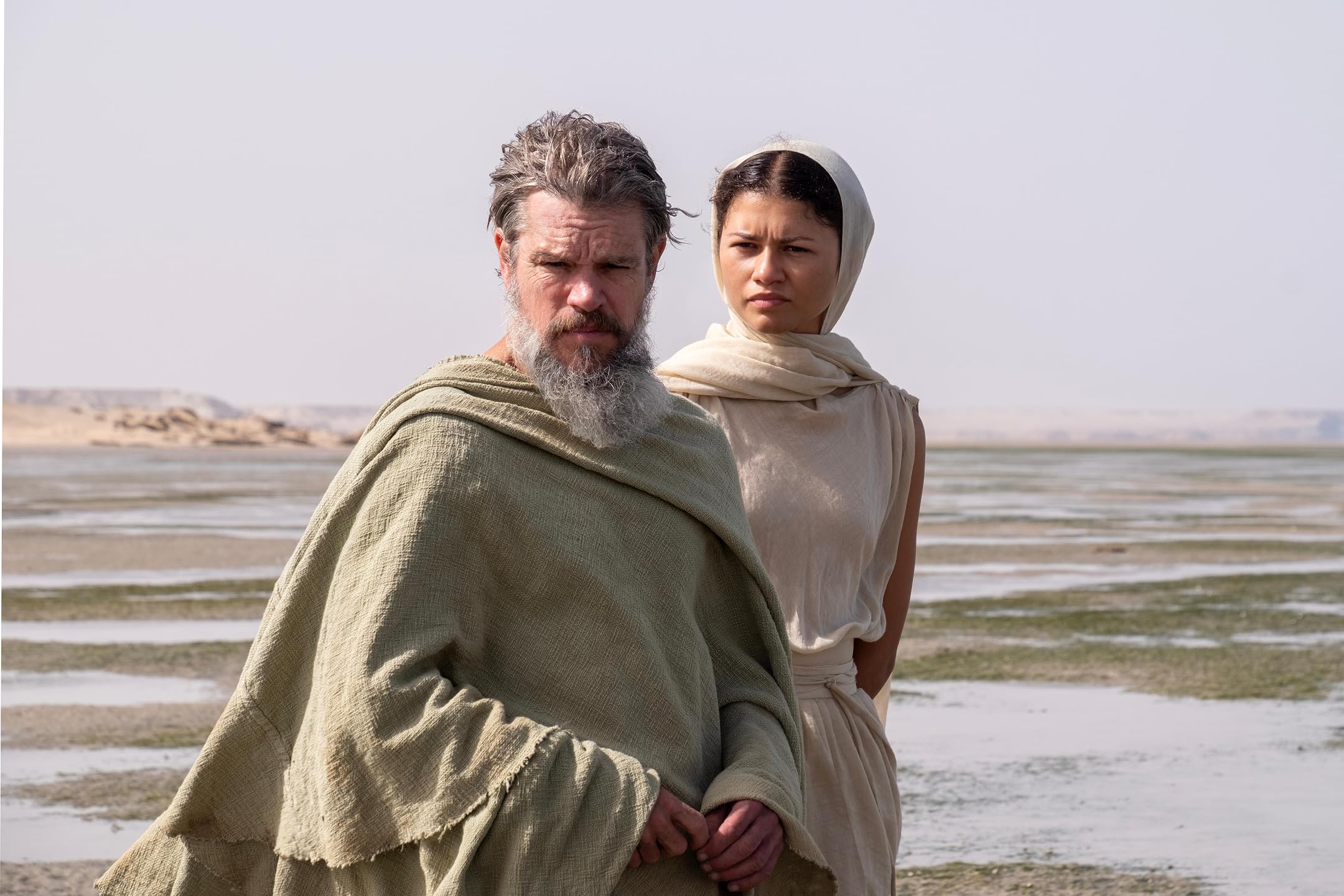
The film begins with two primary threads. In the first, King Odysseus’s absence has left son Telemachus and Queen Penelope struggling to control Ithaca against a horde of suitors who want the throne. It then branches into a coming-of-age arc for Telemachus, who learns bits and pieces of the father he never knew, including tales of his tactical genius behind the Trojan Horse.
The second thread finds Odysseus with a hazy memory, trapped with Calypso. As he attempts to remember the man he himself has forgotten, the film unleashes the spine of the narrative, the epic’s iconic set pieces.
Editor Jennifer Lame’s blistering cross-cutting gradually brings these threads together to ground themes of memory, guilt, nostalgia, and faith, condensing a dense material without losing depth.
“A time of apparent magic…”
The opening text perfectly captures Nolan’s approach to the fantastical. Unlike the poem, the gods never appear onscreen (yes, not even Athena), and Nolan plays coy about their existence. Like the characters, we wonder whether the crashing waves and frequent lightning are Poseidon’s wrath and Zeus’s signs. That ambiguity shifts the focus from how the Greeks told stories of gods—sitting atop Mount Olympus, bickering and meddling in human affairs—to how they felt their presence through thunder, fire, good harvests, and a child’s smile.
Magic, however, is never in doubt. The Cyclops sequence lets Nolan flex horror muscles like he’d never done before, only to outdo himself with the Circe scene. As she moulds Odysseus’s men into pigs like clay, the film suddenly shifts gears into pure body-horror grotesquerie. By never letting us hear the Sirens’ song, Nolan lets Damon’s performance, Ludwig Göransson’s haunting score, and a beautifully written monologue evoke what spectacle never could: our imagination of what we most desire yet cannot have.
Rendered largely with practical effects, Nolan’s restraint makes these classic sequences feel visceral, fresh, and unmistakably his own.
Trade-offs
Yet relentless pacing denies certain beats room to breathe. While we feel the hardship of Odysseus’s journey, we rarely feel the passage of time itself. When he crosses the ocean on his raft and finally returns home, the sequence lacks the emotional weight it deserves. Partly to blame is the underwritten Calypso, with whom Odysseus confronts his inner hurdle and one of the film’s major revelations: his repressed desire not to return home. Her motivations remain so thinly dramatised, along with Nolan’s aversion to sensuality, that even the Cyclops feels like a somewhat fuller character.
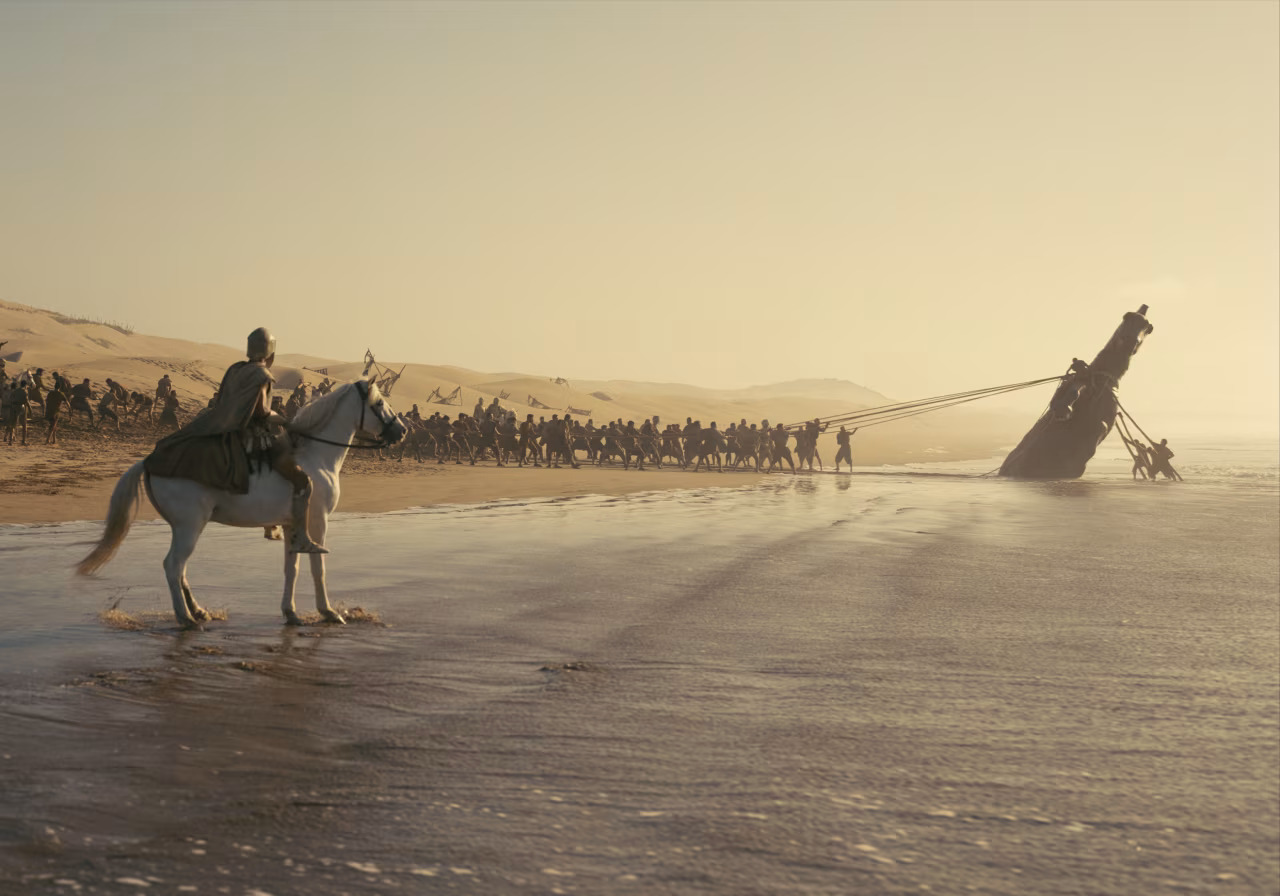
Cinematographer Hoyte van Hoytema can lend even mundane frames texture and gravitas, but Nolan’s long-standing disinterest in spatial blocking often underserves the film’s action, crowds, and elemental spectacle.
Odysseus’s homecoming is intentionally tense rather than triumphant, but it still needed a proper pause. Without it, the transition into the third act blurred, leaving little space to absorb a lifelong odyssey before the film begins laying the groundwork for its climax.
But once that final act takes shape, it becomes one of the most emotionally rousing and thematically satisfying Nolan has ever executed.
 For all latest news, follow The Daily Star's Google News channel.
 Destroyer of worlds
The film repeatedly emphasises “Zeus’s Law". Nolan’s simplified term for Xenia, a sacred tenet of hospitality that dictates that hosts must honour guests who might be gods in disguise. But we see it repeatedly violated. In Ithaca, it’s the suitors who throw lavish feasts and squander its wealth. In Odysseus’s journey, it’s when he’s trapped in the Cyclops's cave, or his men are transformed by Circe over a meal.
But as he enters his own palace posing as a beggar and confesses to Penelope, the film's central recontextualisation emerges: Odysseus’s great trick of the Trojan Horse was not a heroic triumph but the ultimate betrayal of Zeus’ Law, a sacrilege so profound that it broke human contracts and shattered their world.
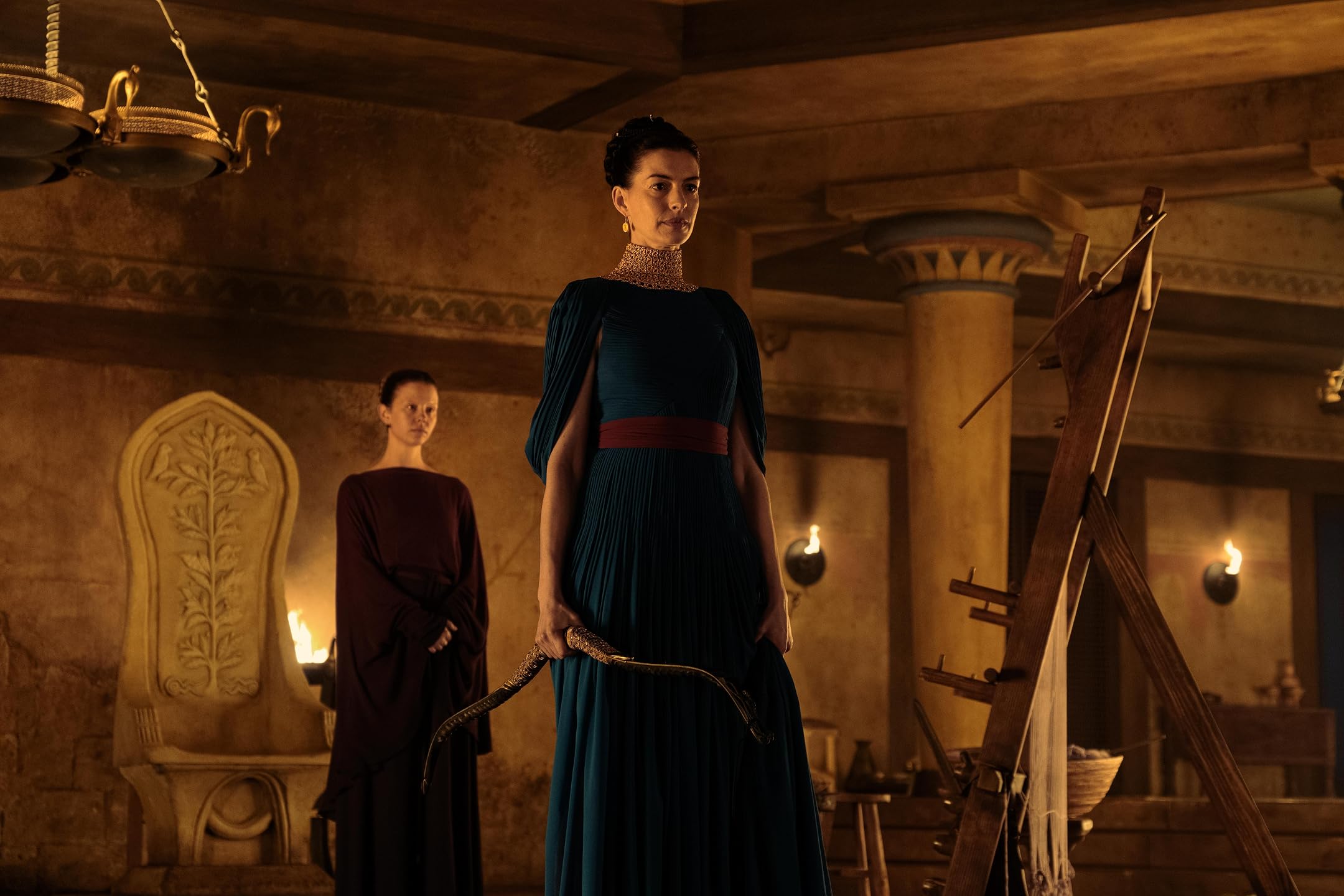
The film flashes back to the sack of Troy, and this time, instead of a gripping action scene, it’s a hellish massacre of fire, pillage, and slaughter. There, Athena is revealed to bear the face of a priestess who was killed in front of him. The man who used to pluck his bow to warn prey before hunting only watched as his cunning resulted in the brutal beheading of an innocent girl. Is she the ghost of his greatest moral failure haunting his psyche, or is Athena taking the guise of the girl he couldn’t forget to guide him, or both? Nolan leaves it up to you. But as the fragmented motifs finally crystallise with this revelation, Nolan turns Homer’s adventures of wits, pride, and hubris into a manifestation of Odysseus’s guilt and an examination of the dark underbelly that exists in Homer’s myth and thus all of Western civilisation.
By turning the Trojan Horse into an original sin, he presents a vision of civilisational collapse driven by the collapse of hospitality and trust. He rejects the notion that the ruthless, stoic masculinity embodied by figures like Agamemnon sustains Western civilisation, presenting it instead as the very ideology that corrodes the human bonds on which it depends. Here, Nolan departs radically from Homer.
A song for a darkened world
Some will resist the use of one of Western literature’s foundational texts as a vessel for contemporary anxieties. But long before The Odyssey was written down, it survived as a living oral tradition, reshaped by every rhapsode who sang it. Historical fidelity is an odd standard to impose on a myth that itself blends centuries of history, memory, and imagination.
Nor do Nolan’s deviations betray a misunderstanding of Homer. On the contrary, the way he reconfigures very specific aspects to serve his vision reveals an intimate knowledge of the text. From the anachronistic aesthetic choices to incorporating elements outside of the poem, like the character of Sinon from Virgil’s Aeneid, who makes Odysseus confront the sins of his past, and the inclusion of “The Sea People”—a group of unidentified seafaring marauders from history who were largely thought to be responsible for the Late Bronze Age collapse, revealed in the film to be the Greeks themselves—every alteration feels deliberate, serving a thematic purpose rather than simply modernising the source. The result echoes concerns that have long run through his filmography. Here, those anxieties culminate in a homecoming that is less about reclaiming a kingdom than reckoning with the world one’s own victories helped destroy.
Such reframing inevitably sacrifices the experience of encountering a worldview profoundly unlike our own. But what is gained is an apocalyptic anti-war epic told by arguably the biggest filmmaker in the biggest format, a melancholic meditation on masculinity, conflict, and the price civilisations pay for mistaking conquest for greatness.
That is the beauty of myths. They can speak to the thoughts and fears of a different age and endure, not because they remain unchanged, but because every generation finds new questions to ask of them. The Odyssey succeeds because it is more than a faithful retelling; it is Nolan’s conversation with Homer. Those discovering the tale for the first time would be left eager to engage with the original, while long-time readers witness two storytellers, separated by nearly three millennia, speaking across time.
Miazee Abrar drowns in daydreams and writes stories for worms.

JnU tightens security after rival groups announce programmes

Education / A Bangladeshi photojournalist's Chevening journey

Opinion / Behind private Facebook faculty review groups

Career / Medical interns open up about the experiences that shape them

Clashes at 4 campuses in 24 hours raise fears of renewed student violence

Press Release / East West University arranges public lecture titled “What Drives Change: Today’s Questions”

Press Release / Fresh Anonna installs sanitary napkin vending machines in madrasas

Shibir and JCD trade blame after scuffles at DU’s Shahidullah Hall

Dhaka University admission applications open Nov 11 for 2026-27 session