


Carry out new child labour census
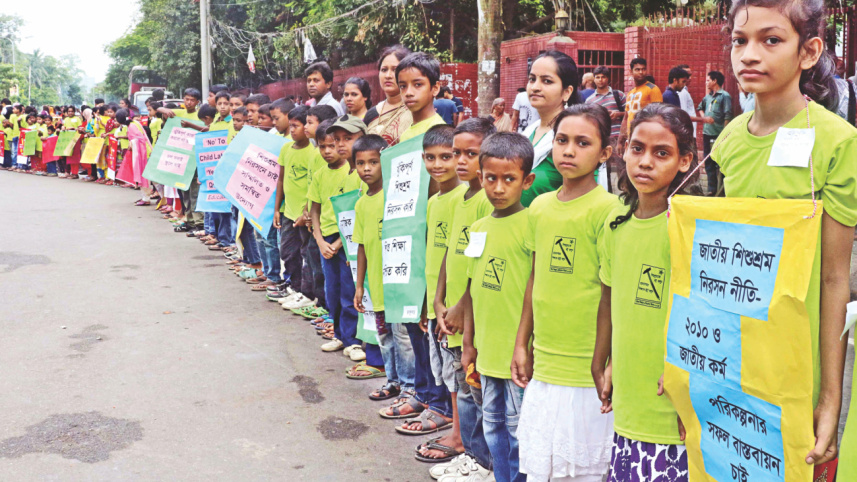
Against the backdrop of outdated information on the number of child labourers in the country, speakers yesterday urged the government to conduct a census on child labourers as an exact estimation will help address the problem fruitfully.
"According to a census, conducted in 2003, there were around 32 lakh child labourers of whom 13 lakh were engaged in risky jobs. On the other hand, the government aims to eradicate hazardous child labour by 2016. How could we achieve the goal if we do not know the updated statistics?" said Director (Governance) of Manusher Jonno Foundation (MJF) Tofael Ahmed.
 For all latest news, follow The Daily Star's Google News channel.
 He made the remark at a human chain, organised before the National Museum at the capital's Shahbagh by MJF, marking World Day Against Child Labour, which is observed on June 12. Around 500 children participated in the programme with posters saying "child is meant to learn, not to earn" in line with this year's theme "No To Child Labour - Yes To Quality Education".
A discussion was also held at the Central Public Library where Israfil Alam, member of the parliamentary committee on labour and employment affairs, said although the constitution and law ensure child protection, children are being tortured and engaged in risky jobs.
Rasheda K Choudhury, executive director of the Campaign for Popular Education, said overall development cannot be achieved leaving children uneducated.
Shaheen Anam, MJF's executive director, said it is the failure of the people, the society and the state that children have to work instead of studying. She suggested strong monitoring to ensure the budgetary allocations for children's development are spent rightly.
Ten child labourers, who are getting education under different NGO projetcs, yesterday were given prizes for an art competition held last week.
Wahida Banu, Aparajeyo Bangladesh executive director; Jamila Sultana, SOHAY executive director; Tahmina Jesmin Mita, SEEP deputy-executive director; Kazi Rajib Iqbal, Nabolok deputy chief executive; Dr Abdul Kaium Laskar, VAFWSD executive director, and Moslema Bari, Community Participation and Development executive director, spoke among others.
Comments