


Insecurity of religious minorities contagious
The insecurity of religious minorities implies the insecurity of all citizens in the country, human rights activist Sultana Kamal said at a discussion yesterday.
When a section of the citizenry is subjected to repression because of their faith, it only shows democratic practice is absent in the state, she said.

"Sadly, a section of people, because of religious identity, is denied a free and peaceful life although they are equal citizens of the country," she said. "There should not be discrimination, deprivation, and apprehension for anyone if human rights exist in the country," she added.
The former caretaker government adviser said a lack of security and peace of the religious minorities implied absence of peace in the country with the hope for justice lost.
London-based Secular Bangladesh Movement and the Campaign for Protection of Religious Minorities in Bangladesh (CPRMB) jointly organised the discussion on the "minority in quest of peace" at Dhaka Reporters Unity.
Pushpita Gupta, president of both CPRMB and Secular Bangladesh Movement, UK, who visited different parts of the country to learn about several incidents of atrocity on religious minorities since late March, said despite a party with secular ideology being in power, religious minorities had not got any relief from repression.
Citing a US parliamentary committee hearing in Washington on November 20 last year, she said 49 million Hindus went missing from Bangladesh since 1947.
The foremost reasons behind disappearing religious minority population include murders, repression, coercion, rape, assault, property grabbing, arson, intimidation and conversion, she said.
Citing findings of Bangladesh Mohila Oikya Parishad, she said the minorities suffered at least 262 incidents of human rights violation last year alone resulting in dislodging of 60 families, 24 deaths, 239 injuries, 25 rapes, and 24 abductions.
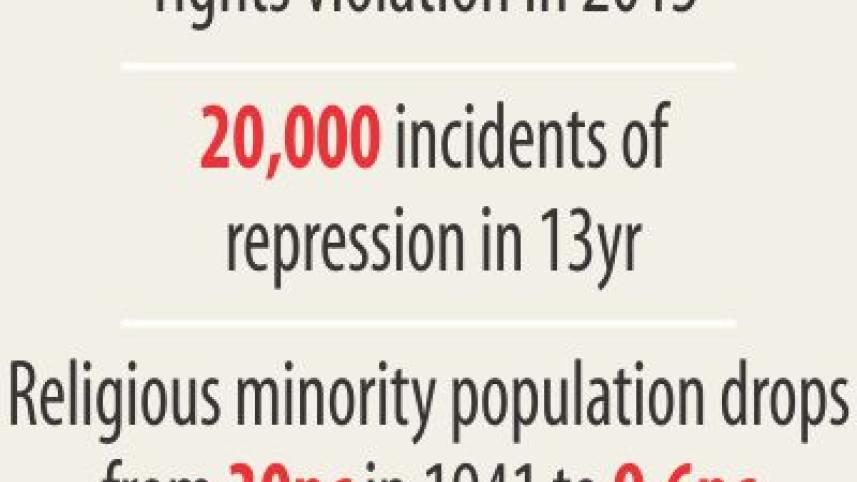
Over 20,000 incidents of repression on religious minorities had occurred in 13 years since 2001, and the barbarity of those committed during the BNP-Jamaat alliance government surpassed that of any other time, she said.
The incumbent government has not ensured justice for the brutality before and after the 2001 general election although there are findings of investigations, said Kajol Debnath, president of Bangladesh Puja Udjapan Parishad. The atrocity will go on as long as the culture of impunity stays, he added.
One political party considers religious minorities as vote bank, while the other thinks they would grab their property once the minorities leave the country, said Joyanta Kumar Deb, the Parishad's general secretary.
Priya Saha, general secretary of Bangladesh Mohila Oikya Parishad, cited the rape of a college student in Pabna and twin sisters in Noakhali, abduction of a female schoolteacher in Faridpur, and murder of a newly-wed man in Sylhet in the past few months, and said there was no hope for justice with the inaction of local administration.
Narayon Chandra Chanda, state minister for fisheries and livestock, said people should build resistance against minority repression but they did not take the risk out of a sense of insecurity.
Asked why the government cannot ensure the security and justice for all the citizens, he said, "No government can guarantee 100 percent security of the citizen."
Citing Bangladesh Bureau of Statistics (BBS) census, Pushpita said religious minorities constituted 30 percent of the population in the country in 1941 but it consistently fell down to 9.6 percent in 2011.
 For all latest news, follow The Daily Star's Google News channel.
Comments