


Pirojpur youths organise to give blood, the gift of life
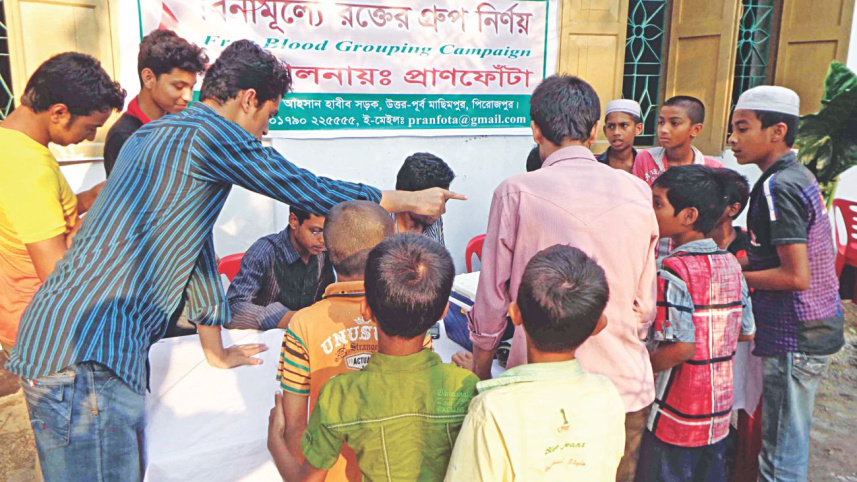
Five years ago, when three-wheeler auto driver Farid Hossain of Pirojpur town first saw his newborn son Samrat he was as ecstatic as any father could be. But two months later, his son was diagnosed with severe thalassemia disease. In order to manage Samrat's condition, the father would need to spend up to 1500 taka every 20 days to secure a bag of A+ blood. That's not easy for any auto driver, for whom every taka counts.
But in more recent times, Hossain and his son have found themselves fortunate to call Pirojpur home. In 2013 eight local youths co-founded Pranphota, an organisation dedicated to saving lives by coordinating blood donation supplies, which has meant that Samrat's monthly blood requirements are now available free of cost.

"It was very difficult to buy blood every month as well as meeting my family's living expenses," says Hossain, "I can't earn a lot as an auto driver. Although I can't say how long my son will live, I am really grateful to Pranphota."
No money, no freezing and no parcels: these are Pranphota's three principles. "Our donors always present themselves to give blood," says Abir Hasan, a first year Honours student and Pranphota co-founder.
"If anybody needs blood," explains M Shahidullah, a student of Suhrawardy Government College and fellow co-founder, "they can call us on 0179 022 5555 and give the hospital or clinic address. A donor will reach them in time."
In the past two years Pranphota has signed up 1,000 local blood donors, aged between 18 and 38, all ready to roll up their sleeves to help others.
"We have been able to donate about 1,500 bags of blood so far," says service holder Sujan Dhali, another co-founder.
"Almost every day we get a call for blood," adds his Pranphota colleague, Honours second year student Protap.
"It's not difficult to help," says local businessman and group member Moshiur Rahman, "It only requires good intentions."
Around ten days ago Nasima Akter, 32, the wife of Abdus Sattar, a mason of Bhandaria upazila benefited from such good intentions. In the midst of a miscarriage, she found herself at Pirojpur Sadar Hospital in urgent need of four bags of blood.
Initially her husband did not know where to turn for help. "It was very difficult for me to organise the blood," says Sattar, explaining that at first the hospital was set to release his wife because without the extra blood they were unable to offer her the further assistance she needed. But then somebody mentioned Pranphota and Sattar found that within a short time the blood for his wife had been arranged. "I'm really grateful to them," he says.
Meanwhile Ashraf Ali Fakir, 75, of Zilbuniya village in Morrelgonj upazila in neighbouring Bagerhat, relies on Pranphota for the bimonthly blood supplies he needs in the course of his cancer treatment. While Pirojpur lacks facilities and specialists for critical operations, with emergency patients referred to Khulna, Barisal or Dhaka, chronically ill patients like Fakir determine that supplies of all blood groups are needed with regularity.
"For rare blood groups we sometimes need to arrange the donation from distant areas," says second year HSC student Naeem Mahmud, another co-founder. "Our members carry blood group cards and we have a Facebook page to help coordinate activities," he adds.
Yet despite the sincere efforts and hard work of its members, the organisation faces funding dilemmas. "For patients the service is free, but we have no income source except our own pockets," says Shahidullah. With most of the group's members being students, those pockets aren't exactly brimming with taka.
"Some patients' families are insolvent and cannot buy the blood bag, in which case we supply it," says Hasan, "and sometimes the donor has no money to reach the hospital, so we arrange their transport costs too."
Nonetheless, Pranphota's founders are happy with their efforts. "I see it as my duty to help those in need," says Arnab Mistry, co-founder and final year Honours student.
"I feel proud to belong to this group," says co-founder Meem Rahman, a first year HSC student. "In helping others, every person should stand up and be counted."
Meanwhile Hossain continues to drive his auto as he always has. Passengers come and go, some generous, others more precise. In the course of their transport, no passenger can imagine he is the father of a chronically ill son. They don't know he has quite enough to worry about in addition to the usual tensions of daily life, nor how important Pranphota's efforts have been in subtracting from his life, and the life of his family, one big stress.
 For all latest news, follow The Daily Star's Google News channel.
Comments