


Poor children's horses make rich children smile
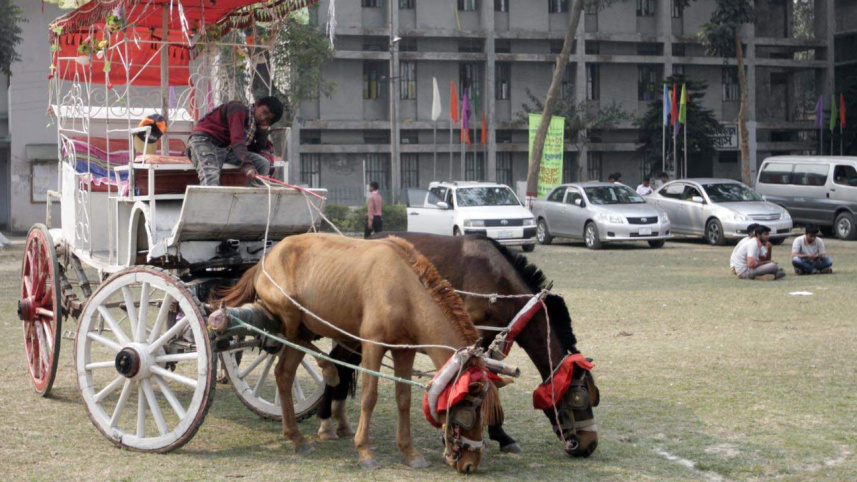
There are fairground rides, exhibit stalls and snack stands to discover. High-spirited loudspeaker announcements and flashing party lights make the trade and industry fair organised by Dinajpur's chamber of commerce enough to excite any child. Held on the iconic field, Gor-e-Shahid Boro Math of Dinajpur town, for many children a highlight of visiting the fair is the chance to ride a horse nearby.
Ishtiaq Ahmed, 7, of Suihari in the town is accompanied by his father Shamim Ahmed. He is lucky, fulfilling his wish to enjoy a horse ride early that evening. But the experience leaves him with questions about the boy leading the horse. "Does he go to school?" Ishtiaq asks his father. "Don't his parents wish him home before sunset?" Without answering the father takes the son's hand and leads him away.
 For all latest news, follow The Daily Star's Google News channel.
 It's a basic truth which makes little sense to children: stations in life differ. For the nine-year-old boy, Rose, who's in charge of the horse, rides are never a matter of amusement. They're about livelihood.
"I took the horse riding profession," says Rose, from Dinajpur Sadar upazila's Gabura village.
He says his father Shamsur Rahman is a tractor driver who doesn't care for the four-member family well. He says he's brought his horse beside the fairground in the hope of earning money, pocket change from the parents of each middle class child who takes a ride. Holding the horse's rope he stands, waiting for more customers, most often children of around his own age.
The other children sit on horseback while cameras click; Rose watches them laugh and smile. He does this every day, travelling back and forth from his village eight kilometres away. "I leave home at 10:00am.," he says, "I try to return home as early as I can but it's never before 10:00 pm."
"Usually I earn up to Tk 200 per day," says Rose, "On a good day I can make as much as Tk 400." For each ride Tk 5 is pushed into Rose's palm. He's been making money with his horse for about a year.
"While all children wish to enjoy a carefree childhood," observes Golam Mostafa, a Dinajpur resident visiting the fair, "this boy has to labour with his horse to entertain the children from solvent families."
Rose says he stopped attending school two years ago because his parents were unwilling to send him. Like that of any working child his life is difficult; and days spent in the company of a horse are hardly days without risk.
Yet he is one of many. From Kuakata beach in Patuakhali to Dinajpur, across Bangladesh it's not uncommon for children work as horse handlers.
Iqbal is another boy with the same job. The 11-year-old says he took the reins of the horses-with-cart he uses to entertain other children from his father. Observed grazing his horses in a Dinajpur field, Iqbal looks exhausted; too tired even to seek out customers. Many children his age, he says, are forced to participate in horse races as well.
Despite laws to prevent child labour it is everywhere, to be found in one form or another. But according to Md. Mobarak Hossain, programme officer of Plan Bangladesh posted in Dinajpur's Khansamsa upazila, using children as horse handlers doesn't have a long history in the district. "As the trend would seem to be in initial stages here," Hossain says, "It's a good time for government officials to address the issue."
"There will be no solution until employing children causes fear," says Dinajpur lawmaker Iqbalur Rahim, referring to the need for strict penalties for those employing minors.
"Childhood for every child should be about completing school and enjoying themselves," he continues, "As education is free in Bangladesh, all parents should encourage their children to go to school." He promised to look into the issue the next time he's in Dinajpur.
In the meantime it might be as well that Ishtiaq's father doesn't attempt to reply to his son's queries, because as yet there aren't any satisfactory answers to be had.
Comments