


How to solve the street vendor crisis sustainably

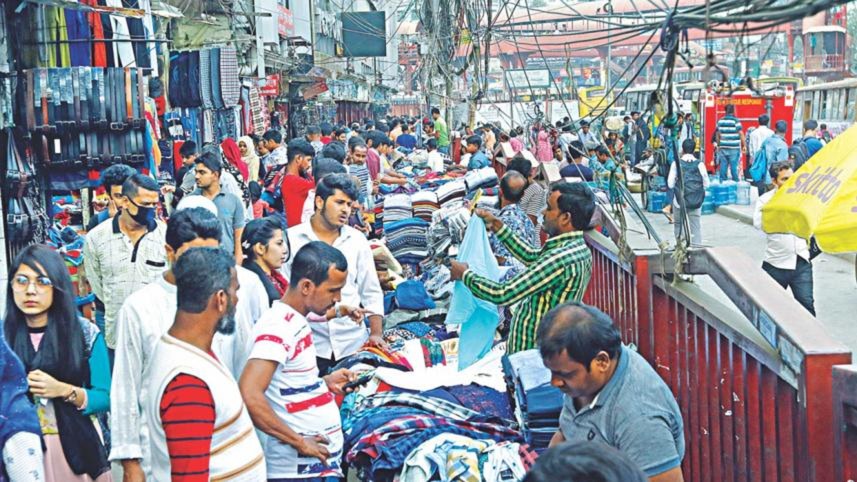
Often in urban Bangladesh, footpaths are cleared of street vendors so that pedestrians can move about comfortably. But it only takes a few days or even hours before they start coming back, crowding the footpaths again. Although street vendor eviction from footpaths ensures that people can walk around without worrying about getting injured, thousands of vendors end up losing their livelihoods overnight. This issue is a failure of governance.
Dhaka alone has 300,000 to 500,000 street vendors, and more than 80 lakh Dhaka residents rely on them daily for affordable food. The informal sector makes up around 40-43 percent of Bangladesh’s GDP and accounts for over 84 percent of the entire labour force. It is time policymakers figure out how to make this sector a productive one rather than a persistent headache.

This issue is not unique to Dhaka and has already been addressed through established models elsewhere. The situation Singapore faced during the 1960s and 1970s closely resembled what Dhaka faces now. Instead of evicting hawkers indefinitely, the government relocated them to purpose-built hawker centres with proper sanitation, electricity, and waste management. These centres became popular community spaces showcasing diverse cultures and cuisines, eventually earning UNESCO recognition as Intangible Cultural Heritage of Humanity in 2020.
India adopted a legislative route with the Street Vendors (Protection of Livelihood and Regulation of Street Vending) Act, 2014, which protects vendors from arbitrary eviction, mandates citywide registration, provides identity cards, and designates vending and non-vending zones. Crucially, it created Town Vending Committees with actual vendor representation, helping reduce extortion and enabling formal taxation. Implementation across India’s thousands of cities has been slow and uneven, but cities that applied the law seriously have seen real improvements.
Kuala Lumpur also turned its night markets into tourist attractions without disrupting daytime pedestrian movement. What unites all the successful cities is the principle of time-sharing where pedestrian zones are kept free of vendors during peak hours but used by vendors during off-peak times.
In the case of Bangladesh, before arriving at the solutions, the reasons behind repeated failures must be understood.
First, vendors return because they have no other way to survive. Expulsion without providing an alternative is not a solution, but rather a postponement.
Second, political interference distorts enforcement. In many Dhaka neighbourhoods, local political networks profit by collecting informal fees from vendors in exchange for protection from authorities. Any meaningful reform must break this extortion cycle. Otherwise, formalised vending zones will simply reproduce the same corruption in a new setting.
Third, the absence of legal recognition leaves vendors permanently vulnerable, giving authorities no tool except eviction. Without formal status, there is no accountability on either side.
The answer is not bulldozers; it is smarter governance that tackles root causes at every level.
A digital registration system is the necessary foundation. A register of licensed vendors organised by wards, trades, and tenures will distinguish legitimate vendors from those who have plotted to encroach. It would also strip informal brokers of their extortion leverage, replacing backroom arrangements with a straightforward relationship between vendors and city authorities.
Dedicated vending zones on underutilised government land must be established before enforcement is escalated. These spaces need basic infrastructure—hygiene facilities, clean water, and waste disposal—not grand architecture. Dhaka South City Corporation has already proposed eight night-market sites. That proposal deserves immediate funding and implementation, not another round of committee discussions. On April 30, 2026, the DSCC and DNCC jointly launched the “Dhaka City Hawker Management Policy 2026,” issuing QR-coded digital ID cards to over 300 hawkers and relocating them to designated vending zones across the city.
Time-sharing models can resolve much of the conflict over public space. Keeping main footpaths clear during peak commute hours while permitting regulated vending from the evening onward is a workable compromise that several Asian cities already run without serious difficulty.
Ward-level management committees consisting of city corporation officials, law enforcement, and elected vendor representatives should oversee implementation with genuine decision-making authority, not advisory roles. People respect rules they helped create and resist rules which are imposed on them. Any relocation also needs to be complemented by rehabilitation services that include temporary financial assistance as well as microcredit opportunities. Without such cushioning, relocation will merely move poverty elsewhere without solving the problem.
Scepticism towards these solutions is understandable. Bangladesh does not have Singapore-level institutional capacity, and licensing schemes can easily become new avenues for corruption.
But the answer lies in sequencing. Start with two or three pilot wards—say, one each in Dhaka North and South. Introduce the full framework, monitor, and measure against published metrics. What works gets scaled. What fails gets corrected before it spreads.
The informal sector’s contribution to Bangladesh’s economy and to millions of lives is too substantial to address with force alone. Registration, zoning, and genuine support would make cities more walkable, reduce congestion, improve public health, and bring informal GDP into the formal tax base.
The streets of Dhaka belong to all its people—the commuter who must dodge traffic to reach work and the hawker whose stall is the difference between feeding a family and leaving them hungry. These two needs are not in conflict. With honest political will, evidence-based planning, and real inclusion of the people most affected, the hawker problem can shift from an embarrassment into an example of practical, human-centred urban governance.
Md Rakibul Hasan works with Bangladesh Small and Cottage Industries Corporation (BSCIC). He can be reached at rakib4457@gmail.com.
Views expressed in this article are the author's own.
 For all latest news, follow The Daily Star's Google News channel.
 Follow The Daily Star Opinion on Facebook for the latest opinions, commentaries, and analyses by experts and professionals. To contribute your article or letter to The Daily Star Opinion, see our guidelines for submission.
Comments