


Watching Sonadia's bird watcher
As the speedboat bounces across the waters en-route to Sonadia's shoals in Cox's Bazar, it's easy to imagine it's a James Bond chase scene. The morning sun is glorious, the natural setting sublime. The pace only slows to negotiate narrower mangrove-lined channels. In a way it is a chase: to count foraging shorebirds before the tide comes in.
For most a job secures a livelihood. For a select few career is a passion. As he heads to the "office" to count sparrow-sized spoonbill sandpipers on the Bay of Bengal's muddy flats, conservationist Md Foysal, 29, of South Keraniganj in Dhaka falls into the latter category.

"Science believes in proof," he says, "We count to show that Bangladesh is an important wintering site."
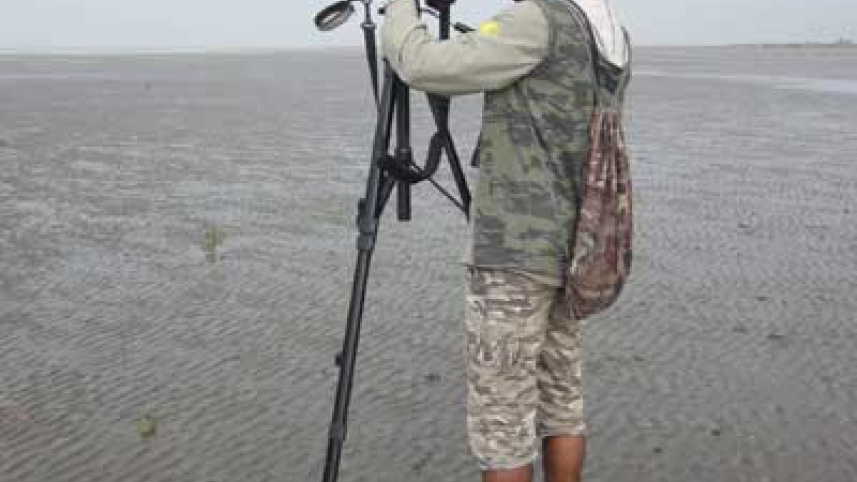
He looks the part: clothes and rucksack are camouflage. Binoculars on sturdy tripod are ready. He's not even thinking of wasting time with a camera like a tourist.
It's an international effort to protect the world's less than 200 mature "spoonies". In tundra breeding grounds of the Kamchatka Peninsula, Foysal's Russian colleagues protect nests and hatch eggs. This year Foysal has recorded 49 birds in his census, representing 25% of global numbers.
Working for the Bangladesh Spoonbill Sandpiper Conservation Project, from October to April he reaches the shoals monthly to watch and tally. "When I'm out in the natural world, I love it."
A warning to parents who see their children as bankers or doctors: this can happen to a child reared in a household of pets. His father had pigeons and a dog; his uncle parrots and mongooses; his sister kept a weaverbird.
At age five Foysal bought a rose-necked parakeet he called Titu and taught to say "Kaka." Their garden gave an interest in plants. "I used to collect unknown plants locally and try to grow them," he says. "I had turtles, snakes, birds, dogs, rabbits and guinea pigs. Mum didn't mind the plants but thought animals dirtied the home."
When he got a snake Foysal's mother said, "It will bite you. You will die." She took some convincing it was non-venomous.
Always there came questions. Why had a hill mynah failed to mimic words? Why did an orange seedling germinated from seed die in sandy soil?
His older cousins laughed when he asked for nature books but once, in class 9, a whole night passed submerged in one.
In college, Foysal spotted a raptor. Subsequently he identified it as a red-headed falcon and determined to see its red head. "I convinced my father to buy basic binoculars," he says, "but it's difficult to see a falcon's head with cheap binoculars." He watched it hunt and hover. Then one day it dived after a sparrow and its red head came, finally, superbly, into view. Foysal kept red-headed falcon notebooks.
In 2001 he attended his first bird club meeting. "People said bird watching was mad," recalls Foysal, "I was so happy not to be alone!"
When Foysal chose zoology, later completing a Masters in Wildlife and Conservation, hopes he'd continue the family shipbreaking business, as an only son, faded.
"Ours is an Old Dhaka family," says Foysal, "Making money and settling down are assumed. But I've never met a girl truly fascinated by nature! If I met one who could live with my career…"
Foysal promised himself to write a falcon paper for international publication. "I struggled with English," he says, "Everybody discouraged me."
When he showed a friend a draft he was told, "The Oriental Bird Club will throw it in the bin." Foysal persisted and one day after submission he heard that the Oriental Bird Club was fascinated. His research paper was published. Foysal received honorary membership.
In 2011, he joined Sayam U Chowdhury in the sandpiper project at a starting salary of 15,000 taka. "Destroying biodiversity makes us weaker," explains Foysal. He mentions gallus gallus, the red jungle fowl domesticated 8,000 years ago in India.
"Chicken eggs produce vaccines," he notes, "As a protein source how valuable is the chicken! Without research we couldn't have accessed this benefit. If it'd become extinct, what a loss!"
"The future of spoonbill sandpipers depends entirely on humans. I like their rapid, non-stop movement. They're hyperactive and it's like my motto: Be young. Enjoy life!"
 For all latest news, follow The Daily Star's Google News channel.
 Tides rise fast. After checking several sites it's time to go. The dry land we walked across is underwater. Foysal's 'office' is shrinking. The speedboat waits, just offshore.



Comments