


From Suez to Hormuz: A stress test for Bangladesh’s export logistics

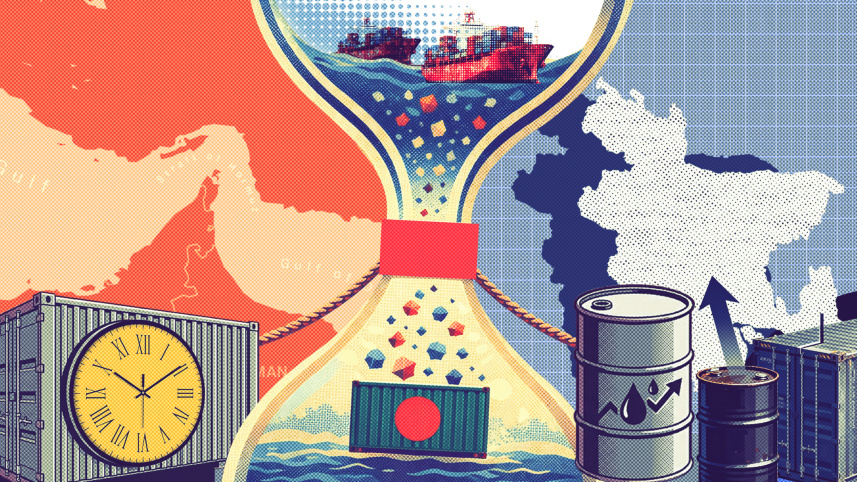
Bangladesh’s export success has never been just about competitive labour or entrepreneurial energy. Logistics—the quiet, disciplined movement of goods from factory floors to port gates, from container yards to mother vessels, and from ships to global retail shelves—has also played a massive part in it. That machinery now faces one of the most serious external stress tests in recent memory.
Amid the ongoing war between US-Israel and Iran, the suspension of trans-Suez services combined with a closure of the Strait of Hormuz will not only disrupt shipping routes but also expose structural vulnerabilities in global trade lanes, as well as in Bangladesh’s own trade architecture. These two maritime chokepoints serve different but equally critical roles. The Suez Canal, the 193-km artificial waterway in Egypt, is the principal artery connecting Asia to Europe. When it shuts down, vessels are forced to divert around the Cape of Good Hope in South Africa, which significantly extends sailing distances and transit times. A round trip between South Asia and Northern Europe can lengthen by roughly one to two additional working weeks. In liner shipping, time is of the essence: when ships stay longer at sea, global capacity shrinks. Containers remain tied up, and schedules lose rhythm.

Meanwhile, the Strait of Hormuz, which sits between Iran and Oman, is one of the world’s most important energy transit chokepoints through which more than 20 percent of global oil and liquefied natural gas exports is shipped. Its closure will send immediate shockwaves through oil and gas markets. For Bangladesh, that translates directly into higher fuel import costs, increased power generation expenses, rising inland transport costs, and more expensive bunker fuel for ships. Freight rates would inevitably respond.
Taken together, these disruptions would produce two simultaneous shocks: a “time-and-capacity shock” and an “energy-and-cost shock.” And for an export-driven economy like Bangladesh, that combination is consequential.
In FY2024-25, Bangladesh exported roughly $48 billion worth of goods, of which more than 80 percent was ready-made garment products. This is a highly containerised, schedule-sensitive industry. Retail supply chains in Europe and North America are calendar-driven. Missing a delivery window is not simply a delay; it can mean discounted sales, contract penalties, or lost future orders.
Our exposure is concentrated in precisely those markets dependent on these trade corridors. The European Union and the US together account for the majority of Bangladesh’s apparel exports. When shipping routes lengthen and freight costs rise, our competitive edge, built carefully over decades, faces pressure from both cost escalation and delivery uncertainty.
Rerouting shipping lines is not free. Longer voyages increase ton-miles, absorb vessel capacity, and strain container rotations. Disruption often results in port congestion as ships arrive in uneven clusters instead of predictable weekly intervals. Under such conditions, variability becomes the enemy.
Bangladesh’s primary maritime gateway has demonstrated impressive growth capacity, handling record container volumes in recent years. However, resilience under disruption is not only about scale but also about flexibility and predictability. When vessel arrivals become irregular, container dwell times increase, yard density rises, inland container depots face pressure, trucking corridors become bottlenecks, and customs delays compound the strain. Even modest inefficiencies become magnified during systemic stress.
Bangladesh’s evolving trade relationship with the US introduces another dimension. The recently announced reciprocal trade framework signals deeper two-way commerce, including expanded imports of American cotton, wheat, and other inputs. Stronger bilateral trade ties are welcome, but increased inbound volumes will compete for shipping space, port handling capacity, foreign exchange liquidity, and trade finance precisely when outbound logistics may already be strained.
Bangladesh could therefore face a dual flow challenge: exports grappling with longer transit times while imports rise under new trade commitments. Is this scenario inevitable? Not necessarily. But it is plausible enough to demand preparation.
The first step is recognising that logistics, during disruption, becomes a central economic priority. A coordinated, data-driven supply chain response is essential. Government agencies, port authorities, shipping lines, terminal operators, customs officials, banks, and exporters all must operate in close alignment. Daily monitoring of berth schedules, yard occupancy, container dwell time, and inland evacuation rates should be institutionalised during such periods of instability.
Second, inland connectivity must be treated as strategic infrastructure. Greater reliance on rail-based container evacuation can reduce highway pressure and accelerate yard turnover. Inland depots must operate with strict turnaround targets. Even small reductions in average dwell time can create significant capacity buffers.
Third, contractual realism is required. Exporters and buyers must revisit shipment lead times, buffer stock strategies, and war risk clauses. The global supply chain is entering a period where rerouting and volatility are recurring features, not exceptional events.
Fourth, trade finance resilience must be safeguarded. Longer transit times tie up working capital. Banks and financial institutions should anticipate this shift and adjust liquidity planning accordingly.
Finally, communication must be clear and credible. Markets react poorly to uncertainty. Transparent guidance to exporters regarding port conditions, expected delays, and contingency planning can prevent panic-driven decisions.
Bangladesh has demonstrated resilience before, from pandemic-era container shortages to global freight rate spikes. The private sector has shown adaptability in navigating turbulence. However, an indefinite suspension of trans-Suez services combined with Hormuz instability would represent a structural, not temporary, alteration of trade routes and energy flows, reshaping cost assumptions across Asia-Europe and Asia-America corridors. In such an environment, competitiveness will depend less on nominal production costs and more on supply chain reliability.
Global trade geography may be shifting. Sea lanes may detour. Energy prices may fluctuate. These forces lie beyond our control. What remains within our control is how efficiently we respond. Bangladesh has built a world-class export engine over the decades. The task now is to embed resilience into that engine. Cleaner customs processes, faster inland connectivity, digital documentation, diversified routing options, and disciplined institutional coordination will determine how well we can weather a prolonged maritime uncertainty.
Ahamedul Karim Chowdhury is adjunct faculty at Bangladesh Maritime University and former head of inland container depot at Kamalapur and Pangaon Inland Container Terminal under the Chittagong Port Authority.
Views expressed in this article are the author's own.
Follow The Daily Star Opinion on Facebook for the latest opinions, commentaries, and analyses by experts and professionals. To contribute your article or letter to The Daily Star Opinion, see our guidelines for submission.
 For all latest news, follow The Daily Star's Google News channel.
Comments