


Fara Dabhoiwala’s history misses the one thing that truly matters
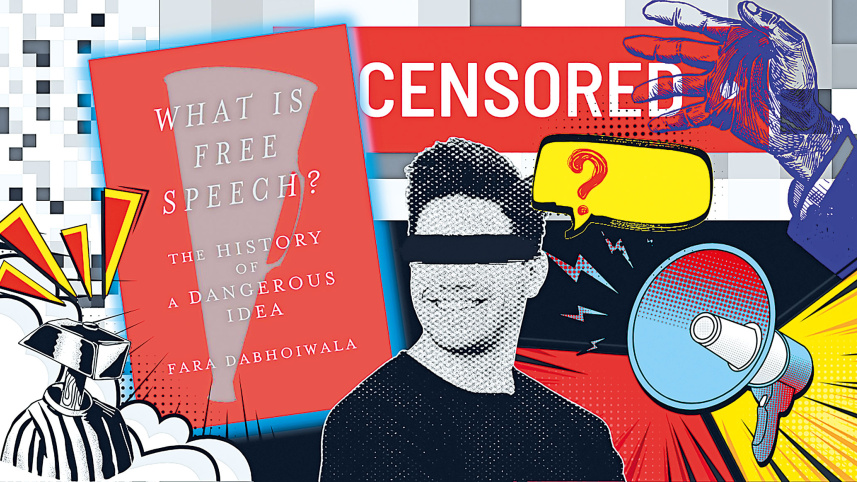
That censorship is not only malign but also stupid and, in the long run, futile, is a lesson that every tinpot dictator and overzealous bureaucrat has to learn afresh. But the opposite assumption, that the absence of censorship automatically creates a healthy marketplace of ideas, Fara Dabhoiwala says, is also an insidious illusion. His new history of free speech, What Is Free Speech?: The History of a Dangerous Idea, argues that free speech is not a natural state of being but a deeply artificial concept, shaped from its inception by imbalances of power, including the silencing of women to the brutalities of empire. Dabhoiwala posits that to celebrate liberty of expression without asking whose liberty and at whose expense is to engage in a form of willful historical amnesia.
To make this case, Dabhoiwala embarks on a panoramic, if occasionally anachronistic, sweep of the last half-millennium, a narrative journey that begins by reminding the reader of the elemental, almost magical, power ascribed to speech in ‘pre-Enlightenment’ societies, where a blasphemy or a slander was not merely an offense but a tangible disruption of the cosmic and social order. He then details how this holistic worldview was chipped away, first by the grudging necessities of religious toleration, and then shattered by the invention of political free speech in 18th-century England, a doctrine he argues was less a philosophical breakthrough than a journalistic racket, born of stock-market panic and partisan fury, whose inherently racialized and gendered conception of liberty was then exported, with all its hypocrisies intact, to the slave-holding colonies of America.
 For all latest news, follow The Daily Star's Google News channel.
 In a post-colonial nation like ours, this is a central mechanism of state control. When the state invokes ‘communal harmony’ to silence reporting on minority rights, or ‘national security’ to jail cartoonists, or ‘wounding religious sentiments’ to crush dissent, it is using the same logic of “harm prevention” that Dabhoiwala champions.
The book’s central, unstated syllogism seems to be this: the origin of free speech is tainted by hypocrisy, greed, and power; therefore, the ideal of free speech is itself a tainted instrument. One might as well argue that because the American Constitution was drafted by slaveholders, its (belated) guarantees of equality are worthless. What Dabhoiwala misses, in his anger about the slave trade and the British Empire, is the simple, double-edged fact that a principle can transcend its flawed creators. For those of us living in the post-colonial world, the fact that Mill, the bureaucrat, was a hypocrite is beside the point regarding free expression; what matters is that On Liberty, the text, provided the language our own anti-colonial forebears used to demand rights of free expression.
Dabhoiwala’s most glaring failure is his inability to grapple with the real ‘danger’ in the book’s subtitle. It is true that he mentions many instances of violence wrought upon individuals for their expression, but his tone is more urgent and sincere when he frets about the social harm of ridiculing holiest beliefs, a fine-sounding phrase that, in the real world, translates directly into a justification for blasphemy laws, the legal architecture of theocratic thuggery. Salman Rushdie makes a cameo appearance in Dabhoiwala’s long, rambling, only to be dismissed as a free speech absolutist. The 30-year campaign of extremist violence which nearly succeeded in murdering him while this book was being written, is not even mentioned. A fine history of free speech, indeed!
Ironically, for a book that so strenuously critiques Anglo-American exceptionalism, Dabhoiwala’s narrative is hopelessly Anglo-centric, advertised as a “remarkable global history”, yet culminating in a final, furious charge against the modern American First Amendment. The inclusion of a valuable chapter on British India and a perfunctory detour through Scandinavia does not make a history global. By focusing his ultimate concern so intently on how the American ideal protects “Nazis, antisemites, (and) racists,” Dabhoiwala frames the central problem of free speech as one of excessive private license. This focus entirely ignores that in most of the world, including here in Bangladesh, the primary threat to expression comes from the coercive power of the state.
More dangerously, Dabhoiwala’s thesis validates the language of the oppressors. His reasonable-sounding insistence on regulating speech to “prevent harm,” treating it as an “action like any other,” provides the precise justification for repressive legal architectures, from the colonial-era sedition laws he details to contemporary DSA and now Cyber Security Act in our country. He exposes how past limitations were arbitrarily drawn to silence women, slaves, and colonial subjects. Yet he fails to see the flaw in his own prescription, simply assuming his preferred regulations against ‘hate speech’ or ‘group libel’ are the logical and correct ones.
This merely substitutes one set of arbitrary boundaries for another, and more importantly, it begs the crucial question: who, precisely, gets to decide what constitutes harm? In a post-colonial nation like ours, this is a central mechanism of state control. When the state invokes ‘communal harmony’ to silence reporting on minority rights, or ‘national security’ to jail cartoonists, or ‘wounding religious sentiments’ to crush dissent, it is using the same logic of “harm prevention” that Dabhoiwala champions. Giving this power to the state is not the solution; it is, and always has been, the core of the problem.
Ultimately, Dabhoiwala’s book is a treatise that, while meticulously documenting the hypocrisies of the past, offers aid and comfort to the tyrants of the present. By elevating the subjective claim of harm over the necessity of liberty, he provides a high-minded alibi for the censor’s pen and the state’s baton. This is the oldest argument in the book of tyranny, the very same one used against Socrates, who was, after all, judicially murdered for harming the youth and offending the gods.
The distinction between word and deed that Dabhoiwala finds so flimsy is, in fact, the load-bearing wall of an open society. The right to free speech is the right to tell people what they do not want to hear. Dabhoiwala, in his anxiety over the content of the speech, seems to have forgotten the one thing that truly matters: the inalienable right to have it, free from the arbitrary and silencing verdict of “who decides”.
Najmus Sakib studies Linguistics at the University of Dhaka. Reach him at kazis713@gmail.com.
Comments