


Let there be monsters: On AI mythology
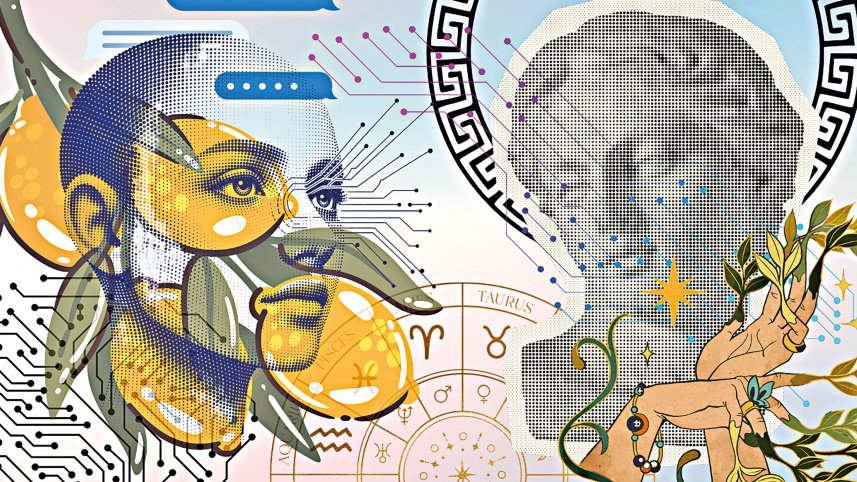
Ask any room of people about their deepest fears regarding artificial intelligence, and eight out of 10 will likely invoke a takeover narrative—the “Frankenstein syndrome”, where the creation turns against the creator.
On my journey to understand this, I found a heap of theories, epistemologies, and fiction. While many of these works are not explicitly about AI, they all circle the same concept: AI as an independent saboteur preying on human singularity. These ideas do considerable damage to our interpretive, pedagogical, and societal landscapes, obscuring how our attitudes define the technology’s parameters.

To understand what I call the “colonial Frankenstein”, it helps to begin where Frederic Kaplan does—at the crux of myths and modernity. In “Who is Afraid of the Humanoid?” (2004), Kaplan casts the Ancient Greeks as pioneers of this archetype. The tale of Pygmalion, where a sculptor’s design is turned human by Aphrodite, is one of the first concepts to prefer the man-made over the naturally occurring.
In another fraction of western exegesis, this is similar to the Golem from the Sefer Jezira (the Jewish book of creation), where a rabbi mimics God’s methods to create a useful servant who can be destroyed if he goes rogue. The creature’s existence is not inherently negative, but rather a progressive approach to simulating God’s artistry. Paracelsus’ alchemical homunculus shares this same practicality. None of these Western origin stories suggest the artificial is an act of transgression.
The way around the AI problem is not an elimination strategy; it is, simply, more monsters. We must let the Djinns, Golems, gods, and gamers into the curriculum, the policy table, and our cultural conversations. The regulations we build around AI will only ever be as innovative as the mythologies we allow to inform them.
So, what initiated this fear towards artificial creatures? The 18th century saw a surge of authors with a disdain for technological advancement, mainly Rousseau and Goethe, whose works shaped the Romantic era and Western sensibility. Goethe’s revival of “The Sorcerer’s Apprentice” (1797) and Rousseau’s philosophy relating mankind’s degeneration to their omnipotence over nature faintly brewed the genius of Mary Shelley’s monster.
With Mary Shelley’s Frankenstein in 1816, the creature’s paradigm caught fire. Popular refinement overlooked the shared culpability of both creator and creation, giving way to a single rule: any artificially created humanoid will necessarily turn against its creator.
Throughout the 19th century, resurrections of earlier mythologies combined with this perceptive monster to produce works like Tales of Hoffmann (1816), The Future Eve (1886), Pinocchio (1883), and R.U.R. (1920)—which minted the term “robot.” These Romantic consolidations later manifested in media like Metropolis (1925), The Golem (1915), and The Clockwork Man (1923), which devised the anxiety around robots post-World War II. Today, popular literature like Klara and the Sun (2021), M3GAN (2022), Machines Like Me (2019), Her (2013), and Black Mirror (2011) continue to propagate unease around AI autonomy.
In “From Monsters to Mazes” (2024), Gideon Dishon argues that the Frankenstein framework is limited, proposing Kafka’s The Trial (1925) as an alternative sociotechnical imaginary that shifts the conversation away from a loss-of-control narrative toward a bureaucratic examination of AI agency, relations, and control. Similarly, Michael Szollosy’s “Freud, Frankenstein and our fear of robots” (2016) proposes that our fear of AI is actually a Freudian projection of deeper human anxieties regarding the dehumanizing effects of science and reason on human nature.
While both papers are divergent in their diagnoses, neither addresses the broader problem: the monolithic shackle of this linear frame. This monolith prevents us from tackling AI through different lenses to keep the conversation capacious enough to hold more than one mythology at a time, and granular enough to address the human scale erosion of literacy, creative practice, and literary education. The alternatives these papers reach for—Kafka, Freud—are still western hands feeling the same walls, falling short of questioning whether other rooms exist.
This realisation prompted me to look at a different angle—windows into different cultural framings of modernity.
The Japanese approach to technology resembles a mother-child bond more than a superior-subordinate relationship. Osamu Sakura’s study of ukiyo-e art shows that while western art depicts mother-child or robot-human pairings looking at each other, Japanese renditions depict them looking at something together. This is supported by techno-animism stemming from Japan’s Shinto tradition, which allows literary freedom beyond Western variations. This deviation is evident in Astro Boy, Goldorak, Mazinger Z, Giant Robo, and Neon Genesis Evangelion, where the human-robot relationship is lateral rather than adversarial, keeping audiences aware of real dangers over exaggerated takeover theories.
Beyond this, some of the most unforgettable fun I had was exploring science fiction rooted in folklore, South Asian tales, and Islamic cosmology. Renditions in River of Gods (2004), The Arabesk Trilogy (2001–2003), The Lifecycle of Software Objects (2010), and Saad Z. Hossain’s Cyber Mage (2021), The Gurkha and the Lord of Tuesday (2019), and Djinn City (2017) have been revolutionary to my perception of technology. The fictitious thrill of these wild imaginaries is the marrow of artistic innovation. The bases of folkloric roots, Islamic myths, and Indian versatility go deeper than the west’s, yet receive much less coverage despite their promises in negotiating with creative autonomy and generative AI.
This survey is far from exhaustive. The African cosmological tradition, visible in Nnedi Okorafor’s Lagoon (2014), dissolves the human-nonhuman binary into something ecological and communal. Further still are the Chinese science fiction renaissance, notably Liu Cixin’s work on collective intelligence, and the Latin American magical realist tradition’s long negotiation with the animate and inanimate. These parallel conversations have long been excluded from the dominant discourse, yet they collectively prove that new ways of looking at technology can dissolve old stigmas and propose new solutions.
How far, then, does the “colonial Frankenstein” affect the arts, pedagogy, society, and our coexistence with technology?
Using the co-production theory from Sheila Jasanoff’s Dreamscapes of Modernity (2015), we can conclude that the policies and margins we build around AI are directly shaped by how we view it—which is molded by what we consume. The Frankenstein frame has homogenised the curricular imagination, dictating what gets taught, published, funded, and feared. It will keep doing so as long as we treat a problem requiring literary agility as one that only requires legislative alarm. A plurally educated individual views AI at a human scale, seeing what happens to a person’s inner life when their imaginative labor is redistributed to a machine.
The way around the AI problem is not an elimination strategy; it is, simply, more monsters. We must let the Djinns, Golems, gods, and gamers into the curriculum, the policy table, and our cultural conversations. The regulations we build around AI will only ever be as innovative as the mythologies we allow to inform them.
Mrinmoyi is an entity floating in the abyss. For more sources on topics of AI debate, contact her at uzma131989@gmail.com.
 For all latest news, follow The Daily Star's Google News channel.



Comments