


Writing what silence carries: Mohua Chinappa on memory, pain, and inheritance
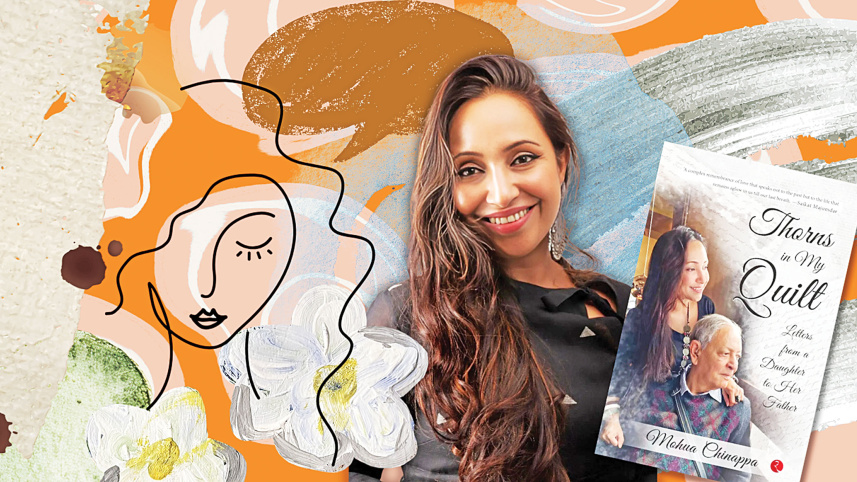
Thorns in My Quilt (Rupa Publications India, 2024) unfolds through address rather than disclosure. Written as a series of letters to her father, Mohua Chinappa’s memoir traces memory not as a sequence of events, but as an emotional inheritance shaped by silence, expectation, and the subtle negotiations that govern family life. The book lingers over what is absorbed rather than spoken, attending to forms of hurt that leave no visible trace yet quietly shape a life.
Moving from poetry and short fiction into the epistolary memoir form, Chinappa adopts a voice of restraint and attentiveness. The letters neither accuse nor seek resolution; instead, they allow complexity to remain intact. Parenting, care, ego, and endurance emerge as lived experiences rather than arguments.
 For all latest news, follow The Daily Star's Google News channel.
 In this conversation, Chinappa reflects on writing memory as something felt rather than retrieved, on finding language for invisible harm, and on the kind of hope that does not arrive as consolation but as a steady, hard-won presence.
Choosing the epistolary form—letters addressed to your father—creates both intimacy and distance. What does the letter allow you to hold that a conventional memoir might flatten or over-explain?
I began writing the book immediately after my father’s death. It was a way to process the pain, the final ending, a sublimation on my part to write this book. Letters helped me pen my thoughts unhindered, without the fear of judgment, as letters are extremely personal. I wanted to bleed without the fear of the outcome.
Memory in Thorns in My Quilt feels less archival and more emotional—shaped by silence, omission, and repetition. How did you approach memory not as fact to be verified, but as something lived and carried?
Our memories sometimes fail in their accuracy, but the feelings of certain events remain truthful in their essence. Also, memories have a range of emotions. Some are more profound than others. They enable us to delve into a deep state of reckoning and reflection on the stories our heart carries. Some details may be fractured, yet they are an amalgamation of all the darkness and light in their entirety in each of my entries.
Much of the book attends to forms of hurt that leave no visible mark—expectations, control, emotional withdrawal, unspoken hierarchies. As a writer, how did you find a language for harm that is systemic yet quiet, and therefore often dismissed?
As a female writer, words are our saviours in expressing harm that is systemic yet hidden in the folds of propriety that society deems right or wrong. Therefore, there can be no specific language to express emotion, except from the deepest recesses of my heart that I knew needed to be acknowledged—for all the dismissals, the denials, and dehumanising feelings. They needed to be written by me.
Parenting in the book appears as a site of deep love, but also of inherited pressure. Were you interested in examining how care and control sometimes coexist, especially in family structures that value obedience and endurance?
I don’t think I was aware at that juncture of my life of what I was enduring, till my father passed away and my marriage of 24 years fell apart. I was forced to look at myself in my rawest state of vulnerability and muster the courage to pick up each piece as I went along.
The image of the quilt suggests warmth and continuity, while the ‘thorns’ complicate that comfort. How do you see this metaphor working across the book—as inheritance, memory, and survival stitched together?
Our families are supposed to be a safe haven for all of us. We return to the comfort and familiarity of our lineage and bloodline after fighting the external world that can be brutal, demanding, and bruise us. But safety is often a negotiation of where you stand in the pecking order. It is far from ideal in dysfunctional families.
There is a strong sense in the memoir of women carrying invisible labour—emotional regulation, accommodation, endurance—without naming it as such. Was it important for you to let this burden reveal itself through narrative rather than argument?
Yes, it was extremely important to lend my art and voice to more women across the globe who are silenced and burdened with tremendous guilt for feeling resentment towards duties they are sometimes emotionally and physically incapable of handling without a mental breakdown. I wanted them to know that I see them and hear their pleas too; their voices are loud to me in their silence.
Throughout Thorns in My Quilt, there is a quiet movement from hurt toward a tempered, hard-earned hope—not resolution, but steadiness. As a writer, what does it mean to arrive at that kind of hope on the page, one that does not erase pain but learns to live alongside it?
My sublimation came from my betrayals, grief, and pain. Not a single day do I wish away the gift of pain that bestowed me with the steadiness these experiences have helped me evolve into as a human being.
I also hope I can write more on unspoken emotions for my sacred sisterhood.
Namrata is a writer, a digital marketing professional, and an editor at Kitaab literary magazine.
Comments