


Love, wounds, and the making of ‘Hemingway’s Women’
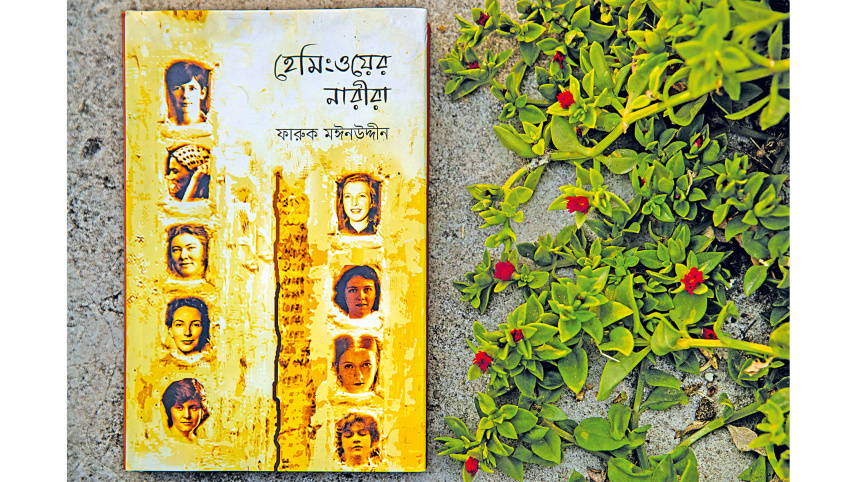
Some books announce their ambition quietly. Others reveal it at a glance. The book Hemingway’s Women: In Love and Hate, Life and Literature by Faruq Mainuddin belongs to the latter kind. Even before one turns to the first chapter, the architecture of the book suggests a carefully composed literary journey rather than a conventional biography.
The chapter titles themselves read like fragments of a long, unfinished poem. “First Love”, “The First Novel After the Second Love”, “No Passage Beyond the Breaking”, “A New Dwelling in the Web of New Love”, and “A Fragile Astonishment”. Each heading hints at passion, rupture, longing, and reinvention. They do not merely map the chronology of Ernest Hemingway’s life; they evoke its emotional weather. Through these titles alone, one senses that Mainuddin is not interested in presenting a dry record of dates and marriages, he is tracing the restless pulse of a writer whose life was as dramatic and conflicted as his fiction. What makes the structure even more compelling is its subtle intertextual resonance. The naming and literary sensibility suggest that the writer approaches Hemingway not only as a scholar but as a creative writer shaped by his own literary tradition. Thus, this layered consciousness enriches the narrative from the outset. The result is a biography that seems a bit expansive in scope yet intimate in tone.

Hemingway’s Women begins not with fame, not with glory, but with a wound. A young Ernest Hemingway lies injured in a Milan hospital in 1918, decorated for bravery yet disarmed by love. The opening chapter, centered on Agnes von Kurowsky, sets the emotional blueprint for a life where passion, pride, insecurity, and art would remain inseparable.
Mainuddin’s writing style is clear, unpretentious, and the book avoids sensationalism while never losing narrative energy. It does not rely on overt wit or flamboyance. Rather, it invites the attentive reader to discover its quieter ironies and subtle humour.
Faruq Mainuddin does not approach Hemingway as a distant literary monument. Instead, he brings him down to the fragile terrain of human attachment. Agnes was older, composed, and realistic; Hemingway was 19, intense, and already prone to emotional absolutism. Their brief romance, sustained through letters and illusion, ended with quiet rejection. That early heartbreak did not merely bruise a young soldier. It planted a pattern. Love, for Hemingway, would rarely exist without rivalry, overlap, impatience, or replacement.
The strength of this book lies in how it traces that pattern across the major women in his life without turning the narrative into gossip. Mainuddin places each relationship within its emotional and creative context. Hadley Richardson is shown not only as the devoted first wife but as a stabilising presence behind The Sun Also Rises (Scribner, 1926). Pauline Pfeiffer is placed alongside the creation of A Farewell to Arms (Scribner, 1929), her own words revealing both resignation and irony about loving a man who fell in love repeatedly. Martha Gellhorn appears not simply as a spouse but as an intellectual equal whose presence shadows For Whom the Bell Tolls (Charles Scribner’s Sons, 1940).
One of the most compelling sections examines Hemingway’s long and turbulent involvement with Jane Mason. Their intimacy, stretching over several years, ended in rejection that cut deeply into Hemingway’s pride. Mainuddin carefully connects this emotional injury to its fictional echoes. In To Have and Have Not (Charles Scribner’s Sons, 1937), the characters Tommy and Helen Bradley bear a striking resemblance to Jane and her husband Grant Mason. The portrayal is sharper, almost vindictive. Through these parallels, we witness not just artistic transformation but the author’s wounded ego and possessiveness finding narrative form.
A major achievement of the book lies in its ability to humanise Hemingway without excusing his faults. Mainuddin’s Hemingway is not merely a victim of his upbringing, fame, or war trauma. He is a man often unwilling to accept strong women, frequently insecure, and sometimes emotionally manipulative. And yet, he is also sensitive, passionate, and fiercely loyal, if only briefly. Mainuddin shows how Hemingway’s bipolar tendencies, alcoholism, hunger for danger, and need for validation intersected with his romantic life. The women were not mere companions; they were catalysts, critics, muses, rivals, and sometimes mirrors. Their presence shaped tone, theme, and temperament in his writing.
In reading Hemingway’s Women, one realises that Hemingway’s literary landscapes—war zones, bullrings, African plains—were never free from emotional undercurrents rooted in real relationships. The personal and the artistic were intertwined to the point of inseparability. His loves were often incomplete, sometimes overlapping, frequently restless. Yet from those fractures emerged some of the most enduring works of twentieth-century literature.
Faruq Mainuddin’s achievement lies in presenting this complicated emotional mapmaking with clarity and restraint. He restores depth to the women who stood beside, behind, and sometimes against Hemingway. In doing so, he allows readers to see not only the celebrated writer but the vulnerable, impulsive, and often conflicted man whose art was inseparable from his affections. It is really great to observe its balance. Mainuddin neither glorifies nor condemns. He is well suited to this task. In this book, his combined expertise as a storyteller and researcher is on full display. He not only interprets Hemingway but also presents the women as complex, resilient individuals who defy the one-dimensional roles they are often assigned in literary histories.
Mainuddin’s writing style is clear, unpretentious, and the book avoids sensationalism while never losing narrative energy. It does not rely on overt wit or flamboyance. Rather, it invites the attentive reader to discover its quieter ironies and subtle humour. Above all, it recognises that Hemingway’s life, filled with romance, ambition, trauma, and self-destruction, needs no overstatement. It only needs careful telling.
For general readers, the book offers a fascinating portrait of a literary icon seen through the prism of his relationships. For serious students and researchers, it opens pathways for deeper exploration. Throughout the book, one understands that this is not merely a book about Hemingway’s women. It is, in essence, a portrait of Hemingway himself, reflected through love and conflict, tenderness and rupture, life and literature.
Safiul Azam Mahfuz is a poet and translator.
 For all latest news, follow The Daily Star's Google News channel.
Comments