


Boishakh in fragments: Food, storms, and memory
Pohela Boishakh, the first day of the Bangla calendar, arrives each year not just as a date but as a declaration of renewal, identity, and collective joy. In Bangladesh, it is a day when the ordinary rhythm of life gives way to something more vibrant, more deliberate. Streets fill with colour, the air thick with anticipation and the steady hum of celebration. Though it is almost upon us, life in London carries on as usual.
Despite having lived in Bangladesh for a brief period during my childhood, I realise that, growing up, Pohela Boishakh celebrations were not as big as they are nowadays. Too young to be allowed to go, the scene unfolds in my imagination—people dressed in red and white, gathering beneath the banyan tree in Ramna Park. There is the morning light of a new dawn, the sound of a harmonium and Rabindra Sangeet among the many songs being performed. The songs carry with them a sense of continuity, a bridge between past and present. It is not just a performance but a ritual, one that binds generations together in a shared cultural language.

There is a tendency to become nostalgic about the smallest of things, and nostalgia can be a powerful emotion. It has a way of weaving itself into memory, quietly colouring moments. Memories themselves have a way of appearing unbidden, never seeking consent. I find myself treasuring my memories, guarding them in case they slip away. A song drifting from a shop doorway, the familiar smell of someone’s deshi cooking as I walk down the street, the soft haze of a misty morning—and suddenly I am somewhere else, transported to another time, to another place. I often wonder whether my childhood memories of Pohela Boishakh are snapshots in time, blurred at the edges, or borrowed memories from snippets of conversation or old photographs, my mind filling in the gaps.
In London, the celebrations are smaller and more intentional. They are arranged around busy schedules, often taking place in someone’s home rather than out in the open. There is food, music, and conversation—familiar elements, but quieter and on a smaller scale. There is a different kind of intimacy here: a sense that the celebration exists because we must make space for it, all of us gathering to recreate something of what we remember.
Over the years, with friends having moved away and my children having grown up, there is a lessening of the flurry of activity, the excitement less palpable. I miss going to the Boishakhi mela that takes place in May, around the Brick Lane area in East London, famously dubbed ‘Bangla Town.’ The first time I went was 20 years ago. I took my children because I wanted them to experience Pohela Boishakh for themselves instead of a second-hand retelling.
We arrived just as the procession began, instantly greeted by the rhythmic pulse of musicians and the graceful movements of dancers making their way through the crowd. Among the highlights was a large metal tiger float, followed closely by children wearing colourful tiger masks and waving Bangladeshi flags. The atmosphere grew even more vibrant with a couple dressed in traditional bridal attire, perched atop a rickshaw. As the procession gradually wound down, our focus shifted towards the stage in an adjacent field, where an eclectic line-up of performances awaited. The sounds of Bangla rock reverberated through the air, followed by Bollywood melodies, energetic bhangra, and innovative East–West fusion. The scent of festival food mingled with the music, while the swirl of costumes and lights added to the sensory richness. This diverse entertainment reflected the festival’s inclusive spirit, appealing not only to the Bangladeshi community but also welcoming a broader audience eager to immerse themselves in the rich tapestry of culture and celebration.
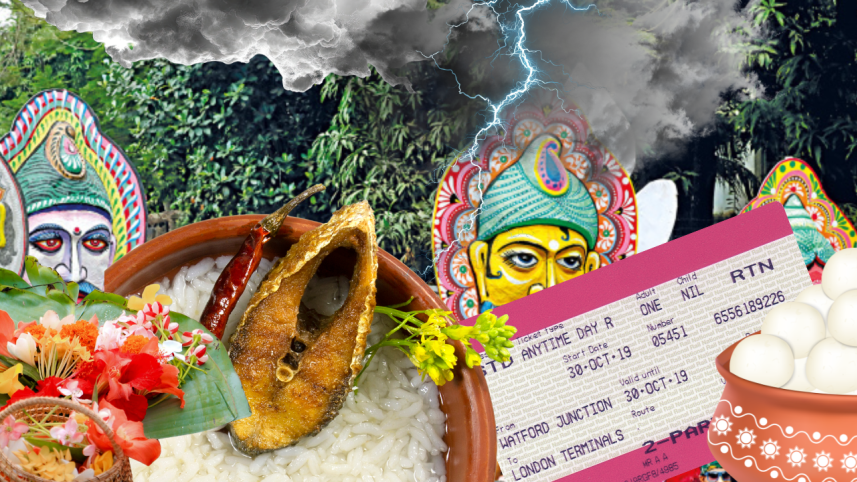
The last time I celebrated Pohela Boishakh in Bangladesh was in 2019. Dhaka is always bustling, but even the streets had a different energy. The intricate designs of the alpona painted on the long stretch of Manik Mia Avenue leading to the Jatiyo Sangsad Bhaban were a sight to behold. I had been invited to a lunch organised by friends, and I felt like a child once again, rummaging through my mother’s wardrobe and wearing her off-white jamdani saree with red motifs, and slipping matching bangles onto my wrists. What I remember most is the food—a spread of several types of bhorta, panta bhat, fried hilsa served with green chillies and onion, and more dishes than memory can do justice to. The food was presented in clay bowls and pots, others on banana leaves. My eyes were definitely bigger than my stomach by the time the mishti was served. For a moment, it felt as though memory and reality had quietly met.
Kalboishakhi jhor came early that year, reminding us of the rawness and power of nature. I remember, as a child, waiting for the storm to appear—the sudden stillness in the air, the dimming of the light before the sky darkened. I would hear the distant rumble of thunder, windows being shut, and the scraping of veranda furniture dragged inwards. I would curl up in one of those chairs, watching. The wind would be hesitant at first, like a gentle warning. What followed was never gentle. The storm swirled and roared, bending trees into impossible shapes, the rain cleansing the world around me. If I stood close enough to the edge of the balcony, I could feel it cool against my skin. It was like a primal dance. Then, almost as suddenly, it would stop, the sharp earthy smell rising from the ground. There was always a strange sense of exhilaration. But nowadays, I see it differently. I had never thought of the devastation Kalboishakhi brought in its wake. I now see it as a lesson, reminding us of the power nature holds over us.
Like the Kalboishakhi storms I remember from childhood, Pohela Boishakh arrives differently now—quieter but still carrying with it a sense of renewal. Perhaps what remains is not the celebration as it once was, but the feeling it leaves behind. A sense of belonging that surfaces in unexpected moments, in memory and in ritual, however small. And though it may look different now, it is still, in its own way, a beginning.
Nadia Kabir Barb is a British Bangladeshi writer and journalist whose work has been published in international literary journals and anthologies. She was longlisted for the 2021 Bridport Prize Peggy Chapman-Andrews First Novel Award for Walk In My Shadows.
 For all latest news, follow The Daily Star's Google News channel.
Comments