


Baishakhi Shobhajatra turns vibrant this year
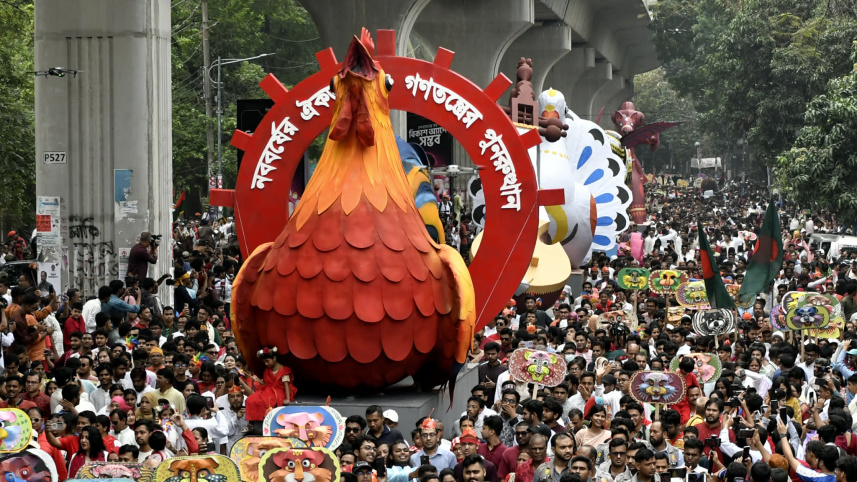
After years of disruption due to the Covid-19 pandemic and repeated overlaps with Ramadan, this year’s Baishakhi Shobhajatra, held under a new name, unfolded in full vibrancy, drawing a turnout not seen since 2020.
The rally, formerly known as Mangal Shobhajatra, was cancelled in 2020 following the outbreak of the coronavirus pandemic in March, and again in 2021 as part of public health precautions.

Although the procession resumed in 2022, subsequent festivities coincided with the holy month of Ramadan -- a trend that continued through 2024 -- resulting in comparatively lower public participation. Last year, the rally was held a day after Eid-ul-Fitr, when many residents had already left Dhaka for the holidays, further affecting turnout.
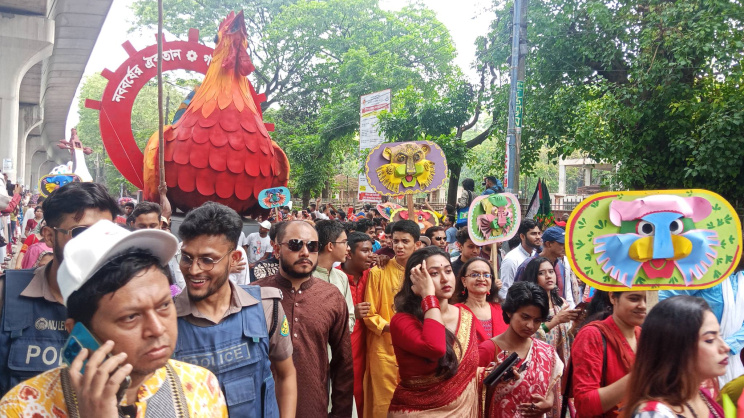
“We are actually getting to witness the real vibrancy of this rally and its huge participation for the first time, despite being a student of this university. It had not regained its vibrant character over the past few years,” said Muntaha Rahman Manami, a third-year student of Dhaka University and an artcraft contributor to the event.
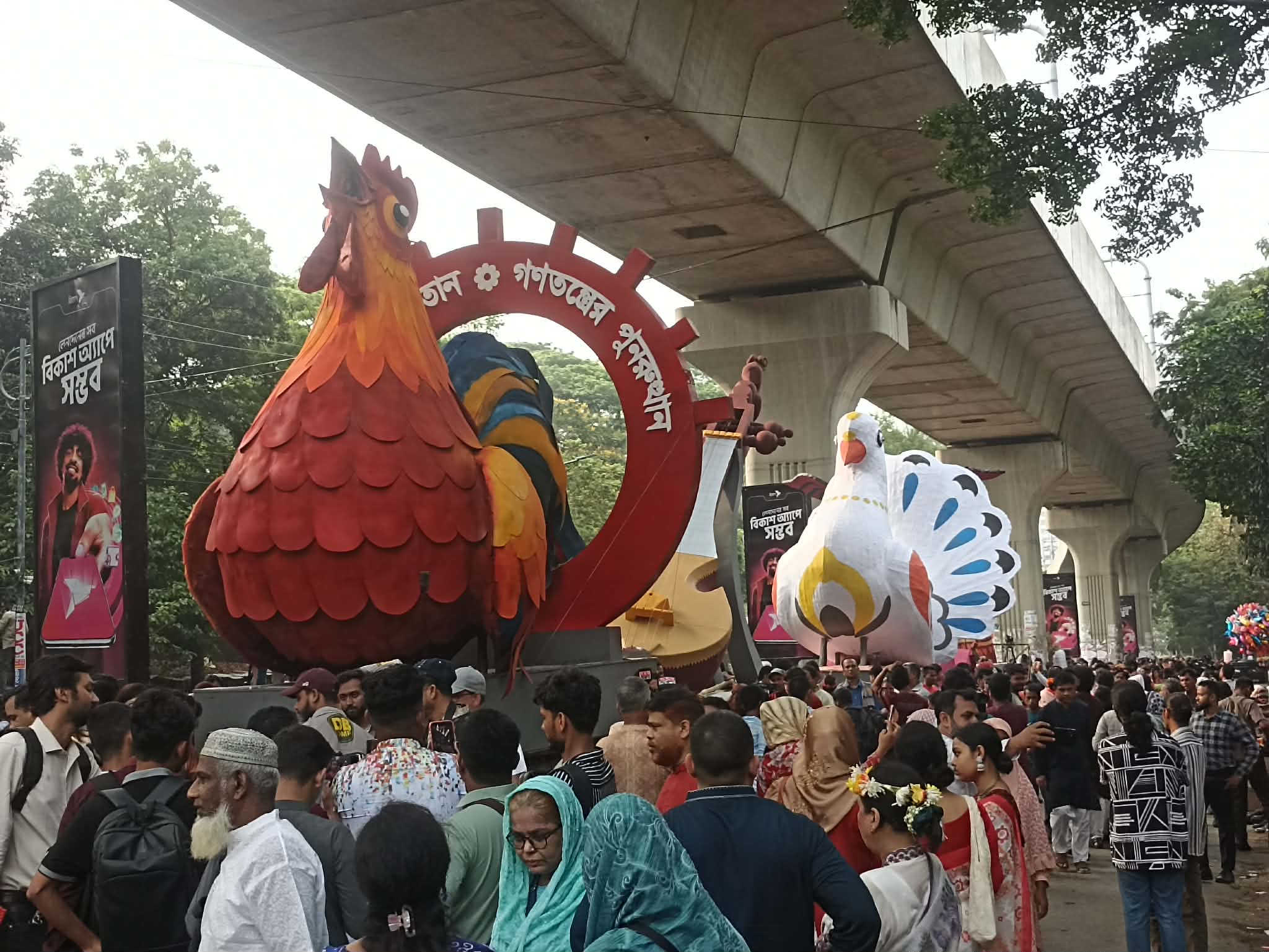
This year’s shobhajatra featured five large representational motifs reflecting the country’s democratic resurgence alongside its rich heritage and traditions.
With the theme “Nababarsher Oikkyotan, Gonotontrer Punorutthan,” organisers crafted elaborate motifs, masks, and a 150-page-long potochitra. The five major motifs -- a rooster, an elephant, a pigeon, a dotara (a traditional Bengali string instrument), and a horse -- were carried through the colourful procession.
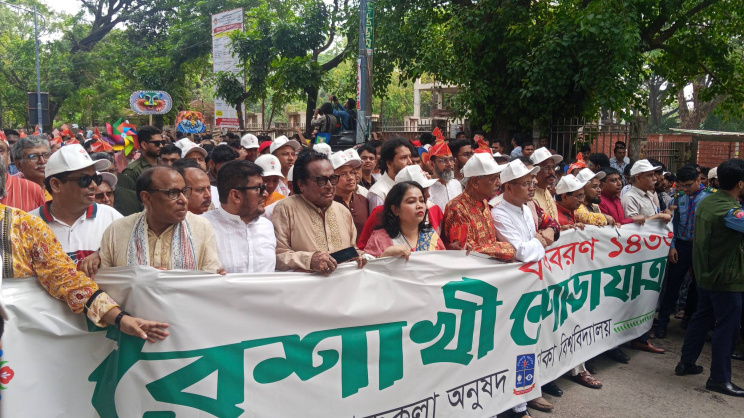
The rally began at the Faculty of Fine Arts following the national anthem. It proceeded under tight security, led by horse-mounted police, followed by units from the Detective Branch (DB), SWAT, and Rapid Action Battalion (Rab). A bomb disposal unit also accompanied the procession to ensure safety.
Among the motifs, the rooster -- topped with a circular structure symbolising the rising sun -- led the procession. At one point, the large structure briefly got stuck while passing beneath the metro rail near TSC. The crowd erupted in cheers when it successfully moved through.
The other major motifs followed in sequence, spaced apart, while participants carried placards and wore colourful masks depicting animals such as tigers, owls, and rabbits.
The procession began from Gate 3 (north) of the Faculty of Fine Arts and proceeded towards Shahbagh Police Station, where it took a U-turn. It then moved past Raju Sculpture and the TSC premises on the right, continued through Doel Chattar and in front of Bangla Academy, before returning to the Faculty of Fine Arts, where the procession concluded.
 For all latest news, follow The Daily Star's Google News channel.
Comments