


The man behind 'Inquilab Zindabad'

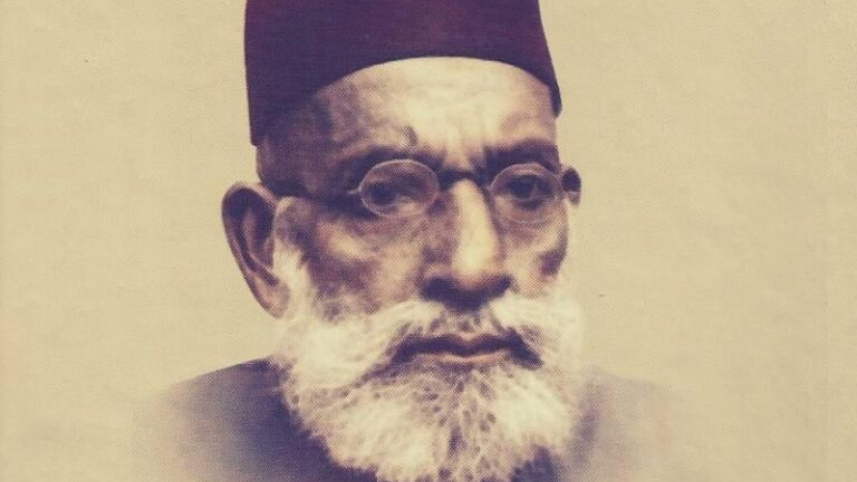
There are men whose lives fit neatly into categories, and then there are those who dissolve them.
Maulana Hasrat Mohani belonged to the latter class.

He was at once a tender romantic and an unflinching revolutionary, a man who could weep quietly into the night and, by daylight, coin a slogan that would shake the throne.
Poetry and politics, often imagined as estranged cousins, found in him a shared bloodstream.
Born on January 1, 1875 as Syed Fazal-ul-Hasanin Qasba Mohan of Unnao district in Uttar Pradesh, he adopted “Hasrat” as his pen name and carried the name of his birthplace as a badge of identity. The result was Hasrat Mohani, a name that would come to signify both lyrical finesse and political defiance.
His early education culminated at Aligarh, where his intellect sharpened into dissent.
Even as a student, Mohani showed little patience for submission.
By 1903, the British Raj had already identified him as troublesome enough to be imprisoned.
Jail, however, did not quieten him. It merely refined his resolve.
After graduating, Mohani launched Urdu-e-Mualla from Aligarh, a magazine that refused to bow before imperial sensitivities.
Its pages carried critiques of colonial policy and moral indictments of injustice, written with a clarity that alarmed the authorities.
The magazine was banned. Mohani was jailed again in 1907. Yet suppression only confirmed the potency of his method. He had discovered that words, when sharpened by conviction, could travel farther than any weapon.
He went to prison again in 1925, but captivity never managed to tame his spirit.
Inquilab Zindabad: A slogan becomes destiny
In 1921, Hasrat Mohani coined a phrase that would outlive governments, borders and generations: “Inquilab Zindabad” -- Long live the revolution.
It was a simple pairing of two words, yet together they formed a declaration that was both promise and provocation.
Bhagat Singh would later shout it into immortality, but its genesis lay in Mohani’s belief that freedom was not a request but a right, not an event but a process.
Across the Indian subcontinent, the slogan became the heartbeat of resistance.
It echoed in courtrooms and prisons, in clandestine meetings and public rallies. It crossed linguistic and ideological lines, available to all who sought justice.
 For all latest news, follow The Daily Star's Google News channel.
 Since the July Uprising of 2024, “Inquilab Zindabad” has re-emerged not as an artefact of history but as a living refrain in Bangladesh.
Chanted in streets and campuses, it has become a permanent vocabulary of dissent, stripped of ornament and heavy with urgency.
That a slogan coined more than a century ago should still articulate contemporary rage speaks to its rare universality.
Hasrat Mohani did not merely coin a phrase. He gave protest a grammar.
Yet to speak of Hasrat Mohani only as a revolutionary would be to flatten him. His other immortality resides in a ghazal so delicate that it seems almost apolitical at first glance: Chupke chupke raat din aansoon bahana yaad hai.
It is a poem of hushed sorrow, of love remembered in secrecy, of tears shed without witnesses.
There is no clenched fist here, no rallying cry. Only the soft ache of longing and the dignity of restraint.
And yet, in its emotional honesty lies a quiet rebellion.
Mohani expanded the ghazal’s emotional terrain, allowing it to converse with solitude, memory and vulnerability without slipping into sentimentality.
When Ghulam Ali rendered it decades later, the poem shed the page and acquired breath. The ghazal became a companion to heartbreak across continents, a testament to Mohani’s mastery of restraint and resonance.
That the same man who gave the world “Inquilab Zindabad” also wrote these lines is not contradiction but completion.
Hasrat Mohani’s genius lay in his refusal to compartmentalise the self.
Love and liberty were not opposing loyalties but parallel pursuits.
In his collected works, "Kuliyat-e-Hasrat", themes of romance, society, politics and freedom flow into one another, suggesting that private emotion and public struggle draw from the same moral source.
He lived austerely, endured repeated imprisonment, and sacrificed personal comfort for collective cause.
Yet he never abandoned the inner life. His romance was reserved, disciplined, almost ascetic, but it was real.
It informed his politics with compassion and his poetry with courage.
Hasrat Mohani died on May 13, 1951 in Lucknow, leaving behind neither wealth nor office, but something far more durable.
A slogan that still rallies the aggrieved. A ghazal that still breaks hearts with elegance. A life that proves tenderness and toughness need not cancel each other out.
In an age that prefers easy binaries, Mohani remains a challenge. He is the reminder that some words, once spoken with sincerity, refuse to retire.
Comments