


The writ on banning “Mangal Shobhajatra”
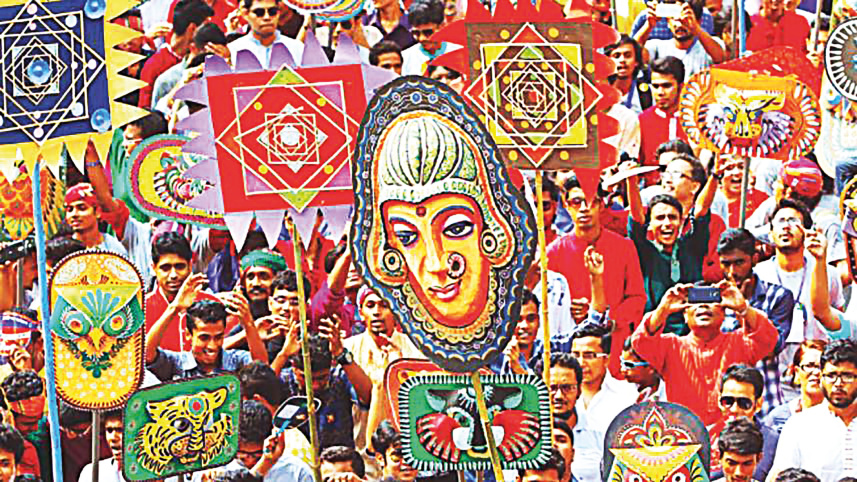
Recently, a writ petition with the High Court Division of the Supreme Court has been filed seeking a permanent ban on “Mangal Shobhajatra” held on Pahela Baishakh. The petition claimed it was offensive to Islamic beliefs, infringed the constitutional rights of the Muslim majority, and threatened communal harmony. Before discussing the merit of the petition, it is worth recalling what “Mangal Shobhajatra” actually is, how it began, and what it represents. Notably this year, “Mangal Shobhajatra” is being organised as “Boishakhi Shobhajatra”. My piece is not about the changes in name, because what is in a name anyway? I would rather discuss its substance because the writ aims for a substantive ban on the procession itself.
Mangal Shobhajatra is an annual procession organised by the Faculty of Fine Arts at the University of Dhaka on the day of the Bengali New Year. It began as “Anondo Shobhajatra” in 1989 as an act of protest against military rule and, over time, has become a defining part of Pahela Baishakh. The supporters of the demonstration say that the masks, folk motifs and large colourful figures carry a language of resistance and renewal. For them, it is a secular expression of Bengali identity, unrelated to any religious ritual. In 2016, UNESCO recognised the procession as intangible cultural heritage. This recognition placed it in a global frame of cultural significance, and therefore, any demand to suppress it must be lawful, grounded in sound logic, and proportionate to the harm it seeks to protect. In contrast, critics of the procession argue that the word “Mangal” has Hindu associations and some imagery used in the demonstration is drawn from non‑Islamic traditions, making the procession incompatible with Islamic norms. However, the objection seems to focus more on the procession’s appearance than on what it actually represents.

It needs to be remembered that the very mechanism of public interest litigation was designed to expand rights, not to shrink them. When a PIL demands the Court to unreasonably restrict freedom of expression (article 39), restrict peaceful assembly (article 37), and narrowly interpret the equality protections (articles 27 and 28) in favour of a religious or ideological reading, the Court needs to review whose interest is in fact at stake.
Now, coming to the current petition, in my opinion, Bangladesh’s constitutional framework can be interpreted to justify Mangal Shobhajatra far more clearly than any justification to ban it. Even though the future of secularism remains contested due to the reforms tabled by the July Charter, the existing constitution still enshrines secularism as a fundamental principle. At the same time, article 39 guarantees freedom of thought, conscience, speech and expression while articles 37 and 38 protect peaceful assembly and association. Since Mangal Shobhajatra is widely understood as a secular celebration of heritage, resistance, and community, it is argued that it falls under the constitutionally protected freedoms of expressive and artistic conduct.
Moreover, article 41 protects the citizens’ right to practice their faith, not the right to curate their surroundings so that nothing challenges their personal comfort. Similarly, Article 2A that recognises Islam as a state religion cannot be used to impose a singular religious view on the masses or suppress secular cultural practices. Additionally, section 295A of the Penal Code 1860 may also seem relevant as with this section, deliberate and malicious intent to outrage religious feelings is required to be proven. Clearly, the mere fact that some of its imagery allegedly resembles Hindu or folk motifs does not, by itself, show malicious intent. In the broader Bengali cultural context, traditions and symbols have long been shared, adapted and overlapped beyond the ambit of organised religions. In any case, a nationwide ban would almost certainly fail the proportionality test, given its far‑reaching impact on freedom of expression, assembly and cultural rights.
Similarly, at first glance, it may seem the petition is maintainable. Under the Dr Mohiuddin Farooque v Bangladesh (1996) case, the Supreme Court expanded the scope of locus standi in entertaining public interest litigation. However, it needs to be remembered that the very mechanism of public interest litigation was designed to expand rights, not to shrink them. When a PIL demands the Court to unreasonably restrict freedom of expression (article 39), restrict peaceful assembly (article 37), and narrowly interpret the equality protections (articles 27 and 28) in favour of a religious or ideological reading, the Court needs to review whose interest is in fact at stake.
Clearly, a permanent ban would not just cancel an annual procession. It would redraw the boundaries of constitutional freedom; it would make articles 37 and 38 negotiable. Most dangerously, it would allow the sensitivities of the majority to dictate what survives in the public space, systematically erasing secularism and equality in the process.
In my understanding, the writ is less about faith and more about exercising power. The majority, by definition, already occupies the dominant space. The presence of something outside its preferred worldview feels like an intrusion, even when it is not. And therefore, discomfort is viewed as danger, disagreement as insult, and coexistence as threat.
The writer is law graduate from the University of Dhaka.
 For all latest news, follow The Daily Star's Google News channel.
Comments