


Election songs reshaping Bangladesh’s 13th Parliamentary Election

For the first time in over a decade, election songs have become a genuinely diverse cultural phenomenon. They are no longer simply tools played on loudspeakers at roadside rallies. They have crossed into weddings, social gatherings, reels, and everyday listening. Election Commission data, derived from Al Jazeera, shows that 43.56 percent of voters fall between the ages of 18 and 37, many of them first time voters who carry the memory and energy of the July 2024 uprising. According to the Bangladesh Telecommunication Regulatory Commission, the country had roughly 130 million internet users as of November 2025, accounting for nearly 74 percent of its population. In this landscape, a catchy four-line hook can travel faster than any rally speech, and the election songs of 2026 are proof of that.
Understanding why this election season sounds so different requires some context. The previous three national elections were marked by irregularities, opposition boycotts, and a political mood that suppressed genuine democratic competition. The student-led uprising of July 2024, which brought down Sheikh Hasina and led to an interim government under Muhammad Yunus. For many, particularly the young, this election feels like a real chance to participate in democracy after years of hollow exercises. That energy has found its way into the music.

The songs of 2026 carry references to the July uprising, promises of accountability, and appeals to a national identity that goes beyond any single party.
They are also, for the first time in meaningful numbers, being made with digital platforms in mind, because that is where the voters, they are trying to reach spend most of their time.
Bangladesh Nationalist Party’s (BNP) official theme song, built around the lyrical hook “Vote dibo kishe? dhaner shish e” (How will I vote? On the sheaf of paddy), is a good place to begin. The structure is a question and an answer. The sheaf of paddy is BNP’s election symbol, but the song does not simply announce it. It frames the act of choosing BNP as a natural response, as though the listener arrived at the decision on their own. The visuals reinforce this. Rather than showing party leaders or political rallies, the video paints a portrait of Bangladesh itself: its landscapes, its rivers, and its people across many occupations, from farmers and garment workers to students and indigenous communities. The word “dhaner shish” also carries deep cultural weight. Paddy is not just a crop; it is a symbol of Bengali identity and livelihood. By anchoring the vote to this image, the song connects the act of choosing to something far more fundamental than politics. For younger voters, the tune is short and catchy, while the inclusion of students and young people in the visuals signals that BNP sees the youth as part of a larger national story.
The National Citizen Party, which emerged directly from the July 2024 student movement, has taken a markedly different approach. Its theme song grounds itself in cultural imagery: ox carts, children at play, festivals, and scenes of everyday life. The most telling moment in its lyrical strategy is the self-identification as “moddhomponthi”, meaning middle path or centrist. It tells younger and reform minded voters that NCP is not a continuation of any old party but something genuinely new. The song references the July uprising directly, positioning the party as something the uprising itself made possible. The cultural visuals work alongside this: they say that NCP is not only about change but also about honouring what Bangladesh already is, which is an emotionally sophisticated position for a young party to hold.
Bangladesh Jamaat-e-Islami’s song “Dekhe Dekhe Kete Gelo Bela” has arguably been the most viral of the season. The lyrics are layered in a way that most election songs are not. The line “Nouka, dhan er shish, langol dekha shesh; daripalla ebaar gorbe Bangladesh” (The boat, the sheaf of paddy, the plough -- seen enough of them. Now Bangladesh will rise under the banner of the scale) names the election symbols of every major party: the boat for Awami League, the sheaf of paddy for BNP, the plough for Jatiya Party. It then declares that the time for watching these symbols govern is over. The scales, Jamaat’s own symbol, are positioned as the new chapter. The line “Khela j cholche kon level a” deserves particular attention. Here, “khela” does not simply mean a game in the casual sense. It refers to the political game itself, the web of complexity, manipulation, and behind the scenes dealings that have defined Bangladeshi politics for years. The song uses this word to ask a blunt question: how deep does that game actually go? It is a lyrical way of naming corruption and political dishonesty without spelling them out.
Artificial Intelligence has been used while composing many of the songs for some parties and many individual candidates. While this made production faster and cheaper, it has raised serious concerns among musicians and creators in Bangladesh.
For professionals in the music industry, AI in composition is not a step forward, but a threat. It bypasses the work of composers, arrangers, and producers who have spent years building their craft.
These individual candidates reveal yet another layer of how political communication is evolving. Ishraque Hossain’s song weaves English phrases like “No fear, no lie” and “Power of youth” into Bangla lyrics. In urban Bangladesh, particularly among educated young people, English words have become markers of cosmopolitanism and confidence. The phrases chosen are the shorthand vocabulary of youth politics: truth, courage, and generational power. Tarique Rahman’s “TR 17” goes further still, packaging its message inside a DJ banger, a genre associated with club culture and youthful energy. The effect is to make political participation feel less like a duty and more like something exciting. “TR 17” itself functions almost like a brand name, blurring the line between a political campaign and popular culture marketing.
When these songs are placed side by side, a collective pattern becomes visible. Each party and candidate have chosen a different register of language, a different visual story, and a different emotional tone, but all of them are designed for the same environment: the infinite scroll of social media feeds.
BNP speaks in warm, colloquial Bangla and shows the nation at work. NCP speaks in the language of cultural beauty and revolution. Jamaat-e-Islami speaks in dense, layered verse and uses technology as part of its message.
The individual candidates speak in the bilingual shorthand of a generation raised online. Each choice is a calculated response to who the audience is and what will make them listen.
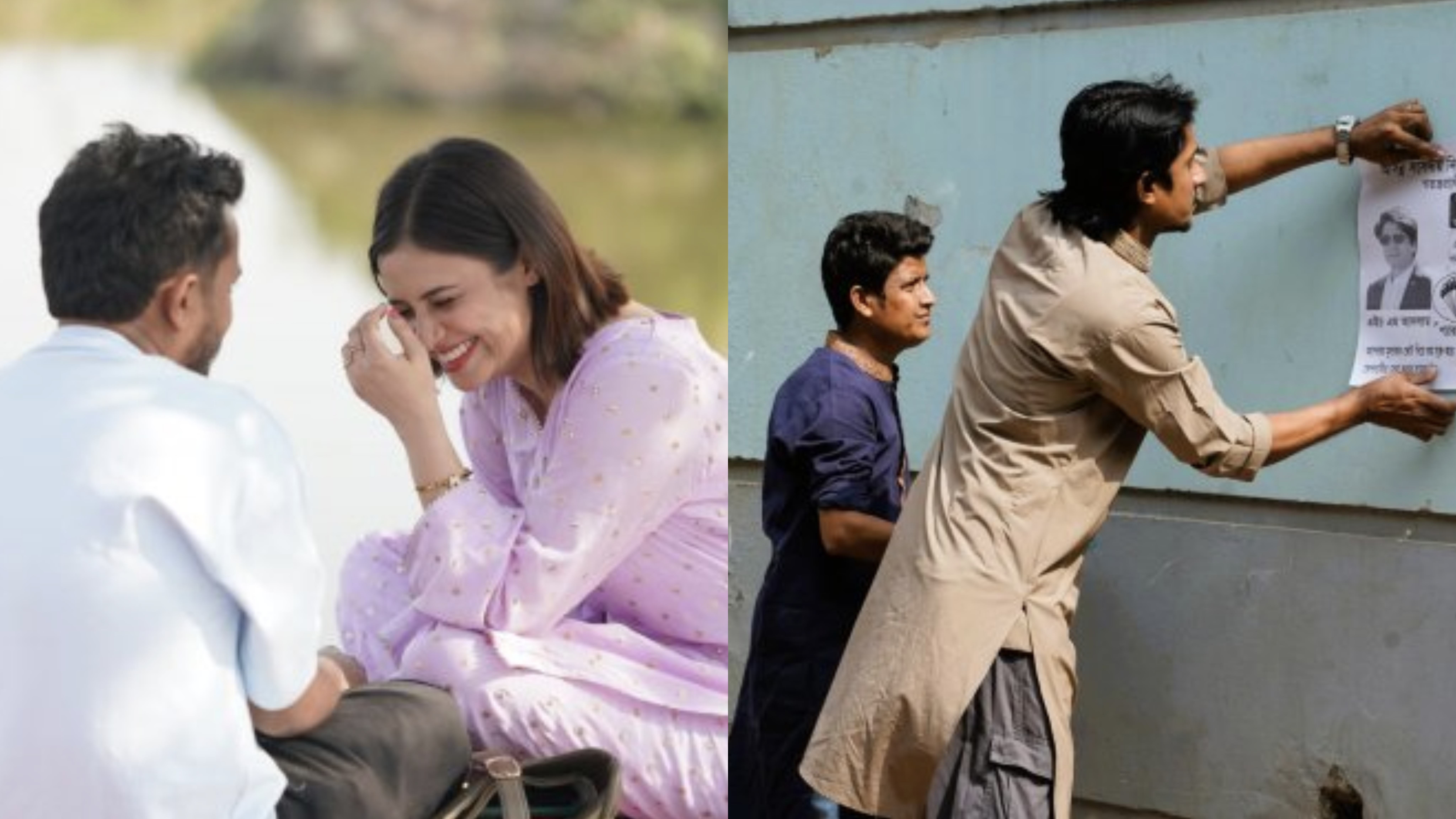
History suggests that the popularity of election songs does not necessarily predict electoral outcomes. Many previous songs continue to circulate among young people even after political shifts. What remains is not the result, but the rhythm, memory and emotional imprint.
This year’s election songs underscore how politics increasingly intersects with culture, technology and identity. Whether through folk nostalgia, AI-generated tunes or bilingual DJ anthems, parties are competing not just for votes, but for attention, emotion and cultural relevance.
 For all latest news, follow The Daily Star's Google News channel.
Comments