


Predicting landslides through rainfall
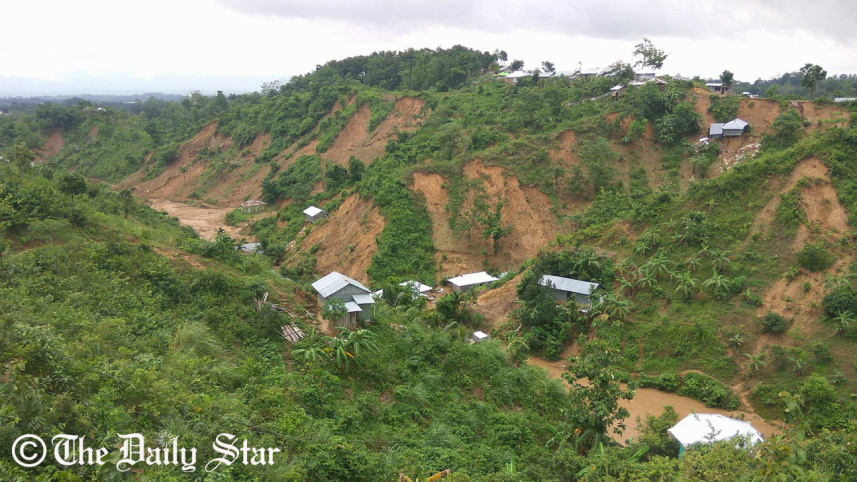
Lal Tha Zual, a young volunteer from Bandarban's Faruk Para village, alerted the people of his village of a potential landslide on September 2, after predicting it by applying a technique that she learnt last year.
She asked her neighbours not to go to certain areas in the following two or three days where they used to go regularly for hill farming.

The secret to this accurate prediction was measuring the amount of rainfall in her region using a rain gauge for seven straight days. Zual learned this technique under an initiative to disseminate this knowledge.
She shared the story at a workshop on landslide early-warning systems held at the multipurpose hall of Department of Disaster Management yesterday.
Around 65 such altruists were trained by local organisations Tahzindong and Bolipara Nari Kalyan Somity (BNKS) under the "Sokkhomokta" project in six areas of Bandarban and Lama upazilas.
Funded by USAID, Caritas Bangladesh, in collaboration with Catholic Relief Services (CRS), is conducting the project, which started in 2020.
This is reportedly the first community-based early warning system in the country, where volunteers go door-to-door to alert people and evacuate them from landslide-prone areas when they sense the possibility of its occurrence. If it rains more than 100 millimetres a day, more than 250 millimetres in three days, or more than 350 millimetres in seven days, there is a risk of landslides.
Caritas Bangladesh's Head of Disaster Management Alexander Tripura and Department of Disaster management's Director General Atiqul Haque spoke at the event among others. The event was presided over by Netai Chandra Dey, director (MIM) of Department of Disaster Management.
 For all latest news, follow The Daily Star's Google News channel.
Comments