


Dhaka drowned, gridlocked
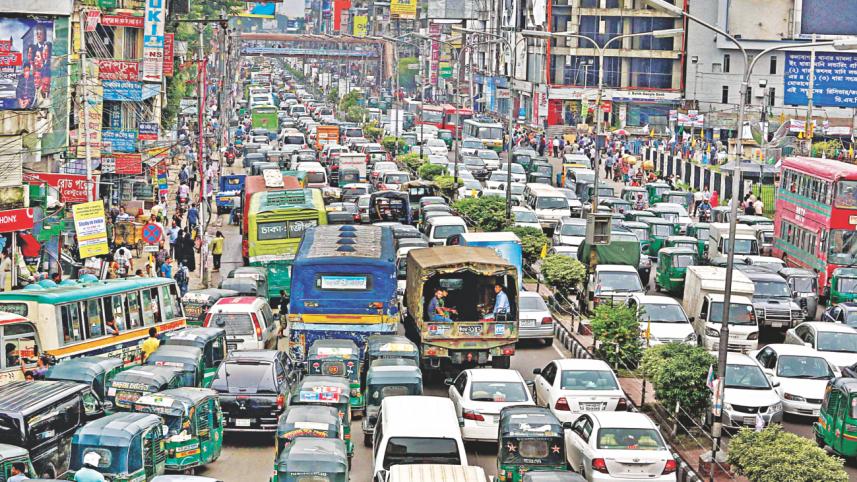
Just a few hours' rain, and the city's traffic system went haywire yesterday, causing immense public sufferings.
The downpour along with a heavily overcast sky and occasional thunder and lightning started around 7:00am when students, officegoers and day labourers set out for their destinations.
 For all latest news, follow The Daily Star's Google News channel.
 It continued until 11:00am intermittently, but the situation worsened gravely for the Gulshan and Baridhara people after police restricted traffic movements in the area to facilitate Prime Minister Sheikh Hasina's passage for inauguration of Police Plaza Concord Bhaban near the National Shooting Complex at Gulshan-1 at noon.
As a result, motorists and commuters got stuck in long tailbacks on rain-submerged roads for hours.
Experts and town planners blame this on unplanned urbanisation, poor traffic management and inadequate drainage system in the city of about 16 million people.
The Met office termed the first monsoon shower "normal" -- just 64 millimetre of rain from 6:00am to 6:00pm yesterday.
Meanwhile, five people died in a trawler capsize in a Bhola river swelled by the rain while the Barisal river port authorities suspended operation of small launches following warning of bad weather by the Met department.
THE SUFFERING
"It took me three and a half hours to go to Farmgate from Bashundhara Residential Area through Gulshan and Tejgaon. It usually takes an hour," said Riazul Kamal, a private service holder.
"At one point, I felt like getting down from my car and start running," he added.
Shamsul Arefin, another sufferer, said it took him an hour to get to Gulshan Avenue from his house on road 137 in Gulshan and two and a half hours to reach his office at Karwan Bazar.
It should not take more than 45 minutes, but things got real awful yesterday due to the rainwater and the restrictions on vehicular movement for the PM's programme, he added.
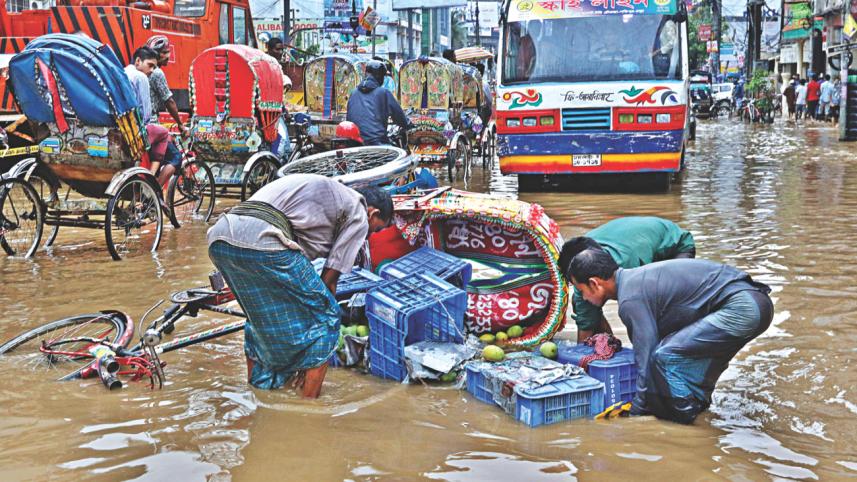
Schoolchildren, many of whom had exams, and women were seen negotiating dilapidated roads and footpaths smeared with filth.
Many got down from public and private transports and walked home and workplace.
Traffic police stood helpless at many intersections while some were grappling with the overwhelming traffic mess all over.
Commuters on most of the city roads in Rajarbagh, Malibagh, Shantibagh, Mirpur, Dhanmondi, entire Old Dhaka, Badda, Bashundhara Residential Area and Tejgaon and key thoroughfares, including Kazi Nazrul Islam Avenue, Gulshan Avenue, Hatirjheel and Panthapath, were among the worst sufferers.
The rain also heavily inundated most roads in Kalshi, Shukrabad, Rampura, Paltan, Fakirapool, Kamalapur, Gulistan, Sayedabad and Jatrabari.
Dhaka-Aricha highway too went under rainwater.
COLLAPSE OF TRAFFIC SYSTEM
Prof Shamsul Hoque, who teaches transportation civil engineering at Buet, said waterlogging on busy roads instantly led to tailbacks.
When rainwater inundates parts of the roads due to poor drainage system, motorists, fearing accidents, line up their vehicles on the visible portions of the street. This means, all the vehicles then ply through just one or two lanes, which causes congestion, he added.
Also, rain slows down traffic movement, while many run-down vehicles fail to pass through rainwater and break down because of engine failure, worsening the situation further.
Besides, desperate pedestrians, unable to move on foot because of rain splash and roadside dirt, take rickshaws on the roads already clogged up. This compounds the situation, as it increases the traffic volume and causes friction between motor and non-motor vehicles.
"All this results in an absolute complex situation of traffic standstill," said Prof Hoque.
THE ROOT CAUSE
Town planners have warned the government time and again that unplanned urbanisation would result in collapse of city traffic in the event of even a usual monsoon rain.
But regrettably, no one paid any heed to it, said urban planner Khondaker M Ansar Hossain, who worked on the Detailed Area Plan (DAP) of Dhaka.
Instead, real estate developers have been allowed to indiscriminately earth-fill all the conservable water retention ponds, canals and floodplains in and around the capital, he told The Daily Star.
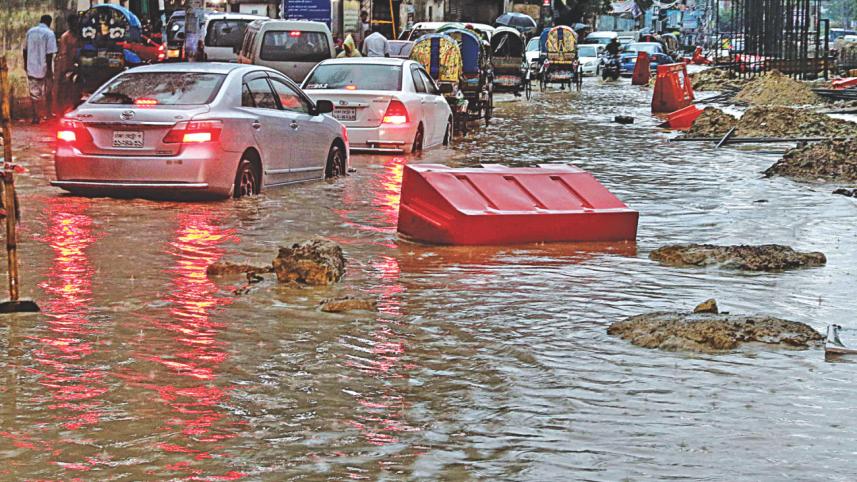
The rainwater was supposed to be carried away instantly to low-lying retention areas through a well-networked drainage infrastructure. But unfortunately, even the slopes of the existing drainage system are out of place.
So it takes hours for rainwater to pass, making city life miserable and damaging roads and vehicles in the meantime, said the town planner.
Comments