


Dhaka lodges strong protest
Terming it a brazen interference in Bangladesh's internal affairs, Dhaka yesterday strongly protested Islamabad's statement on Sunday's execution of two war criminals.
In a three-page protest note handed over to the Pakistan high commissioner to Bangladesh, Dhaka deplored the November 22 statement of Pakistan foreign ministry that expressed "deep concern and anguish" over the execution of war criminals Salauddin Quader Chowdhury and Ali Ahsan Mohammad Mojaheed.
 For all latest news, follow The Daily Star's Google News channel.
 By openly siding with those convicted of crimes against humanity and genocide, Pakistan once again acknowledged its direct involvement and complicity in the mass atrocities committed during Bangladesh's Liberation War in 1971, said the note.
"This perhaps more than explains why the dominant narrative in Pakistan has not only been on a denial mode about the war crimes, crimes against humanity and genocide in Bangladesh, but has also maintained its unrelenting opposition to Bangladesh's efforts to ensure justice and break the culture of impunity for the crimes committed forty-four years ago," it added.
The Daily Star has obtained a copy of the protest note.
Acting Foreign Secretary Mizanur Rahman handed over the note to Pakistan High Commissioner in Dhaka Shuja Alam, who was summoned to state guesthouse Padma yesterday.
The secretary told the envoy to take note of the points raised by Dhaka and bring those to the attention of the authorities concerned in Pakistan.
In the note, Dhaka said the uncalled-for comments were nothing less than a brazen interference in Bangladesh's internal affairs, which was unacceptable.
"The Government of Bangladesh expected that the quarters/authorities in Pakistan would act responsibly and would refrain from continuing such uncalled for statements."
Refuting Pakistan's labelling of the judicial process as "flawed trials", the note reiterated that the verdicts against the convicted individuals had been handed down through an independent, sound, fair, impartial and transparent judicial process, and without any political interference.
The trials took into consideration solely the crimes committed by them and had nothing to do with their political identity or affiliation, it said.
"Pakistan should in no way make biased, borrowed and unfounded comments about the independent judiciary of a sovereign country."
Referring to the misleading reference by Pakistan to the Agreement of 1974, Dhaka said the agreement never implied that the masterminds and perpetrators of war crimes, genocide and crimes against humanity would continue to enjoy impunity and eschew the course of justice.
The note further pointed out it was Bangladesh that consistently advocated regional peace, harmony, reconciliation and integration.
Dhaka also reminded Islamabad that Pakistan has failed to meet its obligation to bring to justice those of its nationals identified and held responsible for committing mass atrocities in 1971, and Pakistan could not escape the historic obligation it owed to the people of Bangladesh as well as to the international community.
"Bangladesh deeply regretted continued malicious campaign by Pakistan against the trials of the crimes against humanity and genocide, and stated that this would not augur well for the friendly bilateral relations between Bangladesh and Pakistan."
On the trials of war criminals by the International Crimes Tribunal, the note said full transparency was maintained in the conduct of proceedings.
"The trials were neither summary nor closed, but were 'open trials' with full access given to the national and international media, relatives of the victims and accused, members of diplomatic missions and research organisations."
It said the Pakistan foreign ministry spokesperson in the November 22 statement referred to Salauddin Quader Chowdhury as a "leader" of the Bangladesh Nationalist Party (BNP), an affiliation he certainly did not have in 1971 since the party itself was not in existence at the time.
"The spokesperson does not mention the political affiliation of Mr Ali Ahsan Muhammad Mujahid, but for the people of Bangladesh what matters is that he was the President of Islami Chhatra Sangha and also the leader of the infamous Al-Badr militia force in 1971."
The protest note mentioned that at the time of the trial Mojaheed held the position of secretary general of Bangladesh Jamaat-e-Islami, which is not registered with the Election Commission as a political party.
Any discerning observer could find some deliberate attempts in the spokesperson's remarks to omit or obfuscate the true identities of the convicted individuals, it said.
According to foreign ministry sources in Dhaka, the Pakistan envoy went to state guesthouse Padma around 2:30pm to meet the acting foreign secretary. The meeting lasted around half-an-hour.
Diplomatic sources said the meeting was originally scheduled to take place at the foreign ministry but the venue was later shifted to the Padma to avoid media attention.
"It could have been embarrassing for the Pakistani envoy, as dozens of TV reporters and other media men lined up at the main gate of the foreign ministry since 12:00noon," a senior official told The Daily Star wishing anonymity.
"Considering the dignity of a foreign envoy, we hurriedly decided to change the venue," said the official.
Learning about the change of the venue, journalists rushed to the Padma, but most of them, especially those of TV channels, could not get any photographs or video footage.
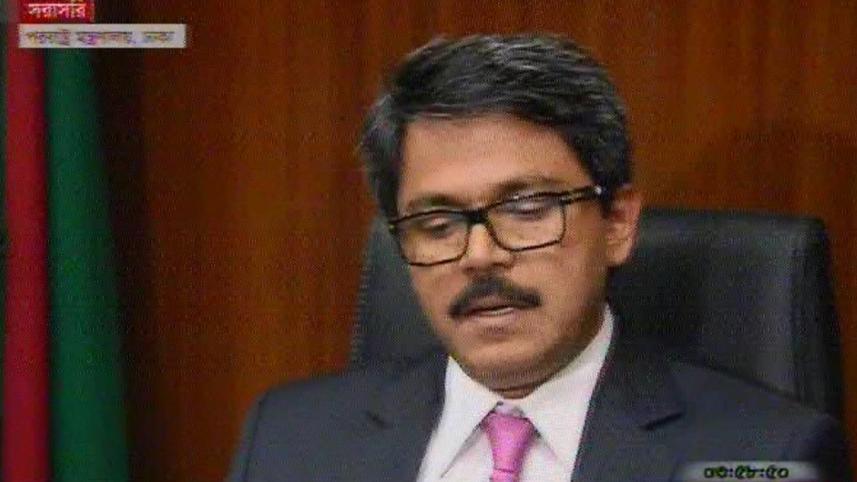
Talking to reporters at his office, State Minister for Foreign Affairs Shahriar Alam categorically said Bangladesh and its 16 crore people are no longer in a position where they will accept any adverse remarks on the war crimes trial.
"From where Bangladesh stands today, we will not accept any negative comments from any country, not only Pakistan, on trials related to war crimes and crimes against humanity," he said shortly after Dhaka formally lodged a strongly-worded protest with Islamabad.
Replying to a query, he said the government was frustrated over Pakistan's statement, as Bangladesh expected that this time no country or organisation would make negative comments on the executions.
The state minister said Pakistan's statement was "beyond diplomatic etiquette".
Bangladesh had no plan to downsize its diplomatic presence in Pakistan following the latest development, he said in response to another question.
Meanwhile, Pakistan Tehreek-e-Insaf (PTI), a political party led by former cricketer Imran Khan, yesterday presented a resolution in the Punjab Assembly "against the hangings of individuals in what it termed the garb of 1971 war crimes", reports Geo TV.
PTI's opposition leader in Punjab Assembly, Mian Mehmood-ur-Rasheed, put forth the resolution which regrets "the execution of individuals who had supported Pakistan in 1971 war".
"These hangings are taking place at the behest of India," the resolution stated.
It expressed sympathies for the families of Salauddin and Mojaheed.
The resolution demanded that the Pakistan government "play its part in preventing Bangladesh from resorting to such cruel practices".
Comments