


Inaction takes its toll
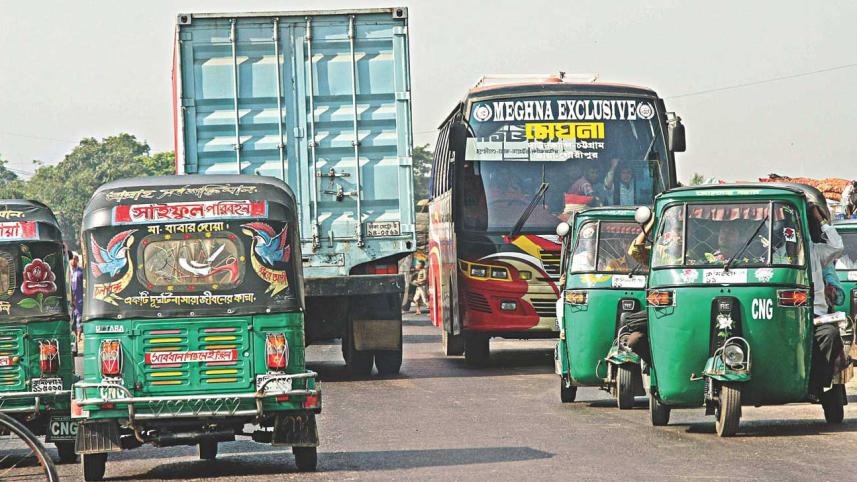
Despite failing to enforce the ban on the slow, illegal, battery-run easy bikes and locally- and foreign-made three-wheelers on national highways, the government yesterday decided to impose another embargo on CNG-run auto-rickshaws on highways.
The new ban could see the same fate as the one imposed five years ago, which had little or no effect.
 For all latest news, follow The Daily Star's Google News channel.
 The slow, cumbersome, and poorly engineered locally made vehicles are often the cause of fatal accidents on highways but the government could not get them off the roads in the five years since it imposed the ban. There has been a lot of talk about how to get them off the highways but hardly any progress was made.
The reality is that the slow and illegal vehicles, locally known as
Easy Bikes, Nosimon, Karimon, Tempo, and Votvoti, run on all roads in the country, disrupting movement of buses, trucks and cars. They fail to follow traffic rules and cause road accidents that claim hundreds of lives every year.
Drivers of buses and trucks face a lot of trouble on highways because of the slow vehicles.
Bipul Kumar, who drives a bus on Dhaka-Tangail highway, said, "Drivers of these vehicles have no clue about traffic rules. They suddenly stop, come on to the highway from feeder roads, and take turns without signalling that cause accidents."
Although police records claim on an average 3,000 people die every year in road accidents, the World Bank says the number is 12,000 and the WHO counts it 18,000, according to statistics of Accident Research Institute of Buet.
The Roads and Bridges Ministry decided to impose the ban on CNG-run three-wheelers yesterday, a day after five people were killed in Sirajganj when such a vehicle hit a bus. It did not decide from when the ban would be effective.
On enforcing the ban, Roads and Bridges Minister Obaidul Quader admitted that he could not execute the decisions for many reasons.
"The steps were taken a long time ago but could not be executed for many reasons. I need cooperation from all stakeholders, including police, administration, lawmakers and party leaders … ," he told The Daily Star.
Sources in the ministry and transport operators say that the previous ban could not be enforced mainly because many ruling party men and policemen are involved in transport business.
In many places, vehicle owners pay ruling party men and police for running the vehicles, they add.
A senior home ministry official seeking anonymity, said, "We are helpless in this. Let alone stopping the illegal vehicles, we are unable to stop their manufacturing in the country."
Records show, the Road Transport Advisory Council in its 33rd meeting on September 21, 2010, decided to ban the slow, unfit, and illegal vehicles. The matter was also discussed in its next meeting on July 11, 2011.
Two other forums -- National Road Safety Council (NRSC) and Cabinet Committee on Road Safety -- also held meetings and discussed the matter.
Minister Obaidul Quader heads all the three forums.
Checking of overloading and punishing drivers for using fake licences or reckless driving are also largely limited to the discussions.
Professor of Buet and former director of Accident Research Institute Shamsul Hoque identified the vehicles as major barriers to ensure safety on highways.
"Besides, most of the drivers of these unregistered vehicles do not have driving licences. So, all these factors impose high risk to people's lives," he told The Daily Star, adding that the vehicles were still plying due to negligence and lack of monitoring of the authorities concerned.
The Roads and Bridges Ministry holds a meeting before each Eid to ensure smooth vehicular movement on the highways.
Stopping the slow-moving and unfit and illegal vehicles on highways and removing roadside structures figure prominently at the meetings.
This year's meeting on June 23, where Minister Obaidul Quader, Railway Minister Mojibul Haq, Shipping Minister Shahjahan Khan and Home Minister Asaduzzaman Khan Kamal were present, decided not to allow rundown and slow vehicles, the same decision as previous years'.
The decisions remain only on paper year after year.
A day before Eid, eight old vehicles broke down on Dhaka-Tangail highway, causing an 80km long tailback and indescribable suffering to thousands of holidaymakers. The gridlock lasted until the morning of Eid day.
Comments