


NBR plans wealth tax revival
- NBR to place FY27 tax proposals before PM
- Revenue authority eyes wealth tax to widen net
- Export incentive tax set to double next fiscal
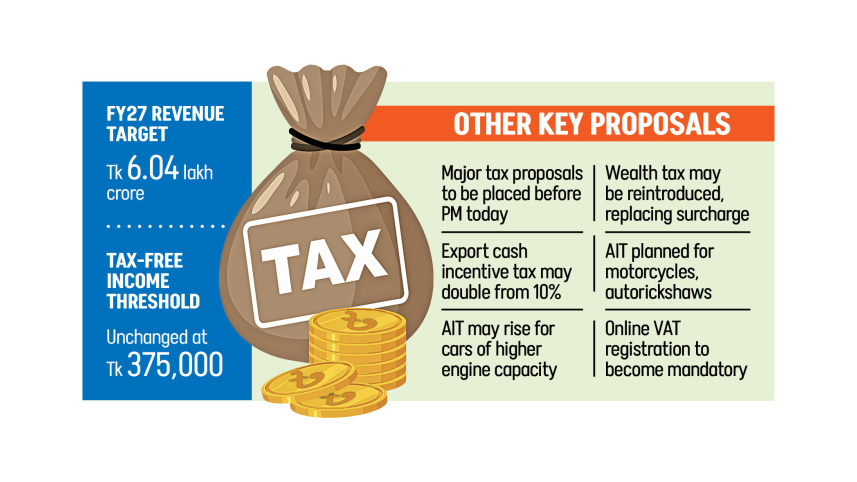
The National Board of Revenue (NBR) is set to place a series of tax proposals before Prime Minister Tarique Rahman today, including reintroducing a wealth tax, doubling the tax on export cash incentives, and imposing a new advance tax on some vehicles in the upcoming fiscal year.
All three wings of the revenue board -- income tax, customs, and value-added tax (VAT) -- are scheduled to present their respective proposals for fiscal year 2026-27.

As part of the proposed measures for the FY27 budget, the revenue authority is considering replacing the existing wealth surcharge with a revised wealth tax to widen the tax net and boost revenue mobilisation amid mounting fiscal pressure.
Initially, the wealth tax would likely be calculated based on net wealth declared in tax returns, as complexities surrounding asset valuation remain a major challenge, officials said.
The revenue authority plans to gradually develop a mechanism to assess assets at actual market value, according to officials familiar with the proposal.
“It will go up to 1 percent. But definitely there will be a cap,” said a top finance ministry official.
He said net wealth of up to Tk 4 crore may remain exempt from the proposed tax, in line with the current threshold for the wealth surcharge.
Under the initial proposal, net wealth between Tk 4 crore and Tk 6 crore could face a 0.25 percent tax. The next Tk 5 crore of wealth may be taxed at 0.50 percent, while another Tk 5 crore could face a 0.75 percent levy.
Any remaining wealth above Tk 16 crore may be subject to a 1 percent tax, according to the proposal under consideration.
The NBR is also planning to raise the tax deducted at source on export cash incentives from the existing 10 percent to 20 percent, according to officials familiar with the discussions.
Besides, the tax authority is weighing a new advance income tax (AIT) regime targeting high-capacity motorcycles, battery-run rickshaws, as well as raising the limit on high-value vehicles.
At the same time, the revenue authority is preparing a set of business-friendly measures aimed at simplifying the VAT system and improving compliance.
Under the proposed changes, all businesses will be required to obtain online VAT registration from the next fiscal year, making the process fully digital.
To encourage compliance, newly VAT-registered businesses may be allowed to pay VAT at a specific concessional amount or under a package VAT system for a certain period, officials said.
The move is intended to bring small and marginal businesses into the formal VAT framework while reducing procedural complexities and harassment.
Officials said the NBR is focusing on expanding the tax base instead of increasing the burden on existing taxpayers.
Meanwhile, the tax-free income threshold for individual taxpayers is likely to remain unchanged at Tk 375,000 for FY2026-27 and FY2027-28.
The NBR will also place a proposal to raise the excise duty-free deposit limit to Tk 5 lakh from the existing Tk 3 lakh.
“If we get the prime minister’s approval, we will proceed with these proposals,” said another top finance ministry official.
 For all latest news, follow The Daily Star's Google News channel.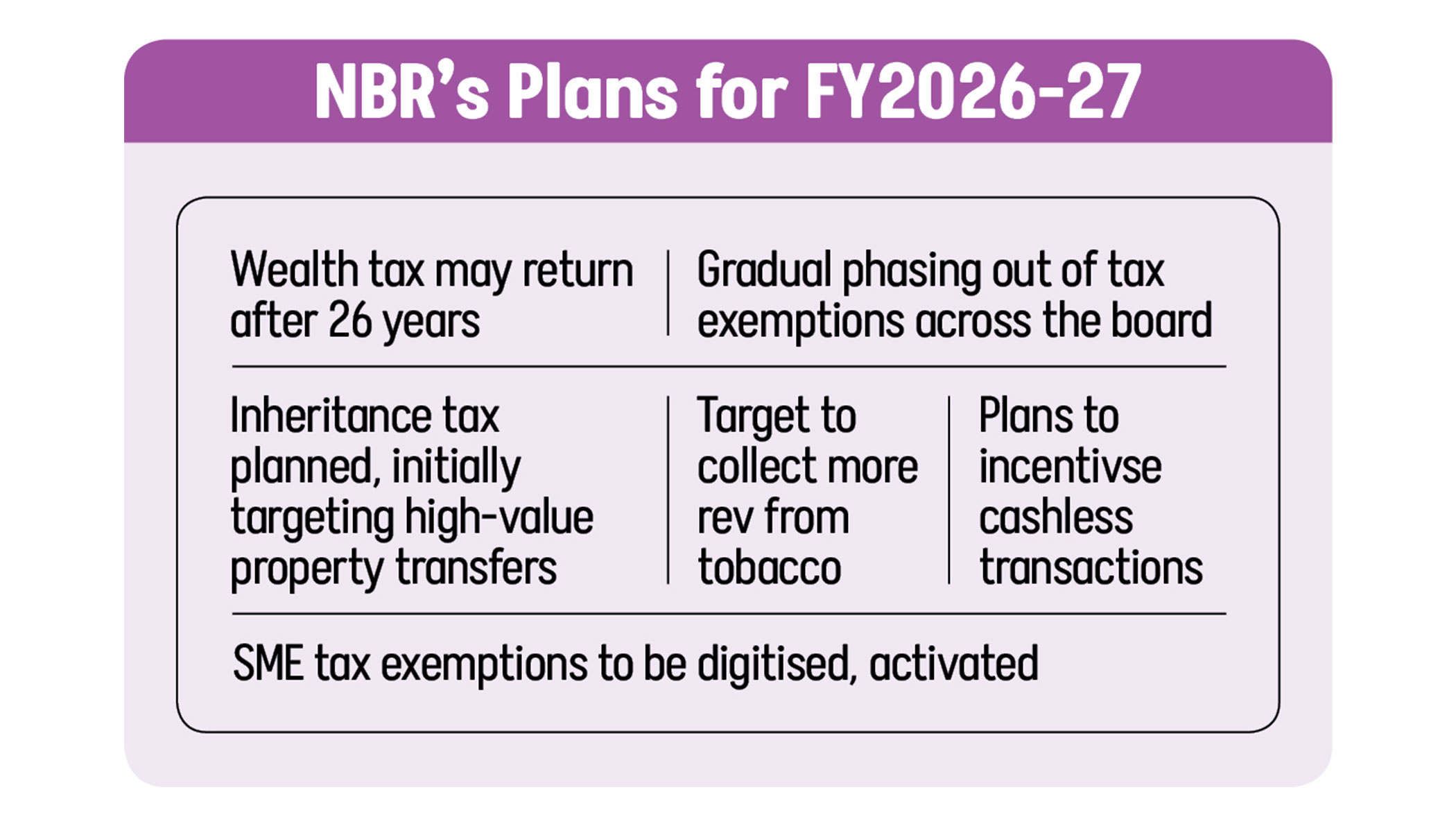
The official said several innovative fiscal measures are being considered for the next fiscal year, with a focus on expanding the tax base by bringing more of the informal sector under taxation.
The proposals come at a time when the NBR is struggling to meet its revenue target. As of March, the revenue shortfall stood at nearly Tk 100,000 crore.
For the upcoming fiscal year, the NBR has been tasked with collecting Tk 6.04 lakh crore in taxes, implying a 21.04 percent growth over the current fiscal year’s original target.
The VAT wing is projected to contribute 51.3 percent of the total NBR target for next year.
The government aims to collect Tk 3.10 lakh crore from VAT in FY27, followed by Tk 2.22 lakh crore from income tax and Tk 67,000 crore from customs duties.
Comments