


PM urges global unity against terrorism
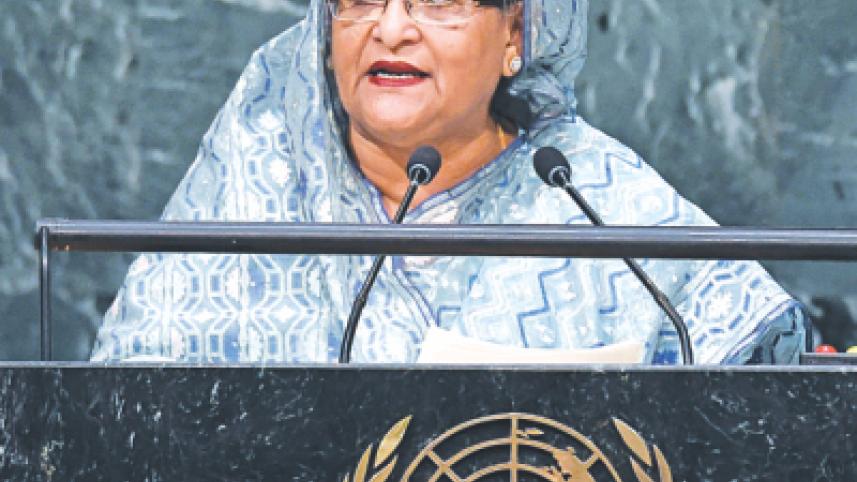
Observing that terrorism and violent extremism remain as two major impediments to global peace and development, Prime Minister Sheikh Hasina yesterday called for global unity to effectively address the threats.
"Terrorists don't have any religion. Terrorism and violent extremism are global challenges. All countries should be united to effectively address these," she said.

Hasina was delivering her speech at the general debate of the 70th session of the United Nations General Assembly at the UN headquarters. Like the previous years, she delivered it in Bangla.
"I urge the comity of nations to renew our collective resolve to achieve a peaceful, stable and prosperous world free from poverty and inequality, violence and extremism, climate change and conflict, and oppression and injustice," she told her audience.
Hasina also noted that it would not be possible to sustain the development endeavours if climate change could not be effectively dealt with. "The new development agenda makes it clear that all our actions need to be underpinned by our strong commitment to protect and preserve our planet, our biodiversity and our climate. We have only a small window of opportunity, and we must succeed to set the world on a safer, greener and more prosperous path."
Hasina said this was a critical year for sustainable development. The Financing for Development Summit in Addis and the just concluded UN Development Summit in New York have ushered in a new hope for people around the world. "With our drive to arrive at a meaningful climate change agreement in Paris this year, we hope to transform our future by ending poverty, mitigating climate change and preserving our planet."
Noting that regional cooperation is critical to fostering sustainable development as well as to achieving peaceful and stable societies, she said Bangladesh has taken the lead in building regional cooperation processes such as Saarc, Bimstec and BCIM-EC. "We've also taken initiatives to develop infrastructure to enhance trade and people-to-people contact among Bangladesh, Bhutan, India and Nepal (BBIN)."

The prime minister had recently said the world has been witnessing unprecedented migration and human mobility reshaping history and geography, as migration has been recognised as a key enabler of development in the 2030 Development Agenda.
"Cooperation is essential among our countries to harness the full potential of migration. With this objective in mind, we've decided to lead the Global Forum on Migration and Development in 2016," she said.
She said Bangladesh would like to lead by example the implementation of the SDGs in Bangladesh like it had done during the MDG era. In this regard, she said Bangladesh is currently developing the next Five Year Plan for 2016-2020, giving due importance to the Sustainable Development Goal (SDG) framework.
"Given the ambition reflected on the SDGs, we surely need to scale up mobilisation of resources -- public and private, domestic and international. It's essential for the developed countries to fulfil their ODA [official development assistance] commitment of 0.7 percent of their GNI [gross national income] to developing countries, and 0.2 percent to the LDCs," she said.
The prime minister went on to say, "We also need to address the challenges faced by developing countries in accessing environmentally sound technologies. Without transfer of such technologies and capacity-building, I'm afraid, many development goals and targets will remain unachieved."
She also noted that her government is determined to ensure that no one is left behind in their aspiration to build a resilient, peaceful and prosperous society. "We believe sustainable development can't be achieved in the absence of durable peace and security. We remain committed as ever to upholding peace and rule of law and ending a culture of impunity."
In this spirit, Hasina said her government was pursuing the trial of culprits of war crimes, crimes against humanity, rape and genocide, committed during the 1971 Liberation War. "Our government has attached utmost importance to preserving religious harmony and tolerance that have nurtured our social fabric through ages."
Talking about the UN peacekeeping missions, she said over the years, the UN peacekeeping and peace building have emerged as its flagship activity. Bangladesh is proud of being associated with these endeavours as a leading troop contributor.
Hasina said the country's valiant peacekeepers have made their mark in 54 peacekeeping missions in 40 countries so far. "We've the distinction of having the highest number of female police in UN peacekeeping missions. Our contribution to UN peace operations has made us a reliable partner in UN's peace initiatives."
Highlighting various successes of her government in different socio-economic sectors, she said Bangladesh is widely recognised as a role model for the developing world.
"Bangladesh has graduated from the UNDP's low human development category to medium, and also the World Bank's lower-income country status to lower-middle income one."
 For all latest news, follow The Daily Star's Google News channel.
 The prime minister said Bangladesh's lead role in the UN in promoting the rights and wellbeing of people affected by Autism and other neuro-developmental disabilities emanates from the government's efforts to build an inclusive society.
"Let's commit our will and wealth for our present and future. In our journey, no one will be left behind as we aspire to build a just, progressive, peaceful and prosperous Bangladesh," she told a high-level event at the UN headquarters on Tuesday.
Bangladesh organised the programme titled "MDGs to SDGs - A Way Forward".
Terming this year's UNGA-adopted SDGs-2030 a collective journey, she said the international community has to deliver on the means of implementation.
"We'll need scaled-up resources from all sources -- public and private, domestic and international. We also need critical support in technology and capacity building areas. We need adaptive and environmentally sound technologies."
Hasina said Bangladesh is now known as a development surprise as the country has already achieved or is on track to meet almost all the MDGs. "We've proved many myths wrong."
Comments