


Poor planning behind failure
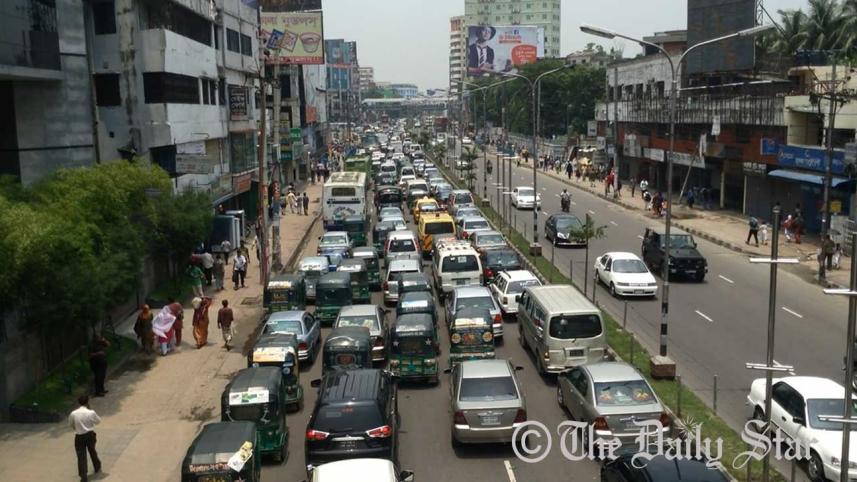
The trial of new traffic signal system with countdown timers in the capital was a failure, as the two Dhaka city corporations conducted it on the basis of a flawed plan, say urban transport experts.
The corporations should have studied traffic volumes on city streets before devising the system. They must know how many vehicles cross the city points and at what time, and what are their starting points and destinations, they say.
 For all latest news, follow The Daily Star's Google News channel.
 It was necessary to prepare the design accommodating unpredictable movement of vehicles. Accurate synchronisation of countdown timers, depending on traffic volume, was another vital point.
But none of those was taken into consideration in case of the newly-installed countdown timers, and the outcome was appalling traffic congestion on city streets on Saturday and Sunday, they say.
Seeking anonymity, an official in Dhaka South City Corporation, said, "It was the civil engineering department of the city corporations that made the plan for the new system and tried to execute it. There was no official or expert from the traffic engineering department."
Shamsul Hoque, professor of civil engineering at Bangladesh University of Engineering and Technology, said the new system cannot be applied because of the existing condition of the roads and pattern of traffic flow in the capital.
"To make a system effective, the authorities should ensure that the synchronisation is done as per traffic volumes, people don't violate traffic rules, traffic police are well trained, jaywalking is stopped and there is no illegal parking on the roads," he said.
When the trial of the new system was conducted on roads between Kakoli and Shahbagh on Saturday and Sunday, it resulted in traffic chaos. The nagging traffic congestion spread to other streets.
The traffic signal turned green but the road ahead was blocked with traffic. When the light turned red, the road ahead was found empty. This was the picture at some of the points.
Drivers were unaware of the new system, and drove on the wrong side of the road, disrupting traffic flow.
Traffic police had to control vehicular movement with hand signals, as the drivers either didn't obey or couldn't understand the new system.
The city corporations finally stopped the trial on Monday morning.
Shehab Ullah, project director of the new traffic signal project, however, blamed the rising volume of traffic and reckless driving for the system's failure.
He couldn't give any reply when asked why the project was taken without resolving the necessary issues.
Traffic constables, who were on duty at Bijoy Sarani intersection during the trial, said the time allocated for the green signal was not enough against the huge volume of traffic.
The vehicles running down from the Nakhalpara flyover got barely 30 seconds in every three minutes to move on, said one of the constables.
"Many drivers had turned off the engines of their vehicles at the signal. When the signal turned green, it took them 10 of the allocated 30 seconds to start the vehicles."
Only a few of the hundreds of vehicles could cross the point when the signal turned green, he said.
Another constable at the same intersection said some of the drivers ran vehicles on the wrong side of the road, contributing to the nagging traffic congestion on Saturday and Sunday.
It took them quite a while to get back to the right side of the road, he said.
A number of drivers yesterday said they had suffered a lot on those two days but didn't know the reason behind it.
A traffic constable at Karwan Bazar intersection said many passengers became impatient and rebuked them, thinking it was the traffic police who stopped the vehicular movement.
"What is the use of this new system if it doesn't work?" asked the constable.
Comments