


Post-Brexit Trade: UK, EU reach landmark deal
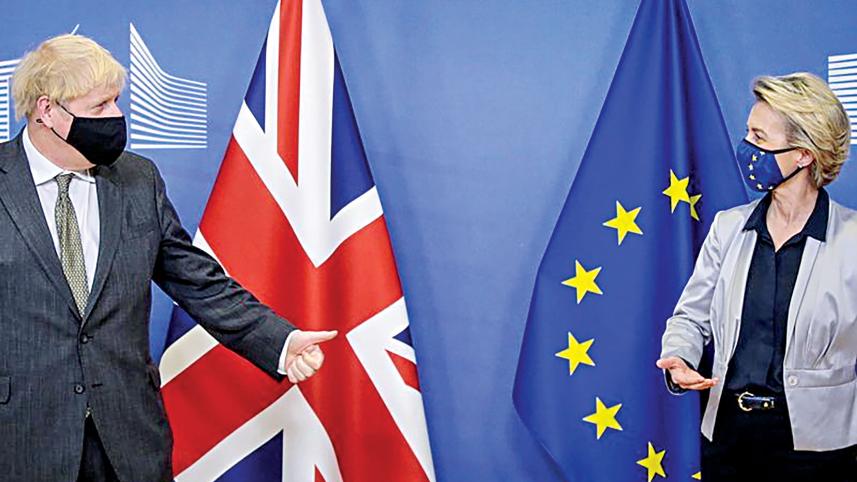
Britain clinched a narrow Brexit trade deal with the European Union yesterday, just seven days before it exits one of the world's biggest trading blocs in its most significant global shift since the loss of empire.
The deal means it has swerved away from a chaotic finale to a tortuous divorce that has shaken the 70-year project to forge European unity from the ruins of World War Two.
 For all latest news, follow The Daily Star's Google News channel.
 European Commission President Ursula von der Leyen told reporters: "It was a long and winding road. But we have got a good deal to show for it. It is fair, it is a balanced deal, and it is the right and responsible thing to do for both sides."
British Prime Minister Boris Johnson tweeted a picture of himself inside Downing Street, raising both arms in a thumbs-up gesture of triumph. "We have taken back control of our destiny," he told reporters. "People said it was impossible, but we have taken back control."
"We will be an independent coastal state," he said. "We will be able to decide how and where to stimulate new jobs."
Britain's parliament will vote to approve the trade deal with the European Union on Dec. 30, Johnson said.
The chief EU negotiator, Michel Barnier, was able to say for the first time in four long years: "The clock is no longer ticking."
While the last-minute deal prevents the most acrimonious ending to the saga on Jan. 1, the United Kingdom is set for a much more distant relationship with its biggest trade partner than almost anyone expected at the time of the 2016 referendum.
A deal had seemed imminent for almost a day, until haggling over just how much fish EU boats should be able to catch in British waters delayed the announcement of one of the most important trade deals in recent European history.
The UK formally left the EU on Jan. 31 but has since been in a transition period under which rules on trade, travel and business remained unchanged until the end of this year.
The details of the accord have yet to be made public, but if the sides have struck a zero-tariff and zero-quota deal, it will help to smooth trade in goods that makes up half their $900 billion in annual commerce.
It will also support the peace in Northern Ireland - a priority for US President-elect Joe Biden, who had warned Johnson that he must uphold the 1998 Good Friday peace agreement.
Even with an accord, some disruption is certain from Jan. 1 when Britain ends its often fraught 48-year relationship with a Franco-German-led project that sought to bind the ruined nations of post-World War Two Europe together into a global power.
German Chancellor Angela Merkel said she was "confident" that the deal was a "good outcome".
"We will quickly be able to determine whether Germany can support today's result of the negotiations," she said in a statement, adding that her cabinet would meet Monday to review the accord.
"I am very confident that we have a good result."
Former British prime ministers David Cameron and Theresa May, who both resigned over Brexit in recent years, welcomed the news.
"Trade deal is very welcome," Cameron said on Twitter, adding it was "good to end a difficult year with some positive news".
In her own message, May added: "Very welcome news that the UK & EU have reached agreement on the terms of a deal – one that provides confidence to business and helps keep trade flowing."
But in a worrying sign for United Kingdom, Scottish First Minister Nicola Sturgeon yesterday said it was time for Scotland to be "an independent, European nation".
"Before the spin starts, it's worth remembering that Brexit is happening against Scotland's will," she added on Twitter. "And there is no deal that will ever make up for what Brexit takes away from us."
After months of talks that were at times undermined by both Covid-19 and rhetoric from London and Paris, leaders across the EU's 27 member states have cast an agreement as a way to avoid the nightmare of a "no-deal" exit.
But Europe's second-largest economy will still be quitting both the EU's single market of 450 million consumers, which late British prime minister Margaret Thatcher helped to create, and its customs union.
The trade pact will not cover services, which make up 80% of the British economy, including a banking industry that positions London as the only financial capital to rival New York.
Access to the EU market for UK-based banks, insurers and asset managers will become patchy at best.
Even with a deal, goods trade will have more rules, more red tape and more cost. There will be some disruption at ports. Everything from food safety regulation and exporting rules to product certification will change.
The UK, which imports about $107 billion more a year from the EU than it exports there, had bickered until the end over fish - a totemic issue, but worth less than 0.1% of GDP.
In essence, the EU's most ambivalent member is exiting the bloc's orbit on New Year's Eve for an uncertain future with a trading relationship that is, at least on paper, distant.
At the stroke of midnight in Brussels, both sides will be diminished.
The EU loses its principal military and intelligence power, 15% of GDP, one of the world's top two financial capitals and a champion of free markets that had acted as an important check on the ambitions of Germany and France.
Without the collective might of the EU, the United Kingdom will stand largely alone - and much more reliant on the United States - when negotiating with China, Russia and India. It will have more autonomy but be poorer, at least in the short term.
Comments