


Some solace for village of widows
The clock struck 10:30.
It was perhaps the most desired moment in the lives of the widows of a remote Sohagpur village. It was the time that brought an end to their long, agonising wait for justice as the man, who unleashed horrendous atrocities on them 44 years ago, walked the gallows last night.

Sohagpur, a small village under Nalitabari upazila in Sherpur, around 200km north of Dhaka, was the place where Muhammad Kamaruzzaman, the chief organiser of Al-Badr in greater Mymensingh, had unleashed terror. On July 25, 1971 his militiamen and Pakistan army men had killed at least 164 people, one by one, turning the entire village into a valley of the dead.
The killing spree lasted for about six hours that day. Then they dragged off the women and raped them brutally. Even the widows, who fled their homes that day and returned two or three days later, were not spared.
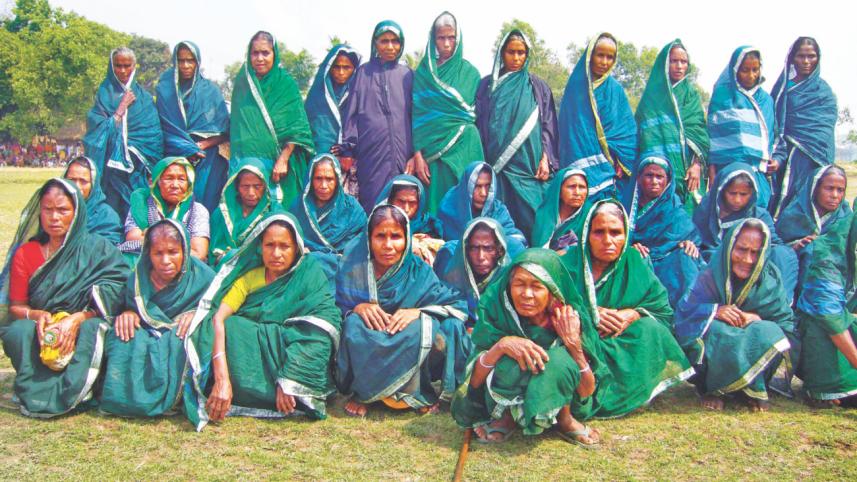
Ever since that fateful day, Sohagpur has come to be known as the "Bidhoba Palli", the village of the widows. Many of them are still alive to bear testimony to the massacre.
The widows have aged, their tears dried up. For more than 44 years, they had kept the unspeakable agonies of their loss buried inside, counting days and praying to see the killers of their loved ones punished. They finally saw justice on the night of April 11, 2015.

Expressing their feelings to The Daily Star, the widows once again broke down in tears, but this time tears of happiness seemed to bury their pains.
"I am happy that the man who killed my husband was hanged," a widow who was raped that night told The Daily Star over the phone. She heard the news of Kamaruzzaman's execution on television.
The Daily Star is not revealing her identity.
The Supreme Court in its verdict termed the incident of Sohagpur one of the "most barbarous and horrendous incidents ever happened on earth in this civilized world".
"We find no difference between the conduct of a man and a beast in the perpetration of these crimes," said the verdict.
However, irony lies in the fact that instead of seeing him punished, the widows saw the man responsible for all those killings gain political clout and lead a free life. Kamaruzzaman, now assistant secretary general of Jamaat-e-Islami, had contested in the parliamentary elections from the very Sherpur constituency that also included Sohagpur.
He took part in the polls five times, but could not win even once.
The widows finally saw a ray of hope when the Awami League government formed the International Crimes Tribunal in 2010 to try those who committed crimes during the Liberation War in 1971.
Braving the social stigma attached to rape victims, they appeared before the tribunal and described in detail the atrocities Kamaruzzaman and his ruthless militiamen had carried out in the village. Three widows, who were raped, testified before the court.

About the widows, the SC in its verdict observed: "They are old women having children and grandchildren. At this age they did not hesitate to disclose the loss of their chastity in the hands of perpetrators of crimes. It was possible and natural on the part of educated women, particularly those of the developed countries to disclose such incidents, but it was unimaginable that these illiterate old women would come forward to disclose in detail the acts of violence caused to them at this age."
It also said, "They knew the impact and consequences of their disclosures. Taking the risk of tarnishing their families honour and dignity to the estimation of the local people and their relations, which might also disgrace their next generation, they were not relented, rather disclosed it.
"It is possible only when they were determined that even at the cost of social strictures, the real story should be disclosed and the perpetrators punished. They did so only to heal their mental shock to some extent."
 For all latest news, follow The Daily Star's Google News channel.
 Since the tribunal handed down death penalty to Kamaruzzaman in May 2013, the victims' families have expressed satisfaction but they have stuck to a single demand: "Hang Kamaruzzaman."
Then the Jamaat leader appealed to the SC, challenging the verdict. The trial process continued and so did their wait.
On November last year, the SC upheld the verdict handed down by the tribunal. Although the victims' families felt relieved, they kept waiting to see him punished.
Kamaruzzaman filed a petition on March 5 this year, seeking a review of his death penalty. The SC on Monday rejected his plea, upholding its previous verdict.
War crimes trial campaigners, investigators and prosecutors, and pro-liberation organisations have expressed their satisfaction over the execution of Kamaruzzaman.
Tureen Afroz, a prosecutor, told The Daily Star, "After so many years, the victims of Sohagpur got justice. The souls of the martyrs will find peace and the widows will get solace".
Comments