


No compromise on 15pc VAT

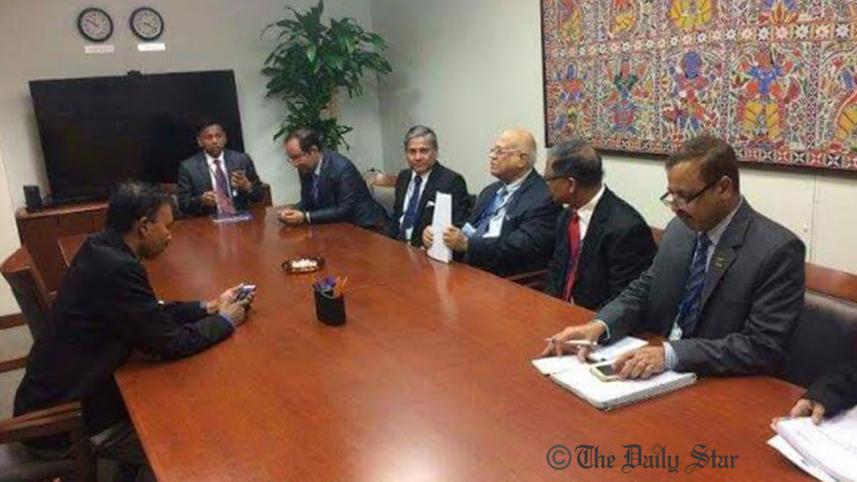
Finance Minister AMA Muhith yesterday said there would be no changes in the government plan to implement a uniform 15 percent VAT rate from July.
“The IMF officials wished to know how we planned to implement the new VAT [Value-Added Tax]. We told them that it would come into effect in July and be set at 15 percent for two years,” he told The Daily Star.

Muhith made the comment after holding a meeting with IMF Deputy Managing Director Mitsuhiro Furusawa at the organisation's headquarters in Washington DC on Thursday.
He, however, mentioned that some concessions may be made, taking the demands from businesses into consideration.
The finance minister is now in the US capital to attend spring meetings of the World Bank Group and the International Monetary Fund.
The government has a plan to cut oil prices to boost economic growth but it is subject to the prime minister's approval, he said.
“I have told them [IMF officials] that we will continue to provide subsidies in the energy sector because we want to bring the whole country under electricity coverage by 2018. It [subsidy] will continue for quite some time but I cannot say exactly for how long,” he said.
“At the moment, we wish to reduce the oil prices a bit. We have informed the prime minister of our proposal. The prices will be decreased once we have her approval.
“Our economists propose cutting the oil prices to boost the economy… I agree with them. This is why we have sought the prime minister's permission,” he said.
Muhith also pointed out that the IMF is quite pleased with the economic situation in Bangladesh.
On April 16, the Centre for Policy Dialogue said the proposed uniform VAT rate of 15 percent is on the high side when compared to neighbouring low and middle-income countries.
The global median rate for VAT is 15 percent, but in South and East Asia and among the low and middle-income countries in general, the median appears to be 12 percent, it said.
If a uniform VAT rate is to be implemented from July 1, it is recommended that the rate be gradually reduced to 12 percent over a medium term, the CPD said.
The think-tank warned that the cost of production in almost all sectors might go up in the coming months as a result of the new VAT.
On Thursday, Muhith had a meeting with Annette Dixon, World Bank vice president for South Asia Region, at the global lender's headquarters in Washington DC.
Following the meeting, he said the WB pledged to extend $6 billion credit to Bangladesh in the next three years. The money would be provided in three instalments ($2 billion each) in every fiscal year till 2020.
Muhith mentioned that the WB was ready to lend support to Bangladesh in dealing with the refugee issue.
“I told them that we may need their support, as we are trying to settle them [Rohingyas] in a new place… We can use that resource there. They [the WB] have opened a new window so that the countries which have refugees can get allocations,” he said referring to the Rohingya refugees in Bangladesh.
The minister further said the WB expressed willingness to provide assistance also in the country's banking sector, but he turned down the offer.
“We will have a banking commission in the next budget. It's our internal step. They said they are also willing to help us with the commission... Right now, we don't intend to take any help from anyone,” he said.
 For all latest news, follow The Daily Star's Google News channel.
 The Bangladesh delegation headed by Muhith includes Bangladesh Bank Governor Fazle Kabir, Finance Secretary Hedayetullah Al Mamoon, Economic Relations Division Secretary Kazi Shofiqul Azam, and Alternate Executive Director at the WB Muhammad Musharraf Hossain Bhuiyan.
Comments