


Why Bangladesh must save its indigenous rice before it disappears
Although modern diets push “no‑carb” lifestyles, rice remains irreplaceable in our culture. Our love for it is so well‑known that we are often teased with the phrase “bheto Bangali.” A plate of piping hot rice with daal and a homely, thin broth of free‑range chicken curry cooked with potatoes, onions, ginger, garlic, and red chilli is not just food; it is home. This quintessential comfort meal nourishes body and spirit, reminding us of fields, festivals, and the rhythm of life itself.
Bangladesh has an incredible wealth of rice varieties, a heritage that reads like a living archive of resilience. With nearly 1,000 indigenous strains alongside 127 high‑yielding varieties developed through research, the diversity is staggering. Yet, prized grains like Barisal’s famous Balam chaal are now rare as machine‑cut rice dominates the market.

At Manikganj’s Pran Boichitra Khamar, the Prakritik Krishi movement treats rice as a heritage crop. Founded by Delowar Jahan, the farm grows over 20 indigenous varieties season after season, ensuring they adapt naturally to shifting weather. Rejecting chemicals, the paddies teem with earthworms and snails, while organic straw feeds cattle and roofs homes.
The model now spans four villages, training farmers to preserve their own seeds and breaking dependence on corporations. It strongly advocates unpolished heirloom rice that is fibrous, antioxidant‑rich, and better for managing diabetes.
Aziza Ahmed is the Director of Operations at the Bangladesh Business & Disability Network (BBDN). She has an agrarian heart and tries to source all her food from organic sources.
“For many of us, the journey to Pran Boichitra Khamar began with a simple desire to eat better food. But it soon became something much deeper. Through Delowar’s work, I discovered that rice is not just a commodity — it is memory, landscape, history, and identity,” says Aziza Ahmed.
She adds, “I have made it a personal practice to bring a different indigenous rice variety into my kitchen every month. What began as an individual choice gradually became cultural stewardship. In a world where uniformity is replacing diversity, preserving our native grains is an act of care for both biodiversity and heritage.”
Perhaps, the most inspiring realisation is that one is never alone in this effort. A growing community believes that protecting local seeds, supporting ethical farmers, and celebrating Bengal’s food traditions is not nostalgia but a commitment to the future.
Food & Décor: RBR
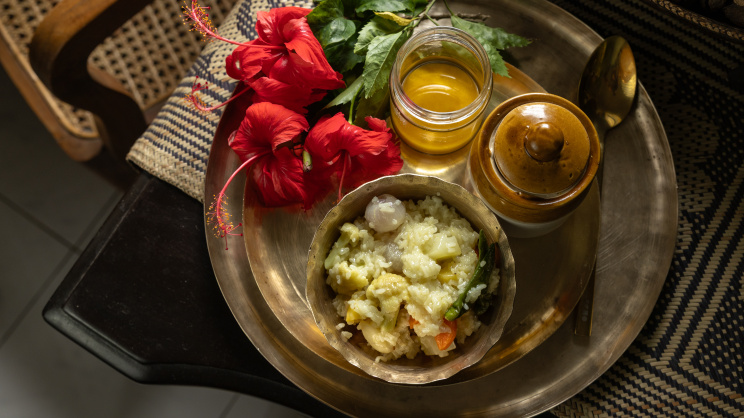
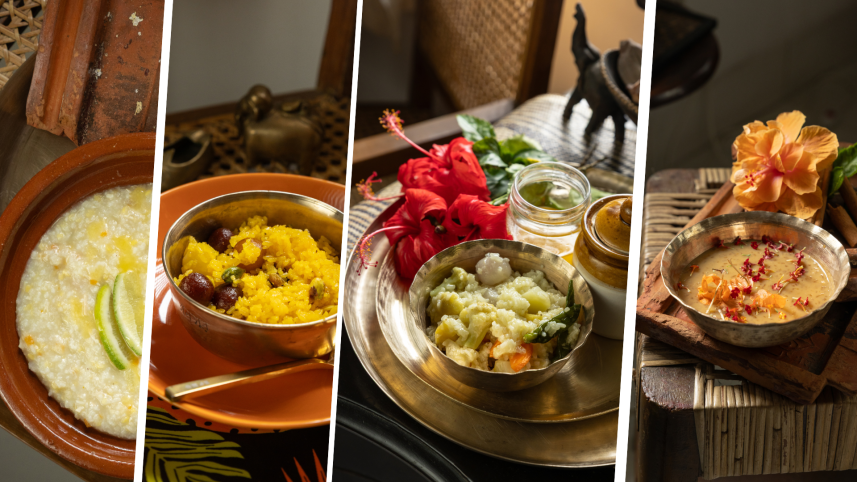
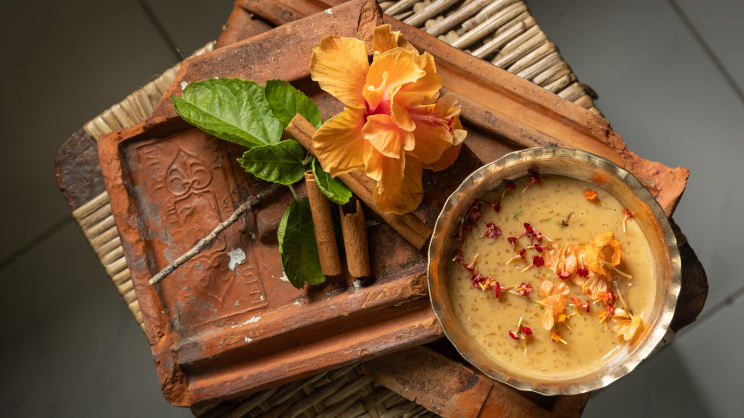
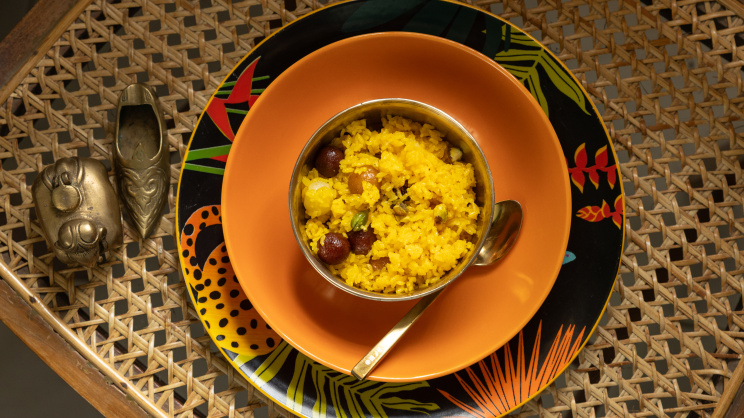
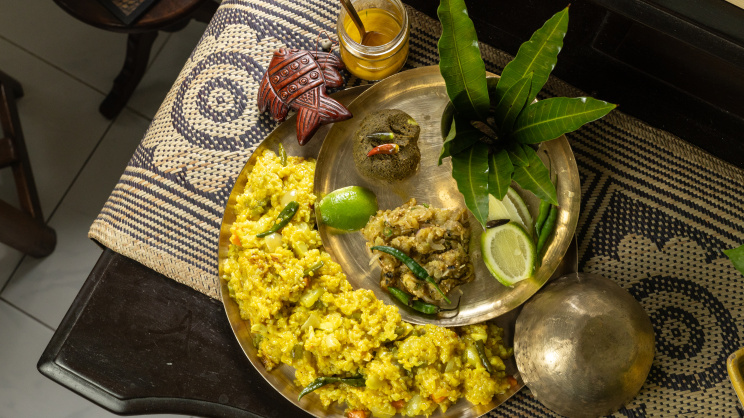
Rice as soul foodFor Bengalis, rice is not only food but also nourishment for the soul. One favourite is jao bhaat, a congee‑style dish with lemon leaves, ginger, salt, and sometimes charred chilli and nigella seeds. A lighter version uses seasonal vegetables like potatoes, greens, and gourds, lifted with a spritz of lemon, known as lebu bhaat. In villages, vegetables are steamed directly in rice, creating a starchy mash that blends beautifully with the grains. Another classic is ghee bhaat, rice seasoned with salt and clarified butter. It can be enjoyed with sugar, molasses, or rich meat curries. A sweet version with coconut shavings and sugar was once a traditional treat, though now it is almost forgotten. There is pish-pash, a congee cooked with chicken, moong dal, and vegetables, finished with butter and ginger, perfect when unwell. Sticky rice, or binni chaal, makes khichuri: the brothy version pairs with beef curries and fried aubergines, while the drier version is cooked with lentils and winter vegetables. Bosha bhat is another beloved preparation. It is rice cooked by absorbing its own starch water. And then there is panta bhat, fermented rice eaten with chillies, onions, and salt. Once the staple of the common people, it is now a delicacy in Dhaka during Pahela Baishakh, served with hilsa and vegetable mash. Bengalis also cherish sweet rice dishes. Payesh is made with molasses for a deep, earthy flavour. Phirni is made with ground rice cooked in milk, flavoured with nuts and raisins, and decorated with silver foil. Jorda, bright orange rice with citrus pulp and zest, is another festive favourite. |
 For all latest news, follow The Daily Star's Google News channel.
#Recipe Rustic khichuri from KushtiaSome recipes are measured with cups and spoons. Others are measured with instinct. This rustic khichuri belongs to the latter. I learned it from my mother‑in‑law in Kushtia, though I have never matched her touch. Perhaps it is because her cooking carries not only skill, but the rhythm of a lifetime spent with grains, vegetables, and the flavours of her land. For 500 grams of rice, she loosely uses 250 grams of mashkalai daal, soaked until softened. The rice and daal are washed together, then mixed with mustard oil, onions, ginger, garlic, and simple spices like turmeric, red chilli, cumin, coriander, and salt. Whole garam masala adds warmth. Everything is combined by hand, water poured generously, and even the spice clinging to fingers is washed back into the pot. The khichuri cooks slowly until tender, neither dry nor soupy, but soft and moist, with grains melting into one another. The aroma of mustard oil and garlic fills the room. It pairs beautifully with beef curry, but is just as satisfying with begun bharta, seasonal vegetables, fritters, or a fried egg. Each time I cook it, I am reminded that the finest food is often the simplest; recipes carried from one generation to the next, holding memory and belonging in every bite. By Aziza Ahmed |
Comments