


Dissecting the World Cup ball: Everything you need to know
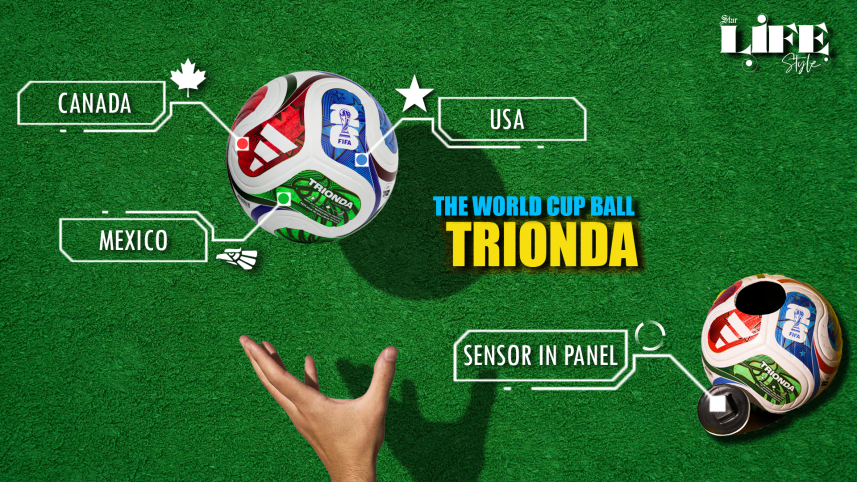
The most-watched sporting event in the world is back again after four long years. In every iteration of the event, FIFA presents a new official ball, and the ball itself is often the topic of conversation. This year is no different. The official ball has been unveiled, and it is called “Trionda”.
If you are curious about what’s going on inside and outside that ball, keep on reading.

One ball to represent them all
The name Trionda in Spanish means “three waves”, which is a nod to the fact that for the first time, three host countries — Canada, Mexico and the United States — are uniting to host the FIFA World Cup. And it’s not just the name. The design of the ball itself celebrates all three countries with its three colours — red, green and blue — along with the designs (maple leaf for Canada, an eagle for Mexico, and a star for the United States) on them that represent each host country.
This is definitely one of the most vibrant and symbolic ball designs in World Cup history.
New design and modern technology
Remember your childhood days when you used to play with Deer balls? Those used to have thirty-two panels. Panels are the separate sections of a ball that are put together to make it. The Trionda will have only four panels.
Adidas will be making the ball. And according to Adidas News, “Trionda will be featuring a new iteration of Adidas’ Connected Ball Technology.
So, what exactly is Connected Ball Technology? It is a system introduced by FIFA in collaboration with Adidas that involves embedding advanced sensors within the match ball to provide real-time data about its movement.
The new World Cup ball will have this sensor in one of the four panels of the ball, as opposed to Al Rihla (2022), which had the sensor at the centre of the ball. And yes, the ball will have to be charged before every match!
So, if there is a piece of sensor in one panel, won’t it affect the ball’s balance? Don’t worry, Adidas has thought of that. To ensure that the balance of the ball is not affected, there will be a counterweight in all the other panels of the ball to ensure that the ball behaves as it is supposed to.
The sensor can track the ball's rotation, position on the pitch, and every single touch along the way, and will be sending that data back to the Video Assistant Referee (VAR) in real time, which should make it easier to make an offside or handball call since they can now track the exact moment the ball was struck.
What to expect?
The ball has been tested in different locations and put through blind tests. It took 3.5 years to design this ball, including various rounds of trial and error. Considering all these, one can expect a good outcome, but then again, this is the World Cup, the grandest stage and the biggest test of them all, and when it’s the World Cup, there usually is some sort of drama or controversy.
Besides, even though the new technology promises faster and more accurate decisions based on real-time data, the audience has a love-hate relationship with VAR and modern technology in football. One of the biggest issues is the fact that VAR takes a long time to make a decision, and that takes out the momentum and fun of the game. Theoretically, that issue should be resolved with this new ball.
But what happens in reality on the pitch often differs from theoretical situations, as we often see in football. Regular football fans will argue that there was never any shortage of required technology and data; it’s the referee’s decisions that are controversial! We will just have to wait and see.
 For all latest news, follow The Daily Star's Google News channel.
Comments