


The new national pay scale and the cost of living

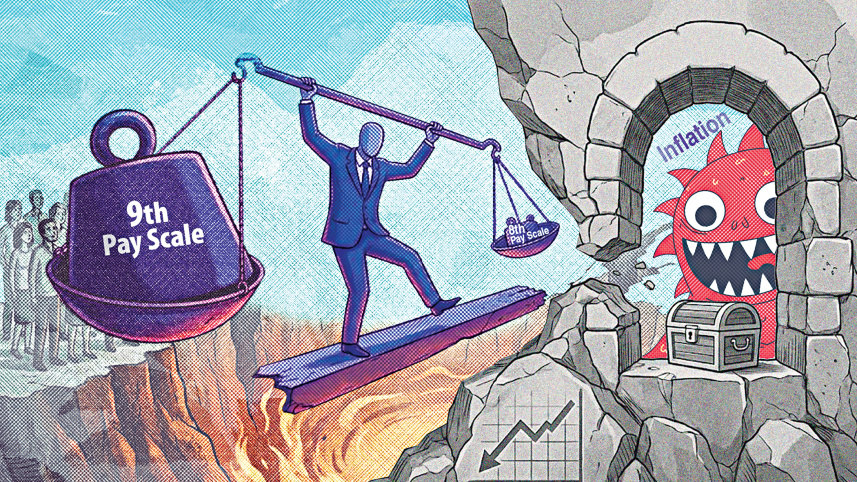
The approval of the National Pay Scale 2026 has brought a mix of reactions across the city. The lowest basic salary will rise from Tk 8,250 to Tk 20,000, while the highest will increase from Tk 78,000 to Tk 1,56,000.
For the roughly 2.4 million people employed in the public sector, this news is a long-awaited acknowledgement of economic reality. It has been 11 years since the last major adjustment in 2015. During this decade, the cost of living in Dhaka has increased significantly.

Those within the system expressed that the adjustment feels like a necessary correction rather than a bonus. Stagnant pay has made it difficult for many families to maintain a standard middle-class life.
"I have been trying to run a 2026 household on a 2015 budget," shares Mahfuz Ahmed, a third-grade primary school teacher. "Tuition fees and medical costs don't wait for a new pay scale. This increase is simply a way for us to get by."
The implementation of the pay scale follows a gradual timeline rather than an immediate overhaul. Public servants will receive their salary increases in four annual instalments, meaning the full impact of the raise will not be reflected in their bank accounts until 2028.
"Receiving the raise in four separate phases makes this feel like a very slow climb toward the promised total," remarks Rakib Ishrak, a government program officer. "It reminds me of the old saying about dangling a carrot in front of a donkey to keep it moving; we are being told to keep going, but the real reward remains just out of our reach for now."
However, for the vast majority of the workforce that does not receive a government pay cheque, the news carries a different weight. There is a common anxiety that the market will react to the announcement by hiking prices before the employees even see the extra money. This psychological effect on citizens often leaves the private sector and daily wage earners at a disadvantage.
"The market reacts to the news faster than the bank does," laments Rubaba Hasan, a junior executive at a marketing firm. She observes that shopkeepers often use such announcements as a reason to raise prices for everyone.
"My landlord and shopkeeper didn't ask if I work for the government before they raise their rates. We are left to face the same inflation with no income adjustment."
This highlights the widening gap between the public and private sectors.
In many private firms, there are no structured service rules or guaranteed yearly increments. The concept of a pension or a housing loan is often a distant dream for those in the corporate world. When the state raises its pay scale, private companies are rarely in a position to match those figures immediately, leading to a sense of imbalance in the urban lifestyle.
The thought of how to bridge the gap between immutable private salaries and rising costs has led to some interesting suggestions too.
"I am looking at my options for a second job now," jokes Nafis Zaman, a graphics operator at an educational agency. He suggests that if things get too expensive, he might have to start a side hustle selling tea and bread outside government offices. "If you can't join the government payroll, you might as well find a way to earn from it."
"If the salaries are increasing, the hope is that the service will at least move forward," contends Farhana Chowdhury, a private banker.
She believes that a higher salary should come with more accountability and a better experience for the ordinary people.
"In many countries, public servants are proactive in helping people. Here, it often feels like you are asking for a favour. We would like to see a smile at the counter along with the new pay cheque."
The macroeconomic challenge is also a concern for many analysts. To fund this massive increase, the state must navigate complex choices. The influx of liquid cash into the market can drive up demand for limited goods, potentially leading to higher inflation. If the funding is managed through more debt or new currency, the actual purchasing power of the money might decrease for everyone.
As everyone moves into this new phase, the atmosphere remains one of watchful waiting. The National Pay Scale 2026 is a response to a decade of static figures, but its success will be measured by how it affects the country as a whole. For now, residents are checking their budgets and hoping that the numbers on the screen don't lead to a much more expensive plate of food.
*Some names have been changed upon request
 For all latest news, follow The Daily Star's Google News channel.
Comments