


'Country missing out on local innovations'
Bangladesh is missing out on potential multi-billion-dollar returns from homegrown scientific innovations due to weak policy support, bureaucratic delays, and the lack of industry linkages, scientists and academics said.
Although the country has world-class research capacity in areas such as climate technology, biotechnology, and sustainable materials, poor coordination among universities, policymakers, and industries is holding it back, they added.

Experts warned that these gaps are forcing many researchers to commercialise their innovations abroad -- by selling patents overseas or manufacturing products in other countries -- thereby depriving Bangladesh of economic and strategic benefits.
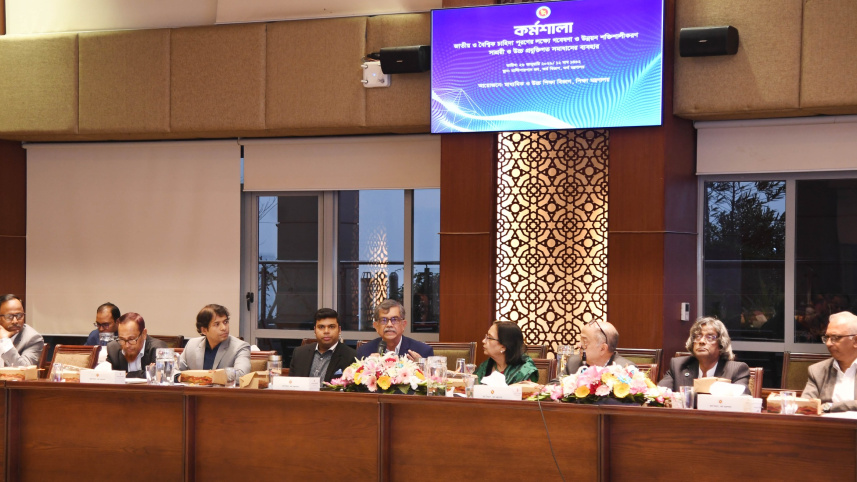
The concerns were raised at a workshop titled “Strengthening R&D for meeting national and global needs: Use of affordable/high-tech solutions”, organised by the education ministry at the Secretariat today.
Noted geneticist Abed Chaudhury said he developed a fungus-based feed additive that eliminates methane emissions from cattle, a major source of greenhouse gases. He offered the technology to Bangladeshi authorities for $5 million, but the proposal stalled due to bureaucratic delays.
“They kept me waiting. In the end, an Australian company bought it for $10 million,” he said, adding that the innovation could have generated billions of dollars in climate financing for Bangladesh.
Tofazzal Islam, director of the Institute of Biotechnology and Genetic Engineering at Gazipur Agricultural University, said his team developed a rapid diagnostic kit for Wheat Blast with funding from the Gates Foundation. However, when local industries failed to manufacture the diagnostic strips, the team had to turn to China.
“It is now being produced there and used worldwide, but we could not commercialise it in Bangladesh,” he said, adding that the country has vast untapped biological resources.
The workshop also discussed the stalled commercialisation of the “Sonali Bag”, a biodegradable alternative to plastic made from jute cellulose.
Mubarak Ahmad Khan, former scientific adviser to Bangladesh Jute Mills Corporation, said the jute-based product has not received adequate industrial support for mass production, despite the government ban on single-use plastics.
“We take pride in jute, but there is not a single department in any university in Bangladesh dedicated to jute research,” he said, noting that India has several such departments.
Biotech entrepreneur Sadaf Saaz Siddiqui said government laboratories often turn into “graveyards” for expensive equipment due to the lack of funding for maintenance once projects end.
Firdausi Qadri, senior scientist at icddr,b, warned of a looming “vaccine cliff”, saying that as Gavi’s support ends by 2030, Bangladesh will face severe financial pressure unless local vaccine manufacturing capacity is expanded.
She noted that a single clinical trial costs between Tk 50 crore and Tk 100 crore, while government research grants typically range from only Tk 1 crore to Tk 2 crore.
Responding to the criticisms, Education Adviser Prof CR Abrar said excessive emphasis is placed on infrastructure, while investment in human capital remains neglected.
He called for at least a tenfold increase in research funding and warned that without faster processes, allocated funds would continue to dry up before reaching researchers.
Secondary and Higher Education Division Secretary Rehana Perven, BANBEIS Director General (Additional Secretary) Md Mojibur Rahman, and researchers under the Grant for Advanced Research in Education (GARE) programme also spoke.
 For all latest news, follow The Daily Star's Google News channel.
Comments