


Boro fields in Khulna turning yellowish
Agriculture officials said fields attacked with 'Bacterial Leaf Blight (BLB)' disease
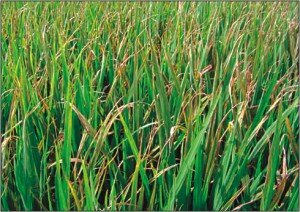
A Boro field in Khulna attacked with BLB disease.Photo: STAR
Boro plants in most areas of Rupsha, Dumuria, Paikgacha and Dakop upazilas in Khulna district are turning yellowish. The substance of the grain is drying up, which may turn those into sterile sheaves, farmers and agriculture officials apprehend. Most Boro paddy fields are in sprouting stage now. Agriculture officials and scientists of government's plant protection department said the Boro fields have been attacked with 'Bacterial Leaf Blight (BLB)' disease. This has been caused by excessive use of urea fertilizer against far less and disproportionate use TSP (triple super phosphate) and MOP (murate of potash), according to officials of Khulna Agriculture Extension Department (AED). The disease has also attacked Boro fields in neighbouring districts they said. They are ascertaining the extent of the damage in Khulna districts, they said. Farmer Shukumar Mondol of Jhilerdang village in Dumuria upazila told this correspondent that he had transplanted Boro on five bighas of land. The plants are turning yellowish and substances of the grain are drying up. He said local AED officials could not identity the disease and suggest any remedy. So were comments of farmers Gopal Mondol of Dhopakhola village under Rupsha upazila and Zakir Hossain of Anandanagar under Terokheda upazila in Khulna district. They said the disease has taken an alarming turn, causing extensive damage to Boro fields. Over 500 farmers in Rupsha upazila staged a demonstration in front the agriculture office on March 29 demanding immediate steps to prevent spread of the disease. Excessive use of urea fertiliser in the land is the lone cause of Boro paddy being attacked with BLB disease, said Ahsanul Hakim, who is an expert working in the plant protection section in the Khulna district AED office. He said farmers had no means to buy TSP and MOP fertilisers as their prices were very high during plantation. TSP and MOP should be applied in fields to remove salinity. Not getting the two fertilizers, farmers used excessive urea without knowing its bad effects, he said. Ahsanul Hakim said there is no anti-bacterial medicine available in the market to check the BLB disease. He suggested some preventive measures like spraying of bleaching powder-mixed water and application of five kilograms of Potash fertiliser per hectare to combat the disease. According to AED, five lakh hectares have been brought under Bboro cultivation in ten districts of Khulna division this year. But officials could not give any information on how much land in Khulna division have been attacked by BLB disease.
 For all latest news, follow The Daily Star's Google News channel.
Comments