


No-confidence motion to oust Pak PM: Khan suggests he might not accept vote result
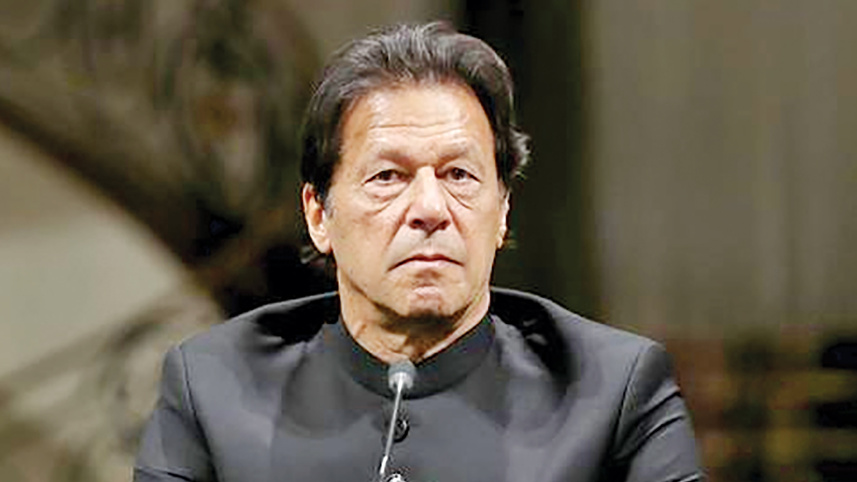
Pakistani Prime Minister Imran Khan yesterday suggested that he might not accept a vote to oust him and called on his supporters to take to the streets today ahead of a parliamentary no-confidence vote that could see him thrown out of office.
No Pakistan premier has ever completed a full term, and Khan is facing the biggest challenge to his rule since being elected in 2018, with opponents accusing him of economic mismanagement and foreign-policy bungling.

Parliament is due to debate the motion today -- with a vote possibly the same day. Khan's Pakistan Tehreek-e-Insaf party (PTI) effectively lost its majority in the 342-member assembly last week when a coalition partner said its seven lawmakers would vote with the opposition.
More than a dozen PTI lawmakers have also indicated they will cross the floor, although party leaders are trying to get the courts to prevent them from voting.
"How can I accept the result when the entire process is discredited?" Khan told a select group of foreign journalists at his office. "Democracy functions on moral authority - what moral authority is left after this connivance?"
"The move to oust me is blatant interference in domestic politics by the United States," he said, terming it an attempt at "regime change".
Earlier this week he accused the United States of meddling in Pakistan's affairs, with local media reporting he had received a briefing letter from Islamabad's ambassador to Washington recording a senior US official telling him they felt relations would be better if Khan left office.
In Washington, State Department spokesman Ned Price told reporters there was "no truth" to the allegations.
"I want you all to protest for an independent and free Pakistan," he said yesterday during a public question and answer phone-in broadcast by state media.
Khan has accused the opposition of conspiring with Washington to remove him because he won't take the West's side on global issues against Russia and China. He called his opponents "robbers, cowards, deceivers".
The opposition is headed by the Pakistan Muslim League-N (PML-N) and the Pakistan Peoples Party (PPP) -- two usually feuding dynastic groups that dominated national politics for decades until Khan forged a coalition against them.
If Khan goes, the PML-N's Shehbaz Sharif is tipped to become the next prime minister -- but on Saturday the government moved to have him sent back to jail to await trial on money-laundering charges that have been pending since 2020.
Khan, a former international cricket star who in 1992 captained Pakistan to their only World Cup win, during the interview hinted he still had a card to play.
"I have a plan for tomorrow, you should not be worried about it. I will show them and will defeat them in the assembly."
In the past, parties have resorted to physically preventing lawmakers from voting on key legislation by blocking access to the national assembly, leading to cat-and-mouse chases and even accusations of kidnapping.
Some analysts say Khan has lost the crucial support of the military -- claims both sides deny -- and Pakistan's army is key to political power.
Hours before he spoke, the head of the army, General Qamar Javed Bajwa, had said Pakistan wanted to expand its ties with Washington.
Bajwa also said that Russia's invasion of Ukraine must be "stopped immediately", terming it a great tragedy. He expressed Pakistan's serious concern over the conflict, adding that "despite legitimate security concerns of Russia, its aggression against a smaller country cannot be condoned."
 For all latest news, follow The Daily Star's Google News channel.
Comments