


Potato farmers stare at losses as prices dip

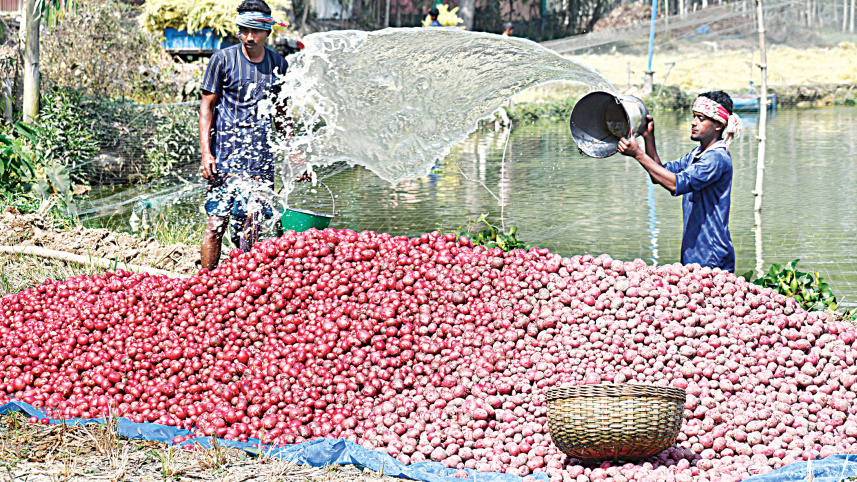
Potato growers across the country are bracing for financial losses for the second consecutive year as prices of one of the nation’s largest vegetable crops have plunged further during the peak harvesting season.
Farmers in the north, central and southern regions said they are selling potatoes in the field at Tk 300–350 per maund (37.32kg), depending on the variety. At the same time last year, the price ranged between Tk 500 and Tk 550.

They warned that if prices remain this low, their financial strain will deepen, compounding the heavy losses they suffered last year.
Many frustrated growers were forced to sell their produce at throwaway prices. Some even dumped potatoes on the streets last year, unable to sell them or store the surplus in already full warehouses.
The production cost for high-yielding potato varieties such as Asterix, Diamond and Granola stands at Tk 16.64 per kilogramme this year. However, over the past month, field prices have hovered around Tk 8–9 per kg, according to data from the Department of Agricultural Extension (DAE).
Agriculturists attributed the low prices to overproduction, compounded by the government’s failure to expand export capacity.
Last year, potato production reached a record 1.15 crore tonnes, significantly higher than the country’s annual demand for 90 lakh tonnes, according to the DAE and the Bangladesh Cold Storage Association.
Frustrated by losses due to low prices, farmers cultivated the tuber on 4.69 lakh hectares this season, down 5 percent from 4.94 lakh hectares the previous year. Yet prices have continued to fall.
“We are selling at the field level at Tk 9–10 per kilogramme. If the market price remains like this, we will suffer greater losses compared to last year,” said Jamal Uddin, a farmer from the Mostafi area of Lalmonirhat sadar upazila, a bordering district in the north and a key potato-growing region.
He cultivated potatoes on 18 bighas of land this year, down from 22 bighas last year due to financial losses.
In Lalmonirhat and four other northern districts -- Kurigram, Rangpur, Gaibandha and Nilphamari -- potatoes have been cultivated on 110,700 hectares of land.
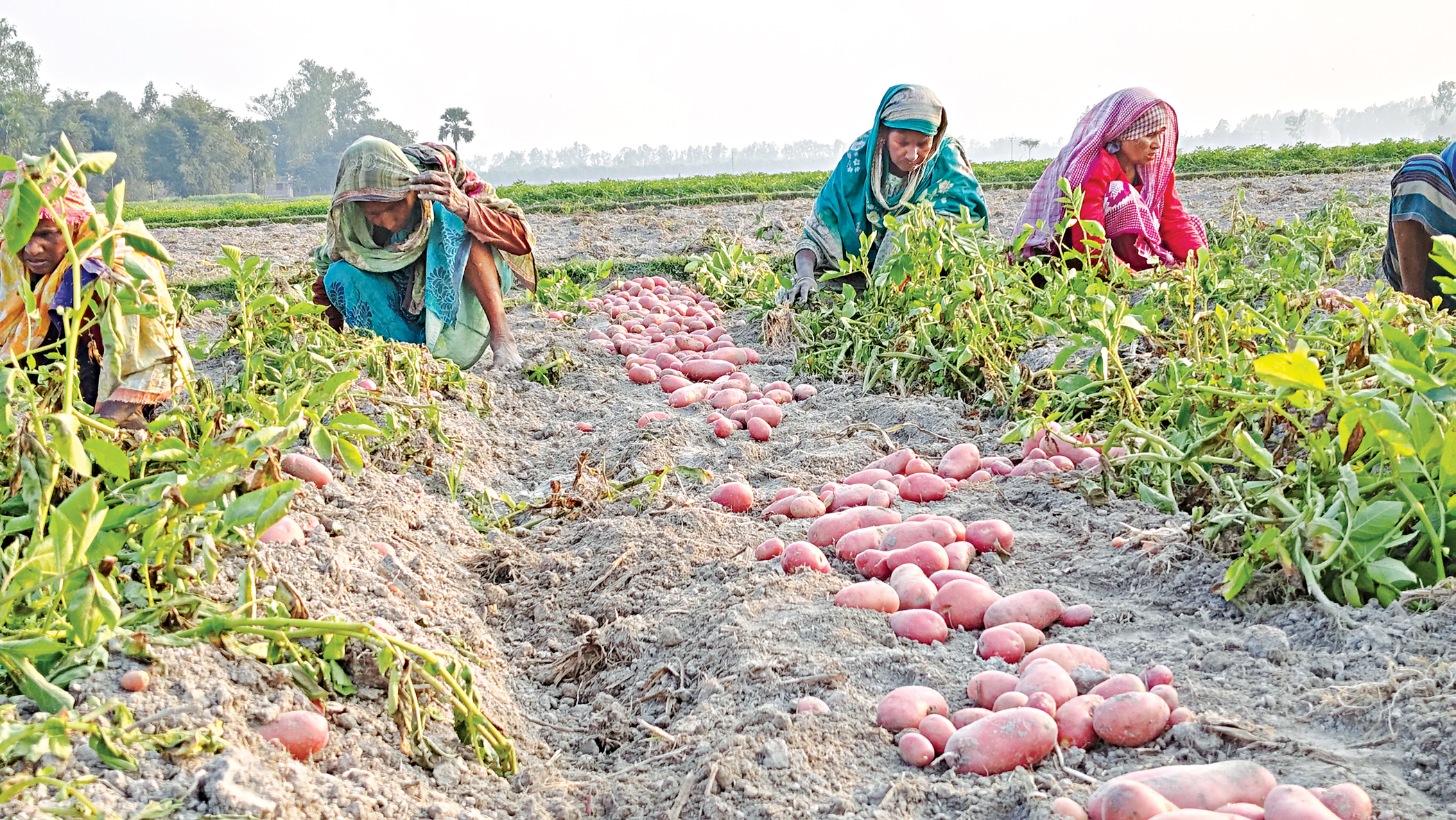
Munshiganj, one of the leading potato-producing districts, saw potatoes cultivated on approximately 34,758 hectares in the 2025–26 season, 100 hectares less than the previous year.
Anwar Hossain, a farmer from Panchasar in Munshiganj sadar, said he planted potatoes on 4 bighas of land this year, compared to 15 bighas last year after incurring huge losses.
“I’m really worried about a further slump in price this year,” he said.
Tozammel Hossain, a farmer from Balakhur village in Joypurhat, said he deliberately delayed harvesting in hopes of securing a better price.
“But I will still incur a loss of at least Tk 8,000 to Tk 10,000 per bigha at the current price, despite an increased yield compared to last year,” he said.
Another farmer from the same village, Md Mukul, said, “I invested Tk 70,000 in 80 decimals of land, borrowing Tk 50,000 from an NGO. I harvested 240 maunds of potatoes, but if I sell at the current price, I can’t even recover the costs, let alone repay my debt.”
Afzal Hossain, a vegetable wholesaler at Rangpur Poura Market, said potatoes were being sold at Tk 13–14 per kg, while traders were purchasing from farmers at Tk 9–10 per kg.
“Prices are gradually declining,” he added.
 For all latest news, follow The Daily Star's Google News channel.
 Trader Rostam Ali of Tilakpur Haat, a major potato market in Akkelpur upazila of Joypurhat, said on February 18 high-yielding potatoes were selling for Tk 300–340 per maund, while red potatoes of the Rumana variety fetched Tk 450.
“Every day I am buying three trucks of potatoes, but prices are much lower than last year and are continuing to drop daily,” he said.
Fazlul Haque, a seasonal potato trader in Gobindaganj, Gaibandha, echoed Rostam.
Ratan Kumar Ray, acting Agricultural Marketing Officer of Joypurhat district, said market prices over the past month ranged from Tk 300 to Tk 350 per maund.
“At this same time last year, the price was Tk 500 per maund,” he added.
Abu Taher, Agricultural Marketing Officer of Bogura district, said farmers had been selling high-yielding potatoes directly from the field for Tk 280–300 per maund over the past month, compared to more than Tk 560 per maund at the same time last year.
Additional Director Sirajul Islam of the Rangpur Regional Office, DAE, said farmers achieved expected yields due to favourable weather this year but remained deeply disappointed by the low market prices.
“If potatoes cannot be exported abroad, farmers will face extreme anxiety over their produce again this year,” he said.
According to agriculture ministry data, potato exports from Bangladesh have not exceeded 62,000 tonnes in the last five years. In the 2020–21 fiscal year, only 51,543 tonnes were exported, while in 2024–25 exports reached 62,135 tonnes.
Asked about managing surplus potatoes and the continuous losses faced by farmers, Abdur Rahim, director general of the DAE, told The Daily Star, “This year, favourable weather and low pest infestation led to a bumper harvest. However, we now have a potato surplus. This excess must be exported.”
He blamed high transportation costs as a major hurdle to exports.
“Special care must be given to potato varieties that are in high demand abroad. We will urge the new government to prioritise potato exports -- we are working on it,” he said.
The DG also stressed the need to increase storage facilities to prevent surplus produce from going to waste.
Jahangir Alam Khan, an agricultural economist and former director general of the Bangladesh Livestock Research Institute, said, “In terms of both consumption and production, potato is the second most important crop in Bangladesh. If farmers repeatedly fail to get fair prices during the peak season, they will be discouraged from production.”
“To save farmers from losses, the government could initiate potato procurement and storage, similar to how they purchase rice and paddy every year. These potatoes could be sold year-round alongside TCB products. Additionally, the government could release these stocks into the open market if prices skyrocket later,” he suggested.
Khan further recommended that Bangladeshi embassies abroad should work on capturing international markets.
[Our Lalmonirhat Correspondent S Dilip Roy and Munshiganj Correspondent Tanjil Hasan contributed to this report]
Comments