


Bangladesh, EU initial Partnership Cooperation Agreement in Brussels
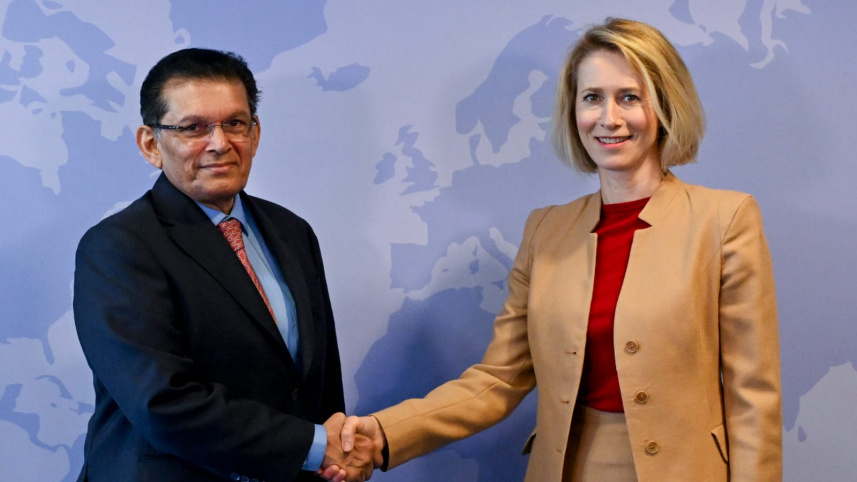
Bangladesh and the European Union today initialled the Partnership Cooperation Agreement (PCA), a move set to add a new dimension to bilateral relations and strengthen cooperation across trade, investment and other sectors on an equal footing.
Foreign Ministry Secretary (East and West) Nazrul Islam and EU Deputy Managing Director (Asia and Pacific) Paola Pampaloni signed the agreement in Brussels.
 For all latest news, follow The Daily Star's Google News channel.
 Foreign Minister Khalilur Rahman, Prime Minister’s Foreign Affairs Adviser Humayun Kabir and European Commission High Representative Kaja Kallas were present at the signing ceremony.
Khalilur Rahman and Kaja Kallas welcomed the PCA as a platform for a forward-looking partnership. They discussed a wide range of areas, including political, economic and development cooperation, with a focus on trade and investment, Indo-Pacific engagement, migration, skills development, labour standards and the Rohingya crisis.
Both sides underscored Bangladesh’s post-LDC transition, the importance of preferential market access and the launch of negotiations on a Free Trade Agreement (FTA) and an Investment Protection Agreement (IPA).
Initiating the PCA provides the agreement with a legal basis, following the finalisation of the draft and consensus between both sides in January this year after five rounds of negotiations since 2024.
However, the agreement will take a few months to be translated into 24 European languages before it is formally signed.
Officials said Bangladesh’s relationship with the EU, its largest export destination, has thus far been anchored in development cooperation under the Cooperation Agreement signed in 2001.
Diplomatic sources described the PCA as a significant elevation of Bangladesh-EU ties, noting that Bangladesh is the first least developed country (LDC) with which the EU is signing such an agreement.
Bangladesh’s exports to the EU have risen sharply, from $2 billion in 2000-01 to more than $26 billion in 2024. The duty-free facility currently available under the “Everything but Arms” scheme is set to be phased out in 2029.
Subsequently, Bangladesh will seek access under the EU’s Generalised System of Preferences (GSP) Plus, which requires implementation of a range of UN conventions on governance, environmental standards and labour rights.
Bangladesh is also part of the EU’s Global Gateway Initiative, which provides funding opportunities for renewable energy projects. In addition, the country has been included in the EU’s Talent Partnership, enabling the migration of a skilled workforce to European countries.
The EU has shown increasing interest in Bangladesh due to its strategic location in the Indo-Pacific and its vulnerability to climate change.
“The PCA is a foundational agreement. We will have different joint committees on various sectors, including trade, investment, environment and labour,” a foreign ministry official said.
The official added that once the PCA is signed, Bangladesh will pursue both a Free Trade Agreement and an investment protection agreement.
“We would like our exports to the EU protected and also ensure protection of European investments in Bangladesh,” the official told The Daily Star.
Comments