


Amar Ekushey: Pearu Sardar and Dhaka’s first Shaheed Minar

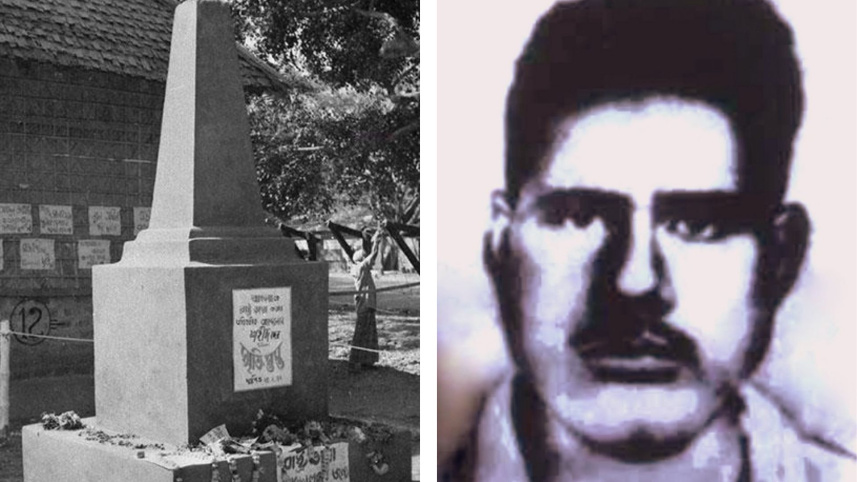
“অশ্রুমেশা আমাদের সেই প্রথম শহিদ মিনার—
যদিও আজ দাঁড়িয়ে নেই আর,
বর্তমানের মিনারেই তো রয়েছে স্মৃতি তার,
আর স্মৃতিতে আজও আছেন পিয়ারু সরদার!”
These immortal lines from “Pearu Sardar Shorone” were penned by noted litterateur Syed Shamsul Haque as a tribute to Pearu Sardar -- the influential leader from Old Dhaka, who played a key role behind the construction of the first Shaheed Minar in Dhaka during the Language Movement in 1952.

According to the book “Prothom Shaheed Minar O Pearu Sardar” and the essay “Shaheed Minar O Pearu Sardar” by Anisuzzaman, after police killed several language activists on February 21, 1952, students of Dhaka Medical College decided on February 23 to construct a memorial in their honour.
However, there was a curfew in force, and the army was patrolling the streets at all times. As a result, students were unable to procure construction materials from outside.
At the time, expansion work was underway at Dhaka Medical College campus, and construction workers had piled up bricks and sand in front of the hostel. While the students could gather bricks and sand from there, they were unable to get cement.
At that point, they learned that the contractor had stored a sufficient supply of cement in a nearby warehouse beside the hostel. The students then began searching for the contractor.
When the students discovered that the contractor overseeing the construction was none other than the local community leader, Pearu Sardar, evening was approaching. A few students went to his house under the cover of darkness.
The designer of the first Shaheed Minar, Saeed Haider, wrote in his article “Tomar Amar Ar Pearu Sardarer Prothom Shaheed Minar”, upon hearing from the students about their plan to build a memorial, Pearu said, “Take the key. Take as much as you need and get to work. Just remember to return the key to me in the morning.”
At the time, the students were unaware that on February 21, when protesters had tried to shield themselves from tear gas, the drums of water they used to wash their eyes and faces had been placed there on Pearu’s instructions.
Pearu did not stop at providing construction materials for the memorial. He also summoned two masons and instructed them to assist the students.
On the night of February 23, Dhaka’s first Shaheed Minar was built on Dhaka Medical College campus. It was informally inaugurated the next morning by Mahbubur Rahman, father of martyr Shafiur Rahman, and formally on February 26 by Abul Kalam Shamsuddin, editor of The Azad.
According to “Prothom Shaheed Minar O Pearu Sardar”, Pearu helped build the students at great risk. As a government contractor, he could have lost his payments, licence, or even been blacklisted if his support for the students became known.
In 1956, when the first official Shaheed Minar was built with funding from the provincial government, Pearu Sardar was again involved as a contractor. On the night of March 25, 1971, the monument was demolished by the Pakistani army with artillery shelling.
Pearu Sardar’s role extended beyond building the Shaheed Minar; students fleeing police often sought refuge in his neighbourhood.
Language activist Abdul Matin wrote in his article, “Pearu Sardar’s neighbourhood was a safe haven for language activists.” Whenever clashes erupted at the university, students would cross the railway tracks and feel safe in the Hossaini Dalan neighbourhood under the protection of Pearu Sardar.
He effectively oversaw the security of the area, personally preventing police raids and calming tense situations. During the regimes of Ayub Khan and Monem Khan, members of the National Students’ Federation (NSF) did not dare to enter his neighbourhood to intimidate university students.
According to “Prothom Shaheed Minar O Pearu Sardar”, he was the leader of several key neighbourhoods in Dhaka. Through his philanthropy, he helped establish orphanages, mosques, and schools in Old Dhaka.
Though he began as a contractor during the British period, his reputation grew in the Pakistan era, and he was involved in major projects such as Dhaka Stadium, the Institution of Engineers, Adamjee Jute Mills, Asad Gate, and Dhaka Medical College’s nursing hostel.
Pearu Sardar was born in 1893. His father, Munna Sardar, was also an influential figure of Old Dhaka. Pearu passed away on October 5, 1961. His descendants’ firm, Pearu Sardar & Sons Decorator, still handles the arrangements for the annual Eid prayers at the National Eidgah.
In 2015, the government of Bangladesh posthumously awarded Pearu Sarder the Ekushey Padak (second-highest civilian award) in recognition of his contributions to the 1952 Language Movement.
 For all latest news, follow The Daily Star's Google News channel.
 Speaking to The Daily Star, Mahbubur Rashid, grandson of Pearu Sardar, said his grandfather’s role in the Language Movement, particularly in the construction of the first Shaheed Minar, remains a source of immense pride and inspiration for the family. “We grew up hearing from elders and neighbours not only about his contribution to the movement but also about his generosity.”
Mahbubur noted that the government has already honoured Pearu Sardar by naming a school and a road after him. “Although we have not yet taken any initiative at the personal level, we hope to launch welfare activities in his name in the future.”
Rough English translation of Syed Shamsul Haque’s poem cited at the beginning:
[“Our tear-soaked first Shaheed Minar—
Though it no longer stands today,
Its memory lives in the present monument,
And in that memory, Pearu Sardar still remains!”]
Comments