


Bangladesh drilling deep in hunt for gas

Bangladesh has embarked on its deepest-ever gas exploration at the Titas field, as the government seeks to unlock untapped reserves far below previously drilled levels and alleviate mounting pressure on its energy supply.
The new well, Titas-31, is being drilled to a planned depth of 5,600 metres, pushing beyond the country’s historical drilling limits and targeting deeper hydrocarbon-bearing layers that have remained unexplored.

The drilling, which began on April 19, is expected to take about 210 days to complete. So far, 22 percent of the drilling has been completed, according to officials.
Drilling on the Bakhrabad-11 in Cumilla, another deep well, is planned to a depth of 4,360 metres with the same rig.
The two wells are part of a single project with a combined estimated cost of Tk 798 crore, scheduled for completion by December 2027.
The deep drilling programme is critical at a time when domestic gas output is struggling to keep pace with demand, forcing Bangladesh to increasingly rely on imported liquefied natural gas, which now accounts for around 35 percent of total supply.
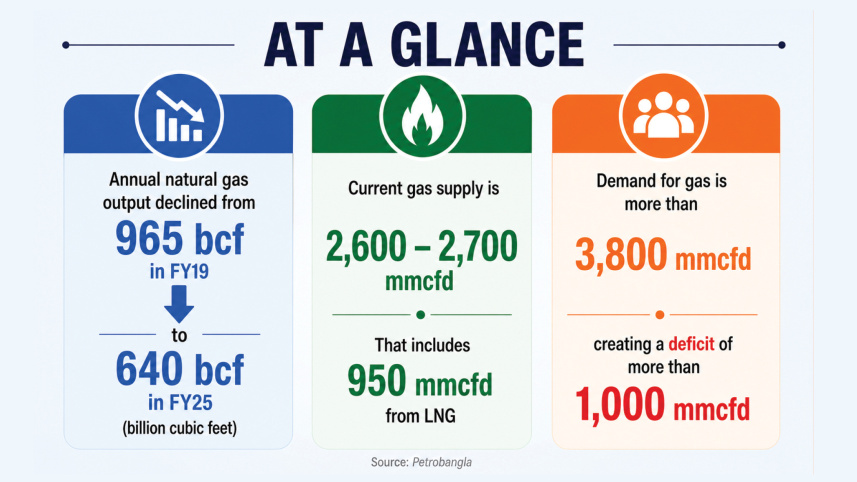
The country’s current gas supply is around 2,600-2,700 million cubic feet per day (mmcfd) against the demand of more than 3,800 mmcfd, while the country is supplying around 950 mmcfd from processed LNG, Petrobangla data shows.
“If successful, the wells could significantly add to the country’s gas reserves,” said Md Abdul Jalil Pramanik, managing director of Bangladesh Gas Fields Company.
The actual volume will be confirmed only after drilling and testing are completed, he said, adding that they expect about 2 trillion cubic feet (TCF) to be added to the national reserve.
Discovered in 1962, the Titas field is the country’s first and largest gas field, with an initial proven reserve of 7.34 TCF of gas.
About 5.6 TCF has already been extracted, and the field is currently producing around 330 million cubic feet per day (mmcfd) from 22 active wells, contributing around 20 percent of total gas supply from domestic fields.
Despite its long production history, officials believe deeper layers beneath Titas may still hold significant volumes of gas.
“Usually, there is a possibility of huge gas resources in deeper formations -- this drilling will take us closer to the source rock,” Pramanik said.
Bangladesh’s previous drilling record stood at 4,977 metres, achieved at Fenchuganj-1 between 1985 and 1988.
Most of the country’s roughly 70 wells fall within depths of 3,000 to 3,500 metres, reflecting longstanding technical limitations.
A research article of the Bangladesh Journal of Geology published in 1984 advised deep drilling up to 5 kilometres in the Titas structure, Md Mahamudul Nawab, the project director, told reporters visiting the site.
“But we don’t know why it took so much time. There was a lack of technological support as well as initiative from policymakers.”
The new deep-drilling initiative is expected to overcome the constraints using advanced equipment and technology.
A high-capacity drilling rig operated by China’s state-owned CNPC Chuanqing Drilling Engineering Company has been deployed for the project, he added.
 For all latest news, follow The Daily Star's Google News channel.
 Engineers involved say drilling beyond 3,750 metres will enter high-pressure zones, requiring advanced safety systems.
To manage the risk, a blowout preventer with a capacity of 15,000 PSI is being used, which is significantly higher than the previously used 10,000 PSI standard.
So far, Bangladesh has discovered 29.74 TCF of gas in 29 gas fields, of which 21.78 TCF has already been consumed, leaving around 7.97 TCF in remaining reserves. The country consumes about 1 TCF every year.
Since 2019, Bangladesh’s local gas production has dropped sharply, reflecting the depletion of mature fields and limited new exploration.
Annual output declined from 965 billion cubic feet (bcf) in fiscal 2018-19 to around 640 bcf in fiscal 2024-25, highlighting a sustained fall in domestic supply.
Comments