


Govt could’ve done better to save more lives

Deaths from measles and measles-like symptoms continue to rise in the country, with health authorities yesterday recording the highest daily toll since the outbreak began.
The record deaths came as DGHS officials say the infection rate is easing.

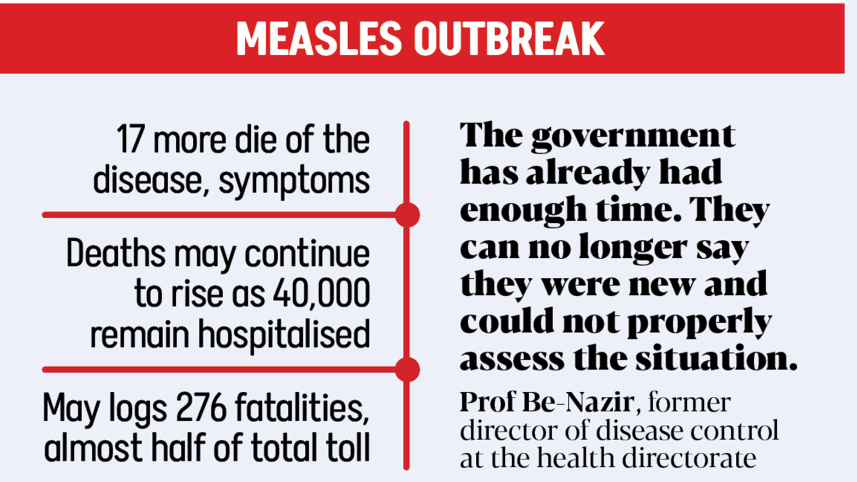
Seventeen more deaths from measles and measles-like symptoms were reported in the 24 hours till 8:00am yesterday, taking the total death toll to 545. Of the 17 deaths, one was a confirmed measles fatality, while 16 others had measles-like symptoms.
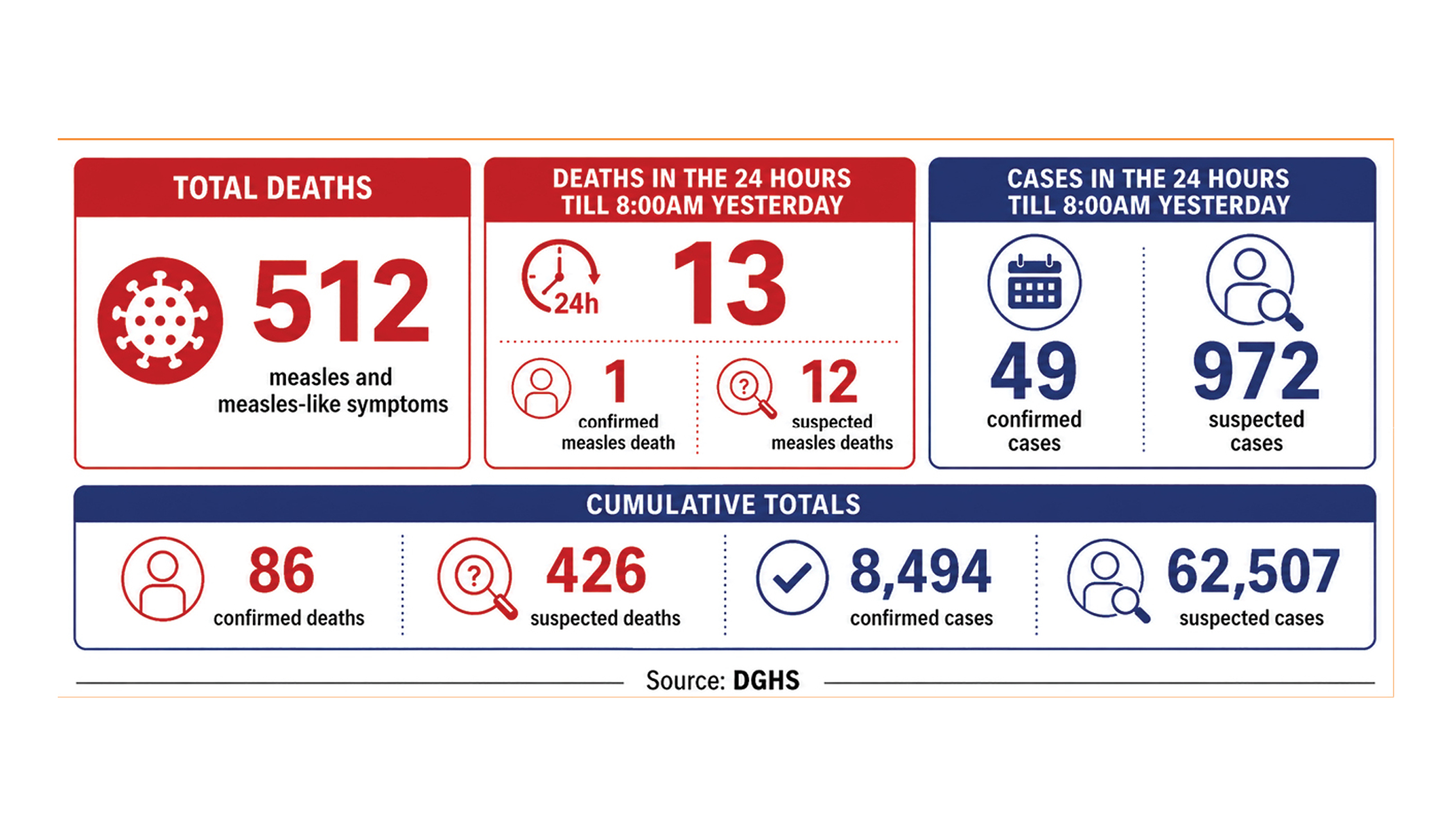
Earlier, on May 4, the country also recorded 17 deaths. However, according to the DGHS, two of those occurred in the previous 24 hours and were added to the tally the following day.
About half of the total deaths were recorded in the first 25 days of May alone, while hospital admissions during this period exceeded those in the previous 45 days combined, according to DGHS data.
The sharp rise in deaths and hospitalisations in recent weeks indicates that the outbreak has entered a more dangerous phase, with experts saying better patient and crisis management by the government could have saved many lives.
Both experts and DGHS officials said deaths may continue for several more days, as around 4,000 children remain hospitalised.
One expert termed the high measles death toll “very unusual”, saying no country in recent times has reported such a large number of fatalities from the vaccine-preventable disease.
Health Minister Sardar Md Sakhawat Husain said authorities had tried their best, helping save the lives of many children. “Otherwise, the situation could have been worse,” he told The Daily Star yesterday.
DEADLIEST MONTH
Although the number of measles cases began rising at the start of the year, infections surged sharply from March.
The DGHS started publishing measles data on April 2, compiling figures from March 15 onward.
According to DGHS data, of the total death toll of 545, 276 were recorded till April 30, while 269 deaths occurred in the first 25 days of May.
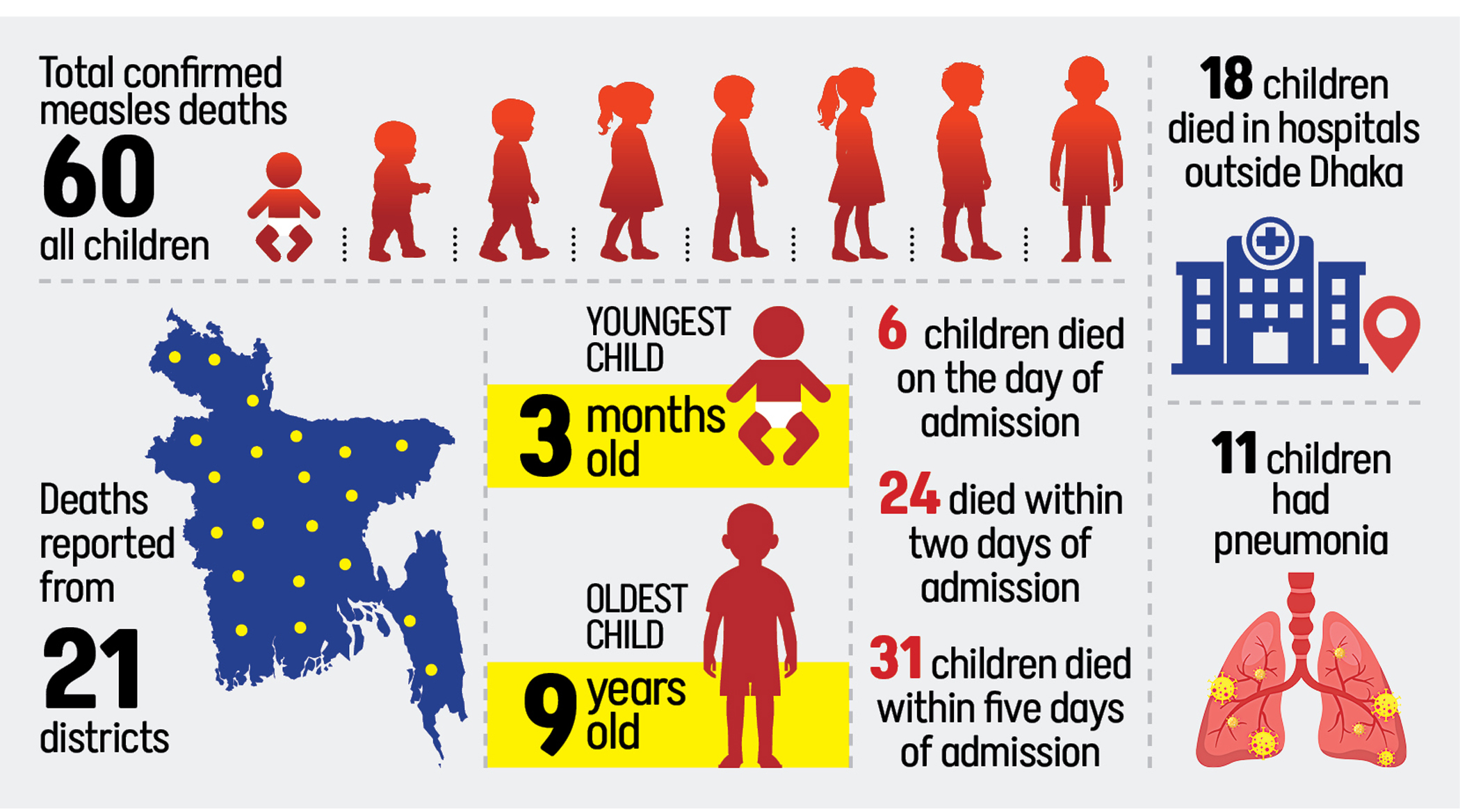
A total of 51,586 patients with measles or measles-like symptoms have been admitted to hospitals so far. Of them, 26,427 (51 percent) were admitted in the last 25 days.
According to the data, at least 73,659 cases -- both confirmed and suspected -- have been detected in the country, of which 31,500 cases (43 percent) were recorded in May.
DEATHS MAY CONTINUE
The DGHS recorded more than 1,000 cases daily this month except on three days -- May 9, 16 and 23.
However, the health minister, DGHS officials and an expert said the infection rate is easing, thanks to a vaccination drive covering 1.84 crore children.
 For all latest news, follow The Daily Star's Google News channel.
 “The infection rate has declined, and we hope it will fall further within the next two to three days,” the health minister said, adding that he visited several hospitals in Cumilla yesterday.
Epidemiologist Prof Mahmudur Rahman, also chair of the National Verification Committee for Measles and Rubella Elimination, said many children develop post-measles complications such as pneumonia and other related conditions.
“So, a decline in infection does not necessarily lead to an immediate decline in hospitalisations. It would take some time,” he told The Daily Star yesterday.
He said a large number of hospitalised patients, late admission of cases and malnutrition could lead to more deaths.
Prof Zahid Raihan, additional director general (administration) of the DGHS, agreed in a separate comment on Saturday.
Prof Mahmudur also termed the measles deaths “very unusual”, saying no country in recent times has reported such a high number of fatalities from the disease.
‘GOVERNMENT TO BLAME FOR HIGH DEATHS’
Public health expert Prof Be-Nazir Ahmed said the government’s failure to ensure comprehensive crisis management led to the high death toll.
By comprehensive management, he meant developing a national guideline and providing proper orientation and training for the health workforce. “Without adequate training and orientation, even minor mistakes in handling severe or critical cases can become detrimental,” he said.
Prof Be-Nazir, former director of disease control at the health directorate, said some paediatric specialists recommend management approaches that are difficult for general physicians to follow.
He said authorities could have introduced alternative measures, including nationwide orientation programmes and online guidelines, for a more uniform treatment regime across the country.
Referring to the bubble CPAP system introduced by icddr,b as an alternative to ventilators, he said the low-cost technology could have been supplied to all upazila hospitals, along with proper training for healthcare workers.
He added that if patients had received oxygen support from the initial stage, many might not have progressed to critical or irreversible conditions.
He said they had repeatedly urged the government to declare the situation an epidemic and treat it as a public health emergency requiring full-scale attention.
“The government has already had enough time. They can no longer say they were new and could not properly assess the situation,” he said.
However, Health Minister Sakhawat Husain said the government had taken all possible steps, from launching a rapid vaccination campaign to supplying ventilators to hospitals, to save lives.
Comments