


Human trafficking: New law drafted as 95% of cases end in acquittal

The government has finalised a new law aimed at ensuring justice for trafficking victims, responding to the fact that an average of 95 percent of migrant smuggling cases ended in acquittal over the last four and a half years.
The advisory council on Thursday approved the draft Prevention and Suppression of Human Trafficking and Smuggling of Migrants Ordinance-2025, introducing stronger measures to combat trafficking and hold perpetrators accountable.
 For all latest news, follow The Daily Star's Google News channel.
 Briefing the media after the meeting at the Foreign Service Academy, Chief Adviser's Press Secretary Shafiqul Alam said ensuring justice for victims is a core objective of the new law.
The new ordinance updates the legal framework to meet international standards, particularly the UN protocol on migrant smuggling.
Under the ordinance, individuals suspected of involvement in trafficking may face freezing of bank accounts, asset seizure and travel restrictions during investigation, subject to court order. It also addresses the growing use of online platforms for recruitment, he added.
A review of case-disposal records paints a grim picture of how trafficking cases have fared in the justice system.
According to the home ministry database, in 2020 courts disposed of 14 cases, and 13 ended in acquittal, with 43 accused walking free. In 2021, both disposed cases ended in acquittal. In 2022, all 34 disposed cases ended in acquittal, involving 150 accused.
The volume surged in 2023, with 415 of 436 cases ending in acquittal and 1,617 accused cleared. In 2024, courts disposed of 363 cases, of which 342 resulted in acquittal, releasing 1,250 accused.
The first six months of 2025 followed the same pattern -- 132 of 141 cases ended in acquittal, with 535 accused walking free, the ministry data show.
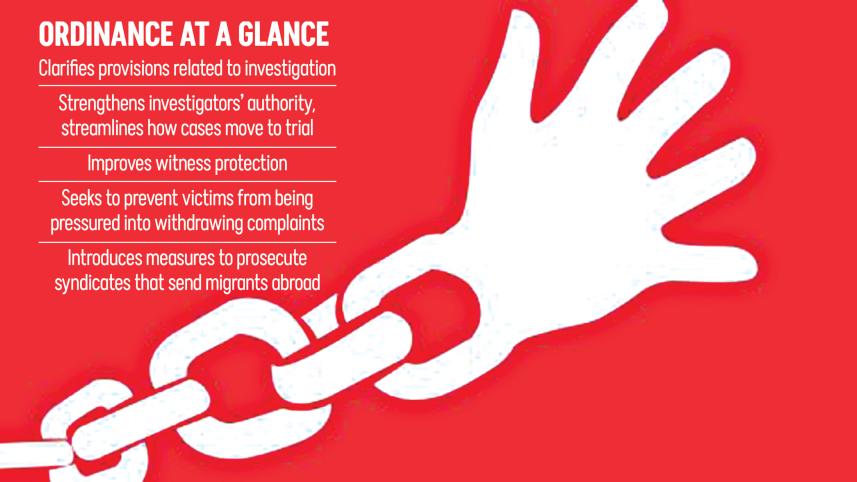
Officials involved in drafting the ordinance said it clarifies provisions on investigation, inquiry and cognisance -- areas that previously caused confusion and delays.
They said the new law strengthens investigators' authority, streamlines how cases move to trial, improves witness protection and seeks to prevent victims from being pressured into withdrawing complaints.
The ordinance also introduces dedicated measures to prosecute criminal syndicates that send Bangladeshi migrants abroad through irregular channels.
It creates a separate chapter on the smuggling of migrants (SOM), a crime that had long remained legally undefined despite its widespread presence.
The absence of clear provisions previously meant many SOM cases were filed as trafficking offences even when they lacked the required elements -- often resulting in acquittal.
One such case was filed with Sabujbagh Police Station in July 2019.
A 28-year-old man paid Tk 4.65 lakh for a promised job in Iraq but was taken to Libya instead, and his family later paid Tk 2 lakh more in extortion. He was eventually sent back to Bangladesh.
Although the incident was smuggling in nature, the case was filed under the 2012 trafficking law. All six accused were acquitted in January 2024.
Shariful Hasan, associate director of BRAC's Migration and Youth Platform, said many Bangladeshis attempting to reach Italy through Libya are detained and tortured in camps for money.
"These incidents constitute smuggling of migrants," he said, adding that including SOM in the law is a positive step.
He stressed that implementation will be key. "A law has little impact if it stays on paper. We need sustained awareness campaigns, especially in communities where people take such dangerous risks."
Justice and Care, which provided technical assistance in drafting the ordinance, said in a statement yesterday that the new law introduces comprehensive revisions to the previous law.
The ordinance defines SOM under Section 5 and sets penalties of three to ten years' imprisonment and a minimum Tk 1 lakh fine for engaging in or assisting the offence.
It retains capital punishment for organised trafficking groups under Section 8 and allows life imprisonment for aggravated forms of migrant smuggling.
Calling the law a "critical step forward", Tariqul Islam, country director of Justice and Care, said, "The ordinance opens new avenues for prosecuting criminals who profit from exploiting vulnerable migrants. It now meets international standards and aligns with UN protocols."
Comments