


A life of sacrifices, grace, and restraint
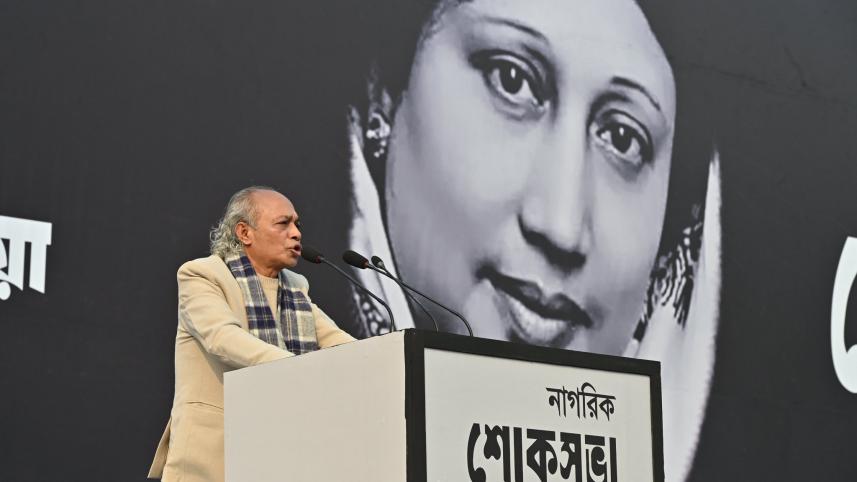
President of the Editors’ Council and Editor of New Age, Nurul Kabir, today said former prime minister and BNP’s former chairperson Khaleda Zia consistently stood out in Bangladesh’s political landscape for her grace, decency, restraint and strong sense of self-respect.
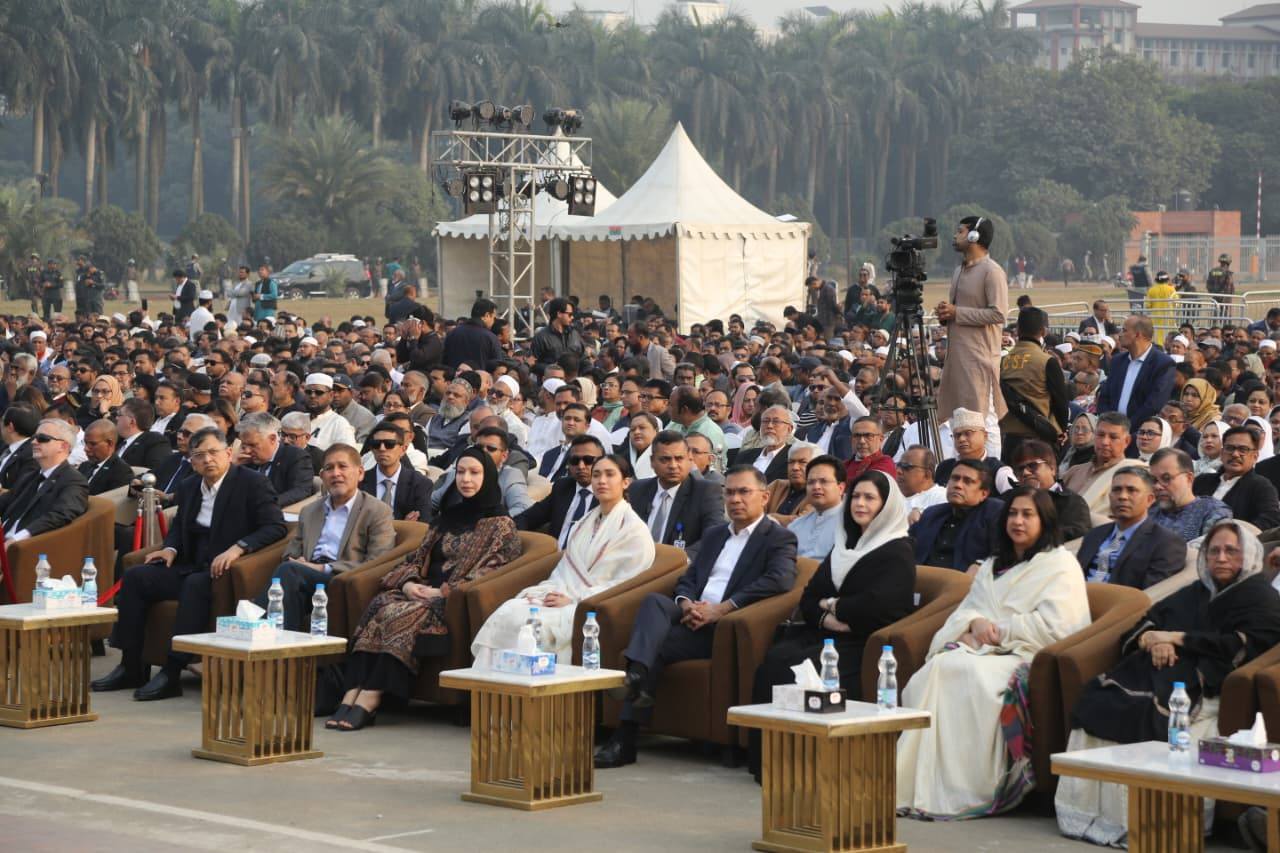
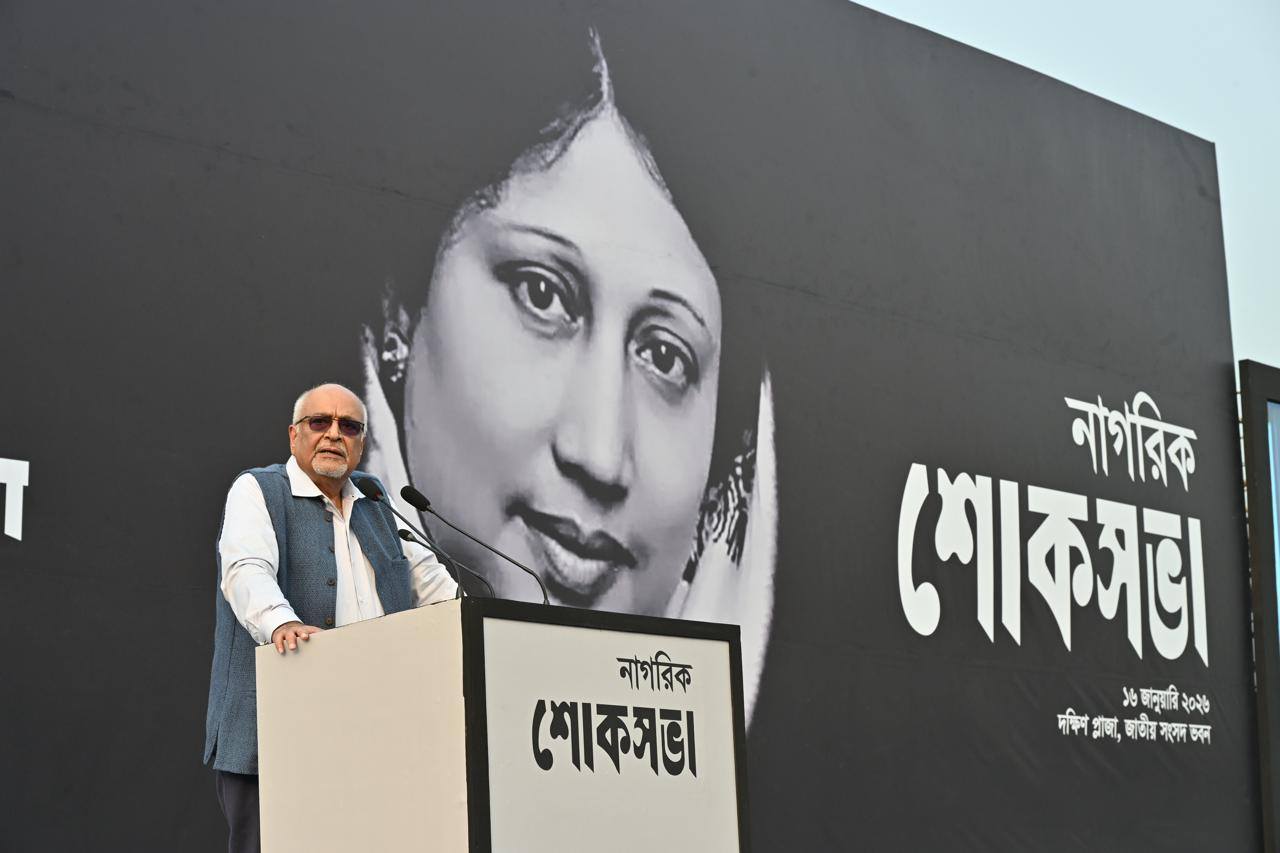
She had a significant role in Bangladesh’s struggle against military and civilian autocracy, he said while addressing a citizens’ condolence meeting organised in memory of Khaleda Zia at the South Plaza of the Jatiya Sangsad Bhaban.
 For all latest news, follow The Daily Star's Google News channel.
 “Through her death, she clearly proved that she was not only a leader of a nationalist party, but truly became a leader of the country. This was proven by the participation of lakhs and lakhs people at her janaza,” he added.
Nurul Kabir said that despite all the suffering faced by Khaleda and her family, she never publicly spoke about her pain, anger, or resentment -- a quality that drew many to her.
Recalling Khaleda’s role during the Liberation War, the veteran journalist said, when Bengali officers were preparing to take up arms against Pakistani commanders, a Pakistani subedar major under then Major Ziaur Rahman attempted to break open an arms cache and open fire on Bengali officers.
“It was Khaleda Zia who stopped him. She was an ordinary housewife at the time, yet her courage saved the lives of many Bengali officers that night,” he said.
Researcher Faham Abdus Salam said, “Great sacrifices make a great leader. If we look at the life of Begum Khaleda Zia, it was full of sacrifices. She lost her husband at a young age and also lost a son. In the latter part of her life, she was separated from her family. During her detention, she went through unbearable torture. The final cruelty was that the fascist Awami League regime pushed her towards death by denying her proper medical treatment.”
Khaleda Zia’s most special quality was that she never stood against ordinary people, he added.
Professor Dr FM Siddiqui, a member of the medical board that oversaw Khaleda Zia’s treatment, said a high-level investigation committee should be formed to determine whether there was any negligence. “It is unbelievable but true that even after her liver function test showed problems, the government-appointed doctors did not even do an ultrasonogram.”
“Many people ask whether Madam was slowly poisoned. My answer is, Methotrexate was the drug that accelerated her fatty liver disease to cirrhosis of the liver. In that context, it acted like slow poisoning for her liver,” he said.
“This was willful negligence. It is an unforgivable crime, and it needs to be examined whether this was part of a long-term plan to kill her,” Siddiqui said.
Transcom Group CEO Simeen Rahman said Khaleda Zia always believed that business must be done with ethics, and that development must be based on values.
“I learned through my father, the late Latifur Rahman, founder chairman of the Transcom Group, that Khaleda Zia always encouraged businesspeople to do business ethically and in the right way,” she said.
Simeen said that as a person, Khaleda Zia was uncompromising, strong, and deeply dignified, and that her contribution to Bangladesh’s business and economic development was far-reaching.
“In the 1990s, Khaleda Zia’s market-oriented policies helped speed up growth in the private sector, trade, and investment. Through VAT policy, reforms in the financial sector, the establishment of the Privatisation Board, and the establishment of the Securities and Exchange Commission, economic institutions became stronger. Growth in remittances and exports further accelerated development,” she added.
“Her contribution to the RMG sector is especially memorable. Similarly, due to the 1994 drug pricing policy, there was quality development, research, and increased investment in the pharmaceutical industry. As a result, Bangladesh today is almost 100 percent self-reliant in medicine, which is a rare example for developing countries,” Simeen said.
Law Adviser Asif Nazrul said the former prime minister was unjustly convicted in what he described as the most disgraceful and farcical trial in Bangladesh’s history.
Asif termed the Zia Orphanage Trust case against Khaleda Zia a “sham and disgraceful judgment” in the country’s judicial history.
He recalled an incident from the trial, saying a defence lawyer had asked Khaleda Zia whether she had misappropriated funds for orphans.
“Hurt and astonished, Khaleda Zia repeated the question -- ‘Did I embezzle orphans’ money?’ The court treated this as her statement and convicted her on that basis. As a student of law, I can say with certainty that there cannot be a more disgraceful trial than this,” the law adviser said.
Asif said that there was a time when hardly anyone dared to speak out in support of the BNP or against the injustice done to Khaleda Zia. While searching for statements protesting the unfair trial, he said, only four people at home and abroad could be persuaded to issue statements.
“I am talking about a time when it was almost impossible to find people willing to stand by Khaleda Zia,” he added, noting that the situation has since changed.
Asif further said Khaleda Zia has found a permanent place in the hearts of the people, while the ousted former prime minister Sheikh Hasina has been relegated to a place of rejection.
“Khaleda Zia is no more. Now the biggest concern is what Bangladesh will look like in the days ahead. If we want a better Bangladesh, we must uphold Khaleda Zia’s ideals, and run the country in that spirit,” he said.
The chief organiser of the event, economist Prof Dr Mahbub Ullah, said that people of Bangladesh will remember Khaleda Zia forever for her patriotism, courage, honesty, dedication, sacrifice, and her great ability to endure oppression.
“She loved this country. She loved this land. She loved the grass, flowers, birds, and water of this country,” he said.
Amar Desh Editor Mahmudur Rahman said that in the last 100 years, only five leaders in this region had reached the peak of popularity, two of whom belonged to the same family -- Shaheed President Ziaur Rahman and Begum Khaleda Zia.
Referring to Ziaur Rahman, Mahmudur Rahman said that when Bangladesh’s independence was under threat on November 7, 1975, Zia stood in the field holding the flag of independence and emerged as a symbol of national unity.
He recalled that every person had wept at Shaheed Zia’s funeral, and said a similar scene was witnessed at Begum Khaleda Zia’s funeral. However, he pointed out a crucial difference: Zia was the president at the time of his death, while Khaleda Zia was not in power.
“She was in the hearts of the people,” he said, adding that this was why spontaneous public grief was seen at her funeral.
Addressing BNP Chairman Tarique Rahman, he said it was a matter of immense pride that he was the son of Shaheed Zia and Begum Khaleda Zia. At the same time, he added, it was also a source of fear and anxiety because people would inevitably compare him to his parents.
Economist Debapriya Bhattacharya said that Begum Khaleda Zia passed away at a critical juncture for the nation, when her presence, advice, and guidance were perhaps needed the most.
Debapriya said that Khaleda Zia possessed a rare patience when listening to technical advice, something he had hardly seen in other leaders. “She knew how to ask questions,” he said. “She did not ask questions for rhetorical purposes; she asked them to test the robustness of logic and to identify any flaws.”
Writer Mohiuddin Ahmed said the most important question today was how Begum Khaleda Zia would be remembered by the people.
He divided her life into three phases. The first was her rise, from 1982 to 1990, when she reorganised a shattered political party through sustained movements and emerged as a leader, he said.
The second phase, he said, involved governing the state and serving as leader of the opposition. Governing inevitably brings challenges, he said, noting that good deeds earn praise while mistakes invite criticism.
The third phase began after 2007, marked by intense struggle and her victimisation in various forms, he said.
Mohiuddin said that during her rise, she was seen as an uncompromising leader, while in the final phase, she appeared as a victim. After her death, he said, the depth of public emotion, love, and attachment towards her became evident. “These two images are what people will remember,” he said.
Describing her in one word, he said it was “elegance”. He said she was refined, commanded respect, and possessed a magnetic quality rarely found in politics.
Referring to Khaleda Zia’s last speech on August 7, he said she had urged the country to move away from vengeance-driven politics.
“We have spent decades with an eye for an eye, a life for a life,” he said, adding that the country could not move forward this way. He warned that pursuing abusive politics merely to win applause would ultimately hand politics over to thugs.
The Daily Star Editor, Mahfuz Anam, said the founding of The Daily Star and Begum Khaleda Zia’s rise to the prime ministership occurred around the same time.
As a journalist, he said, he firmly believed in the value of independent journalism, which requires keeping governments under constant scrutiny and holding them accountable.
In that spirit, he said, he practised journalism and met the then prime minister several times. He said Khaleda Zia deeply respected independent journalism, and her sense of tolerance, acceptance of diverse views, and capacity to accept criticism earned his admiration and deep respect.
Mahfuz Anam said that after she left office, subsequent governments subjected her to humiliation and repression. She spent two years in solitary confinement and four and a half years under house arrest, he said, adding that the most heartbreaking aspect was that she was denied proper medical treatment.
Despite all this, he said, when she delivered her first message after her release on August 7, she spoke against destruction and revenge.
“She could have said, she did not want revenge but wanted justice for what had been done to her,” he said, adding, “She did not even say that.”
He described this restraint and forward-looking attitude as an extraordinary quality. If such values could be internalised in politics, he said, they would make a significant contribution to Bangladesh.
He said Khaleda Zia spoke of love, peace, and a knowledge-based society. One of her last messages to the nation, he added, was the need for future generations to build a knowledge-based society.
“We need a knowledge-based society with competence and skills,” he quoted her, adding that she urged the next generation of leadership to recognise that the world was rapidly changing and that this was the direction Bangladesh must take.
Comments