


NCP won’t sign July charter at this moment


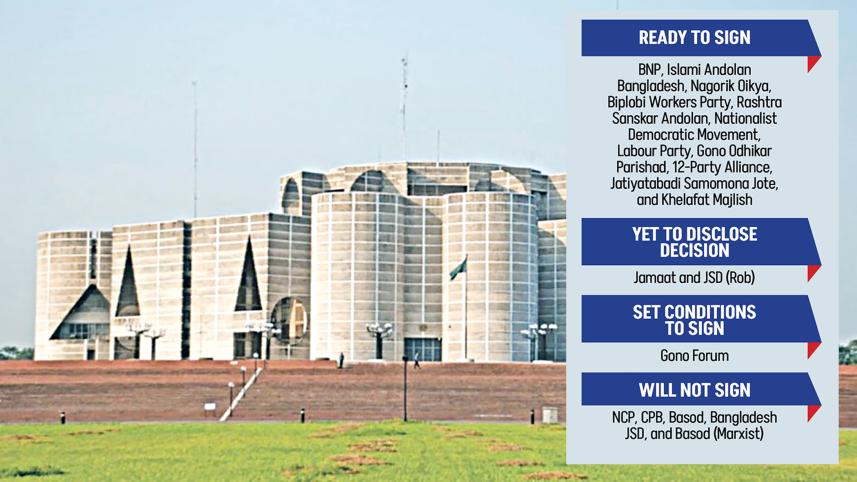
The National Citizen Party has decided not to attend today's much-awaited July National Charter signing ceremony, let alone sign the document containing reforms agreed upon after months of intense talks.
The BNP and eight like-minded parties have said they are ready to sign the charter, which is the outcome of three rounds of talks between the National Consensus Commission and 30 political parties.
 For all latest news, follow The Daily Star's Google News channel.
 The Jamaat-e-Islami is yet to officially disclose its decision regarding the signing. Party insiders, however, said there is a strong chance that it will sign the charter.
The NCP says backing the charter at this moment will be meaningless without ironing out key issues regarding its full implementation, such as the fate of reform proposals with notes of dissent and the question of referendum to ensure public endorsement for the reforms.

The party's Senior Joint Convener and Head of Political Liaison Ariful Islam Adeb and Joint Convener Javed Rasin confirmed the decision to The Daily Star at about 1:30am today.
"The process to implement the July charter hasn't been clearly outlined. And what decision will be taken regarding dissenting notes, or what the referendum question will be?" Rasin said.
"We also don't know the wording of the constitutional order. Without knowing any of these, we are not signing the charter."
Minutes later, Adeb announced the decision in a statement on the party's Facebook page.
"Since this signing ceremony will not achieve any legal basis, this is only a formality. We have spoken about this legal basis many times. Therefore, before a legal basis is established, such a formality will turn into another one-sided document like the 'July Declaration'.
"However, since the consensus commission's tenure has been extended, we will participate in its next process and present our position. If our demands are met, NCP will sign later."
Earlier in the day, NCP Convener Nahid Islam, at a press conference, said they would not sign the charter unless their conditions were met.
"Without a legal basis and assurance of a constitutional order, signing the July charter would be meaningless. For this reason, the NCP will not participate in tomorrow's July charter signing event," he said at a press conference at their party office.
Nahid also demanded that the text of the proposed July Charter Implementation Order and the wording of the question for the referendum must be finalised and made public.
And the order must be issued by the chief adviser to ensure that it "expresses the sovereign will of the people".
He added that all 84 reform provisions outlined in the charter must also be put to the public in the referendum. "In that referendum, any 'note of dissent' will carry no separate legal effect."
If the public approves the charter through the referendum, the next parliament will be bound to reform the constitution in line with the charter, he added.
"Until these issues are resolved, signing the charter remains a mere formality. Proceeding with the ceremony without clarifying these matters amounts to political farce."
The NCP decided not to sign the charter after the government and the consensus commission made hectic unofficial efforts to persuade the party into signing the charter for several days, sources in the government, the commission and the party said.
On Tuesday night, the NCP held an informal meeting with the commission, during which its leaders made it clear that it would not sign the charter unless the reform process is advanced through the issuance of a constitutional order.
The following day, Chief Adviser Prof Muhammad Yunus met Nahid, who had served as an adviser before resigning to form the party.
Yesterday, two advisers also sat with Nahid.
A key member of the commission held a three-hour long discussion, starting at 10:00pm with the NCP convener and other party representatives.
Meanwhile, the chief adviser in a message last night called on all TV and online media to broadcast the July charter signing ceremony live.
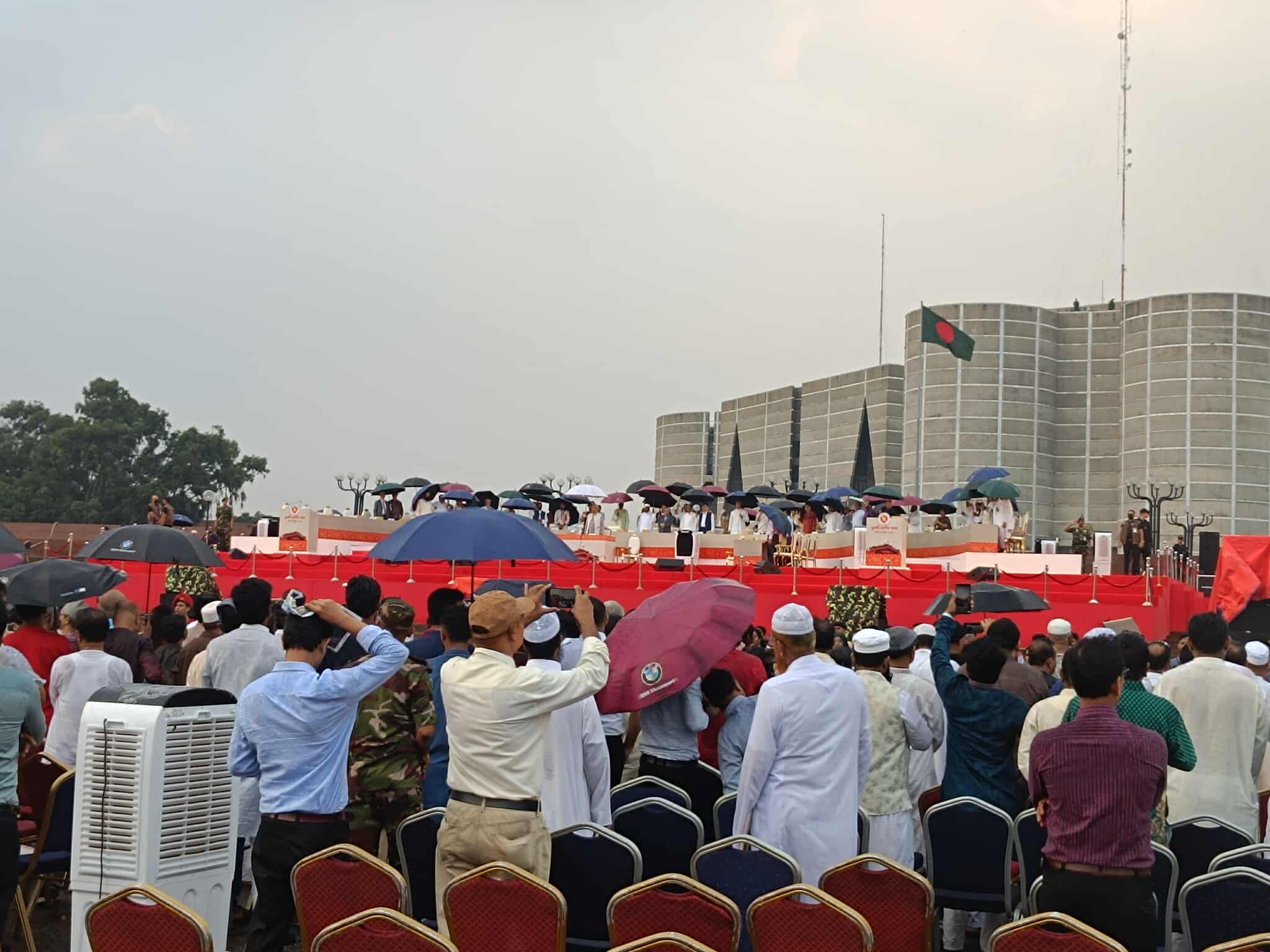
Yunus, who also chairs the consensus commission, will attend as chief guest at the South Plaza of the Jatiya Sangsad complex at 4:00pm.
"To every Bangladeshi -- wherever you are, at home or on the move, in your shops, factories, crop fields, or playgrounds -- tune in and be part of this historic moment!" he said in the message.
"Despite our political, religious, or ethnic differences, we stand together as ONE UNITED NATION," he added, according to the Chief Adviser's Press Wing.
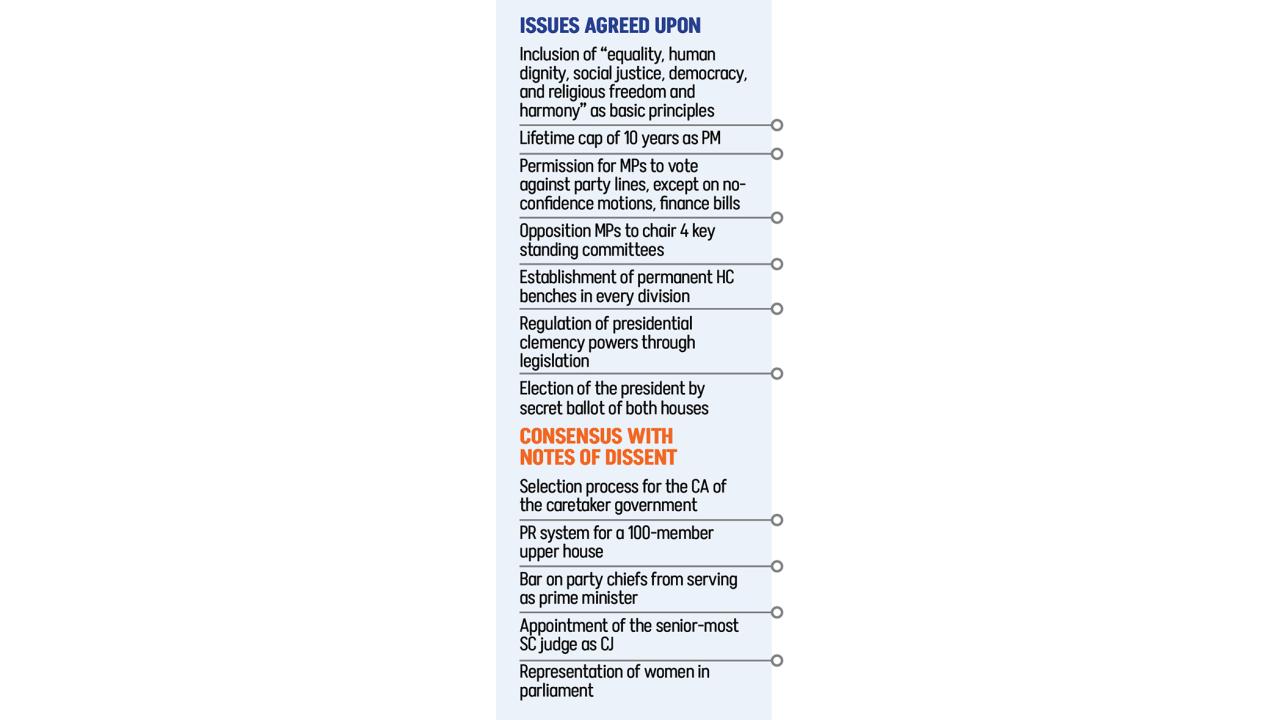
Commission Vice-President Prof Ali Riaz yesterday said the charter is grounded in consensus on 84 issues, some with notes of dissent.
He hoped that party leaders who had been involved in the dialogue would attend the signing ceremony.
Any party that participated in the talks but is unable to sign today will still be allowed to do so later.
He described the NCP's announcement that it would not sign the document before reviewing the draft of a proposed July National Charter Implementation Order as "unfortunate".
"We understand that this reflects their political position," he said. "However, we remain hopeful that, considering the overall situation, they will eventually sign the charter."
Riaz reiterated that the commission would submit the implementation proposal only after the charter is signed.
The interim government in a gazette yesterday extended the consensus commission's tenure to October 31 after a one-month extension on September 15.
Riaz said the commission would present a clear and comprehensive implementation recommendation to the interim government by October 31.
"We would continue to make our best efforts to ensure the charter's implementation," he added.
Badiul Alam Majumdar, a member of the consensus commission, and Monir Haidar, special assistant to the chief adviser on consensus building, delivered invitation letters for the signing ceremony to top leaders of the BNP, Jamaat and NCP.
They handed over the letter to BNP Chairperson Khaleda Zia at Evercare Hospitals, where the former prime minister is undergoing treatment.
The letter for BNP acting chairman Tarique Rahman was given to Khaleda's personal secretary.
They also handed over invitations to Jamaat Ameer Shafiqur Rahman, and NCP Convener Nahid Islam.
Formed in mid-February, the consensus commission was tasked with reviewing proposals from six major reform bodies covering the constitution, judiciary, electoral system, Anti-Corruption Commission, and public administration.
It drafted the 84 proposals after two rounds of talks. Half of these issues were constitutional reforms.
BNP and its allies submitted notes of dissent on at least nine issues.
The final draft of the charter was sent to parties on September 10, and a third round of talks on its implementation began the next day.
During these discussions, parties agreed that non-constitutional reforms would be enacted through ordinances and executive orders, while constitutional changes would go to referendum.
Although parties accepted the idea of a referendum, they failed to agree on its timing, procedures and framework.
BNP's top leaders, at an unofficial virtual meeting joined by Tarique Rahman yesterday night, decided that it will sign the charter today.
Secretary General Mirza Fakhrul Islam Alamgir and Standing Committee member Salahuddin Ahmed will sign the charter on behalf of the party.
"Our party's position is in favour of signing the July charter. We will sign it. It will be a historic moment," said Salahuddin.
"We will keep the promises we'll make on behalf of the party," he added.
Salahuddin briefed the meeting about the charter in detail, including notes of dissent.
However, several leaders expressed dissatisfaction over no mention of the anti-autocracy movement against HM Ershad in the 1980s in the preamble of charter despite the party's demand.
"We, however, decided not to make it an issue since the signing ceremony is tomorrow and everything is already finalised," said a Standing Committee member.
Jamaat Secretary General Mia Golam Porwar said several of their key concerns remained unresolved.
If they see any scope for resolving these issues through dialogue, they will have no objection to attending the signing ceremony, he said at a programme at the Institution of Diploma Engineers in Dhaka.
"We have received the invitation, but we are still thinking about what role we will play tomorrow," he added.
Jamaat Assistant Secretary General Ahsanul Mahboob Zubair told The Daily Star that talks on implementation of the charter will continue even after the signing.
The seven political parties demonstrating simultaneously for a proportional representation system and other demands, including Jamaat and Islami Andolan Bangladesh, also sat last night.
They decided that each party would make its own decision regarding the signing, multiple sources confirmed after the meeting.
Four of these parties had taken part in the commission talks.
After the meeting, leaders of Islami Andolan and Khelafat Majlish confirmed that they would sign the charter.
Islami Andolan Secretary General Maulana Yunus Ahmed said, "We are going to attend the signing ceremony. We also want the signing process to be completed."
"However, our protests will continue to press for the legal recognition of the July Charter, protection of the July activists, and a referendum before the next national election," he added.
Nagorik Oikya President Mahmudur Rahman Manna, 12-Party Alliance Spokesman Shahadat Hossain Selim, Jatiyatabadi Samomona Jote Coordinator Fariduzzaman Farhad, Biplobi Workers Party General Secretary Saiful Haque, Bangladesh Rashtra Sanskar Andolan President Hasnat Quiyum, Nationalist Democratic Movement Secretary General Mominul Amin, Bangladesh Labour Party Chairman Mostafizur Rahman and Gono Odhikar Parishad General Secretary Rashed Khan confirmed their parties would sign.
However, four leftist parties -- the Communist Party of Bangladesh, Bangladesher Samajtantrik Dal (Basod), Bangladesh JSD and Basod (Marxist) -- announced at a joint press conference they would not sign the charter.
Basod General Secretary Bazlur Rashid Firoz said, "We cannot sign any charter, even with a note of dissent, that requires commitment to change the four existing fundamental principles of the constitution -- democracy, socialism, secularism, and nationalism."
He criticised a move to obstruct anyone from challenging the charter in a court in future.
The leftist parties are also against the proposal to drop the Declaration of Independence issued by Bangabandhu Sheikh Mujibur Rahman on March 26, 1971, and the Mujibnagar Government's Proclamation of Independence on April 10, 1971, from the sixth and seventh schedules of the constitution.
Comments