


‘Persons with disabilities seek dignity, not charity’
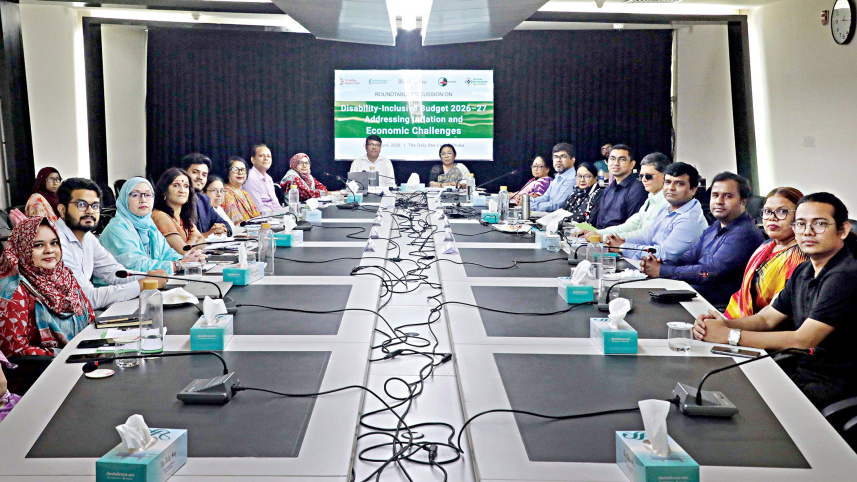
Rights advocates and experts yesterday urged the government to move beyond allowance-based support and adopt a disability-inclusive budget for the 2026–27 fiscal year, noting that rising living costs, limited access to services, and disability-related expenses are worsening hardship for persons with disabilities.
They made the remarks at a roundtable titled “Disability-Inclusive Budget 2026–27: Addressing Inflation and Economic Challenges” held at The Daily Star Centre. The Daily Star, Access Bangladesh Foundation, and Women with Disabilities Development Foundation jointly organised the programme.

At the discussion, Shaheen Anam, executive director of Manusher Jonno Foundation, said persons with disabilities do not want charity but opportunities to work and live independently with dignity.
However, the challenges they face are structural, institutional, and social, and cannot be addressed by law alone unless public attitudes change, she said.
The disability sector accounts for 3.49% of the social safety net budget and only 0.52% of the national budget. The monthly allowance remains at just Tk 900, compared to about Tk 3,400 in Nepal and around Tk 3,950 in Sri Lanka.
Shaheen Anam called on rights groups to place clear proposals before policymakers on infrastructure, transport, and accessibility.
She stressed that the diverse needs of persons with disabilities must be reflected in budget measures.
Presenting the keynote, Albert Mollah, executive director of Access Bangladesh Foundation, said the government currently runs 95 social security programmes under 24 ministries and divisions, of which only seven are dedicated to persons with disabilities. Of these, only two directly support individuals through allowance and stipend schemes.
Noting that the disability sector accounts for 3.49 percent of the social safety net budget and only 0.52 percent of the national budget, he said, “Currently, the monthly allowance remains at just Tk 900, compared to about Tk 3,400 for persons with profound disability in Nepal and around Tk 3,950 in Sri Lanka.”
Citing a World Bank study supported by the UK’s Foreign, Commonwealth and Development Office, he said families with a person with disability face an additional 13 percent in costs, while the poverty rate among such households rises by 23–34 percent.
Ashrafun Nahar Misti, executive director of Women with Disabilities Development Foundation, stressed the need for inclusive budgeting across ministries and departments to ensure that persons with disabilities are not deprived of education, healthcare, employment, transport, rehabilitation, services, and access to justice.
Mohua Pal, chairperson of Access Bangladesh Foundation, called for a multidisciplinary rehabilitation approach involving doctors, physiotherapists, occupational therapists, speech therapists, and counsellors.
She also urged increased allocations for rehabilitation, therapy services, counselling, and accessible support centres to help persons with disabilities live and work independently.
Mohammed Moniruzzaman Khan, director of the Institute of Disaster Management and Vulnerability Studies at Dhaka University, called for budget measures to support women entrepreneurs with disabilities, including low-interest or interest-free loans, training, tax waivers, and market access.
BERDO Executive Director Sadiqul Huq urged allocation for implementing the Rights and Protection of Persons with Disabilities Act.
Salma Mahbub, executive director of Bangladesh Society for the Change and Advocacy Nexus, called for accessible buses, tax waivers on lifts, and tax exemptions on house rent of up to Tk 50,000 a month.
Litan Baruri, movement liaison at Action on Disability and Development, said many children with disabilities are dropping out at the primary level, ramps often remain unusable, and wash blocks are inaccessible.
He also said Tk 5 crore could provide 20 speech-to-text and text-to-speech devices to each of the country’s 51 public universities.
Dewan Mahfuz E Maula, advocacy and communication manager at CBM Global, Bangladesh, called for VAT and tax relief on the import and local production of assistive devices.
Anika Rahman Lipy, assistant director of Centre for Disability in Development; Nasrin Jahan, executive director of Disabled Child Foundation; and Anamika Panday, facilitator at Community Development Association, also spoke. The event was moderated by Tanjim Ferdous, head of strategic partnerships at The Daily Star.
 For all latest news, follow The Daily Star's Google News channel.
Comments