


Plastic waste clogs Jamal Khan canal

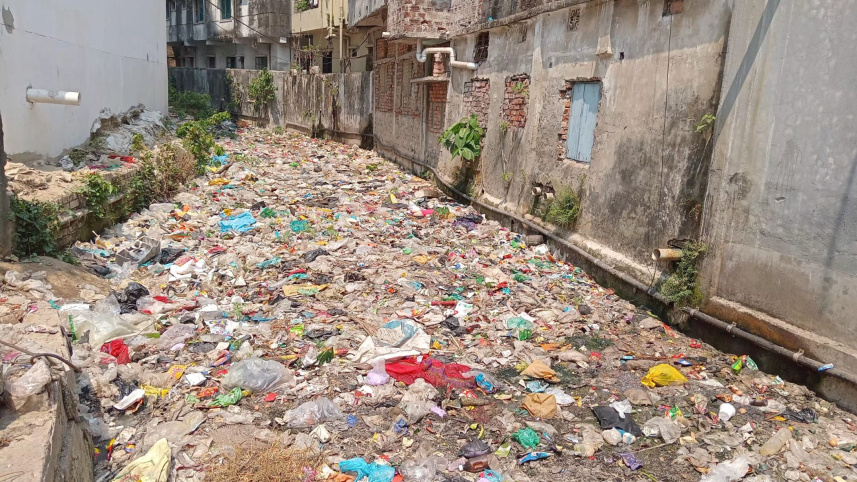
The Jamal Khan canal, a waterway running through Chattogram city and vital for drainage, has become clogged with a thick layer of plastic and polythene waste.
Residents and experts warn that if the debris is not removed immediately, it could trigger severe waterlogging in the coming monsoon.

The canal originates in the Kazir Dewri area and flows through Jamal Khan, Hem Sen Lane, Rahmatganj, and Dewan Bazar before merging with the Chaktai canal.
Abdul Malek, a local resident, alleged that the Chattogram City Corporation’s conservancy workers do not clean the canal regularly, allowing plastic waste to pile up over the years.
Shatodal Barua, another local resident, however, blamed residents for indiscriminately dumping household trash in polythene bags directly into the canal.
Pranab Kanti Sharma, CCC’s deputy chief conservancy officer, said, “We clean the canal regularly, but people start dumping plastic waste again the very next day.”
The scale of the problem was highlighted in a 2022 study by the Civil Engineering Department of Chittagong University of Engineering and Technology (CUET). Pial Barua and Al Amin, two students of the department, presented the study findings at the Chattogram Press Club on September 10, 2022.
The research, supervised by Prof Dr Swapan Kumar Palit, revealed that while the city generates around 249 tonnes of plastic and polythene waste, CCC workers collect only 109 tonnes, leaving 140 tonnes to end up in drains and canals.
Prof Swapan said the lack of dustbins and poor public awareness were major factors. He also lamented the lack of enforcement of the Mandatory Jute Packaging Act, 2010.
“Around 90% of grocery bags are still made of polythene,” he said, calling for mobile courts to enforce the law.
New research offers a potential way to repurpose the waste. Shovon Halder, an assistant professor of the department, recently completed a study titled “Performance of pervious asphalt pavement using waste polyethylene modified binder”, which found that mixing 4% melted polythene waste with bitumen during road construction can increase the longevity of road pavements by 30% during the monsoon.
“We should seriously consider reusing polythene waste in road construction to solve the two problems at once,” Shovon said.
 For all latest news, follow The Daily Star's Google News channel.
Comments