


‘Public interest must come first for journalists’
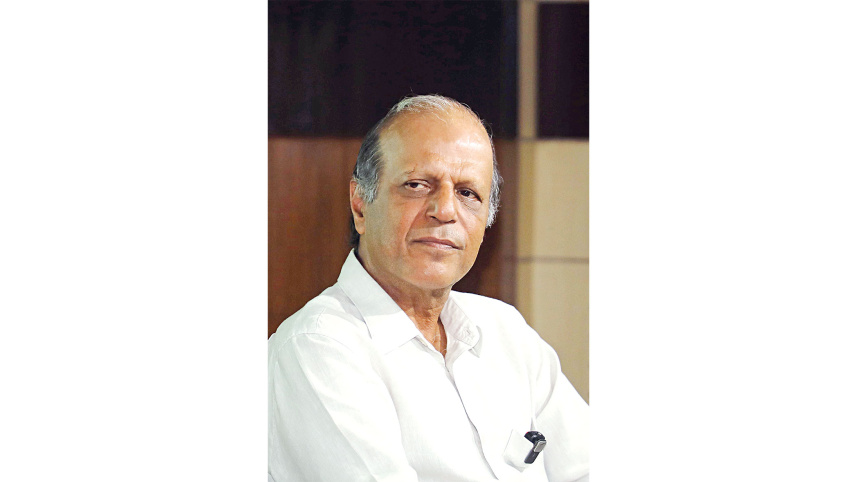
Journalists should continue informing the public and serving public interest even when authorities dislike their reporting, said Zaffar Abbas, editor of Pakistani newspaper Dawn.
“Our values are very clear that if anything is against democratic values, we will oppose it. Whether it is a civilian government or a military government, if they go after rights activists, we will oppose it,” he said while speaking at a programme titled “Journalists at a crossroads: Conversation with Zaffar Abbas”, organised by The Daily Star at its office in Dhaka yesterday.
 For all latest news, follow The Daily Star's Google News channel.
 “If there is a clash between the government’s version of national interest and our understanding of national interest, we will weigh the public interest and go for it,” he said.
Zaffar said journalists must remain confident that their goal is to defend free speech and inform people about what is wrong with society, the government and the authorities.
Speaking about Dawn’s liberal values in Pakistan, often regarded as a conservative Islamic country, he described the country as having a “deeply religious society”.
“When we talk about liberal values, we are not talking about anything against religion. It is about explaining what a civil society should be all about,” he said, adding that he was not challenging any religious narrative.
He said Dawn had openly supported equal rights for women and affirmative action on women’s rights and that the same principle applied to other fundamental rights.
“If rights are being taken away, we will write against that,” he said.
On reporting militancy and extremism, Zaffar said mistakes could happen in journalism, but newspapers must acknowledge them, correct them and move forward.
Journalists should continue reporting on violence, terrorism and militancy but should avoid glorifying terrorism or militant groups, he said. “What we have tried to tell our colleagues is: continue reporting on acts of violence, terrorism and militancy, but make sure we do not glorify terrorism or militant groups. We must also avoid dehumanising those accused of extremism,” he said.
Speaking about how Pakistan’s history of military rule had affected free speech and press freedom, Zaffar said “military rule and free speech don’t go together”.
“When there is military rule, how can you even talk about free speech?”
He said there had been “complete censorship” during periods of military rule and that fundamental rights had been taken away. According to him, the military had remained part of Pakistan’s political system, directly or indirectly.
Zaffar said the struggle for freedom had continued over the years, with journalists and media organisations securing gains, including the abolition of the Press and Publication Order, which he described as a “draconian law” introduced by Ayub Khan in the 1960s.
On editorial independence, Zaffar, who has served as editor of Dawn since 2010, said editors usually faced “zero involvement” from management in editorial matters.
Management might discuss or disagree with editorial decisions after publication, but not beforehand, he said.
Asked about pressures on Dawn, he said such pressure had existed over the past few decades and had continued largely because the newspaper had developed a policy centred on public-interest journalism.
At the outset of the programme, Mahfuz Anam, editor and publisher of The Daily Star, welcomed Zaffar and described Dawn as “a beacon of light”.
He said establishing independent journalism in Pakistan, “whose most prominent feature is not democracy”, was “really fantastic”, adding that he knew “for a fact” how much pressure the Pakistani military and other vested groups exerted on Zaffar and Dawn.
Kamal Ahmed, consulting editor of The Daily Star, conducted the event. Teachers and students from journalism departments of different universities attended the programme.
Comments